If you would like to support our work writing and maintaining the teaching resources on this site please click on the donate button and follow the online instructions - thank you for your contribution.
Peace-punk
see 'anarcho-punk'
Peace-weaver
in Anglo-Saxon culture, a woman who is married to a member of an enemy tribe to establish a peace-treaty or end a blood-feud without paying wergild
Peacham, Henry (1576-1643)
a poet and writer, known today primarily for his book, The Compleat Gentleman, first printed in 1622. It is presented as a guidebook on the arts for young men of good birth. In it, he discusses what writers, poets, composers, philosophers, and artists a gentlemen should study in order to become well-educated. Because he mentions a large number of contemporary artistic figures, he is often cited as a primary source in studies of Renaissance artists
Henry Peacham from which this information has been taken
Péage
(French m.) toll, toll-gate
Peal
suono (di campane) (Italian m.), Läuten (German n.), carillon (French m.), repique (Spanish m.), toque de campanas (Spanish m.)
a group of different-sized bells, usually from two to six, located in a belfry of the Christian church and rung according to the liturgical calendar and on other special occasions. Each bell of the peal swings at its own rate, thus producing an ensemble of disorganized sound. This ringing is referred to as pealing. In the British Isles, peal refers to 5,040 "changes" rung in continuous succession on a "ring" of bells. Seven bells or more permit this number of changes; if the ring contains fewer than seven, a peal will consist of the maximum number of changes possible on that number
loud sustained sound of series of sounds (for example, prolonged ringing of bells, firing of cannon, rolls of thunder, applause, laughter, etc.)
Peana
(Italian m.) a paean, a hymn, a song of praise
Pear
(pera (Italian), Birne (German), poire (French), peer (Dutch), pera (Spanish) European Species: Pyrus communis: Average Weight: from 45 to 50 pounds per cubic foot) a very hard, tough wood similar to apple. Used for carving, tool handles, block printing, and mechanical parts
Chinese opera is a popular form of drama in China. In general, it dates back to the Tang dynasty with Emperor Xuanzong (712-755), who founded the 'Pear Garden', the first known opera troupe in China. The troupe mostly performed for the emperors' personal pleasure. To this day operatic professionals are still referred to as "Disciples of the Pear Garden"
Pear Garden from which this information has been taken
Pear-shaped bell
the shape of the bell section on a cor anglais, padiglione piriforme (Italian m.), Liebesfuß (German m.), pavillon piriforme (French m.), pabellón en forma de pera (Spanish m.)
Pearly
on the piano, a clear round smooth tone, particularly in scale passages
Pearly Gates
one of the two-couple figures danced in a circle of four people traditionally associated with square dancing
the unusual masculine silhouette produced by padding the doublet front to give a paunch shape. The fashion spread from Spain and was especially extreme in France
Peau
(French f.) skin, hide (leather)
(French f.) a drum head
(French f.) skin or leather bag of a bagpipe
Peau de batterie
(French f.) drum skin
Peau de buffle
(French f., literally 'buffalo hide') a stop of jacks on a harpsichord in which the plectra are made of very soft leather - usually the rank of jacks farthest from the player
sometimes written peau de bouffle
Peau de chamois
(French f.) chamois leather
Peau de mouton
(French f.) sheepskin
Peau-de-soie
(French f., literally 'silk skin') a thick silk fabric with a dull satin face on both sides
Peau supérieure
(French f.) drumhead
Peca
(Spanish f.) freckle
Pecado
(Spanish m.) sin
Peccadillo
(Spanish m.) a trifling fault, a pardonable offence
Peccavi (s.), Peccavimus (pl.)
(Latin, literally 'I/we have sinned') a confession of guilt or an admission of responsibility for an error
Pêche
(French f.) peach (fruit)
(French f.) fishing (activity), catch (fish)
Péché
(French m.) sin
Pêche à la ligne
(French f.) angling
Péché mignon
(French m.) guilty pleasure
Péché mortel
(French m.) a chaise-longue consisting of an upholstered arm-chair and a matching upholstered stool which can be removed
pécher
(French) to sin
pêcher
(French) to catch (fish), to dig up (familiar), to fish
pécher par timidité
(French) to be too timid
Péchés de vieillesse
(French) Rossini's description of the 150 or so chamber works he composed in or after 1855 - including piano pieces, arias, ensembles pieces - the term bearing the figurative meaning 'sins of old age'
Pêcheur (m.), Pêcheuse (f.)
(French) fisherman (m.), fisherwoman (f.)
Pêcheur (à la ligne) (m.), Pêcheuse (à la ligne) (f.)
(French) an angler
Pecia
system of transcription of books in some universities, by which students hired master copies in sections to make their own transcripts
Pécourt, Louis-Guillaume (1653-1729)
a French dancer and choreographer. He became the Superintendant des ballets du Roi, succeeding Pierre Beauchamp
an abbreviation or, as shown above, a graphic symbol, found in piano music, both indicating the use of the right or damper pedal which when depressed sustains the tone
Ped.
on the organ, a marking indicating that notes are to be played on the pedals
(English, German n.) pedale (Italian), pédale (French), a lever operated by the foot found on keyboard instruments, harps and some percussion instruments
the purpose of the pedal will depend on the instrument:
glassharmonica
a foot-operated treadle mechanism rotates the axle to which the glasses are attached
harmonium
the pedals on a harmonium operate the bellows that supply air to the reeds. A similar mechanism can be found on small chamber organs to supply air to the pipes
harp
7 double-action pedals used to shift the pitch of the 7 diatonic strings (from left to right DCB EFGA) in each octave. The pedals have 3 positions. When the pedal is up, the note is a semitone flat, when the pedal is down, the note is a semitone sharp and when in the middle, the note is natural
harpsichord
some harpsichords have pedals to change the registration by engaging different stops and/or effects
organ
larger organs have a pedal board that is played with the feet. The pedal board is also found on some larger clavichords, harpsichords and the pedal piano
player piano
to advance the pre-punched paper roll which controls which notes are being played at any particular time
organ
the 'crescendo pedal' which brings on stops and couplers gradually, the swell pedal which opens and closes the shutters of the swell-box producing a gradual increase or decrease of tone, the combination pedal (one of a group of the levers placed above the pedal keyboard by means of which certain groups of stops are thrown in or out
piano
on the modern piano the pedals offer sustaining, dampening and a change of tone by moving the hammers so that they strike fewer strings
timpani
to allow the tension of the head to be adjusted, the pedal being connected to the tuning screws via a spider-like system of metal rods
amplified string instruments
controlling devices that alter the sound quality or timbre of the input signal, adding effects such as distortion, fuzz, overdrive, chorus, reverb, wah-wah, flanging, or phaser. They sit on the floor and have large on/off switches on top that are activated by foot. Some, such as wah-wah or volume pedals, are also manipulated while in operation by moving a large foot-activated analog switch
electronic organs & synthesizers
usually include a volume pedal similar to that of a guitar (indeed, the electronic organ and not the guitar pioneered this pedal), and some advanced models also include an 'effects pedal' that may be programmed to serve several of the functions
vibraphone
the pedal operates a damper bar, which has a material like felt attached to it. The damper bar usually rests against the bars of the vibraphone, preventing the bars from ringing freely, however pressing the pedal pulls the damper bar away from the bars thus allowing the notes to ring freely
(German n.) treadle
Pedal
also called point d'orgue (French), pédale harmonique (French) or pedal armónico (Spanish), 'pedal note', 'pedal point' or 'pedal tone', a long held note above which other parts move
see 'inverted pedal point'
see 'internal pedal point'
the lowest note on an instrument, particularly that on a brass instrument for any slide or value setting
(Spanish m.) pedal, point d'orgue (French), pédale harmonique (French)
Pedal board
a keyboard designed to be played with the feet, commonly found on organs, but more rarely on other instruments like the pedal piano and the pedal clavichord
Pedal C
C, two octaves below middle C
see 'octave'
Pedal celeste
(Spanish m.) left pedal (on a piano)
Pedal central
(Spanish m.) middle pedal (on a piano)
Pedalclaves
(German) pedal keys, pedals, pedal-board in an organ
Pedalclaviatur
(German f.) pedal-board in an organ
Pedal coupler
in an organ, a draw stop that connects the pedals with a particular manual
Pedal derecho
(Spanish m.) right pedal (on a piano)
Pedal drum
timpani where a pedal mechanism is employed to change the tuning
Pedale
(Italian m.) pedal (on the piano, this word means that the pedal which takes off the dampers must be pressed down)
(Italian m.) a pedal bass, organ-point that lies in the lowest part, a stationary bass
the Pedal division in an organ
see 'pedal point'
Pédale (s.), Pédales (pl.)
(French f.) pedal(s)
Pedale a ogni battuta
(Italian) use the pedal at each beat or division of the time
pedalear
(Spanish) to pedal (for example, on a piano)
Pédale céleste
see 'celeste pedal'
Pedale dalla gran cassa
(Italian m.) bass drum pedal
Pédale de la grosse caisse
(French f.) bass drum pedal
Pedale del piano
(Italian m.) soft pedal
Pédale de prolongation
(French f.) sostenuto pedal
Pédale de résonance
(French f.) sustaining pedal
Pédale de sostenuto
(French f.) sostenuto pedal
Pedale destro
(Italian m.) right pedal
Pedale di risonanza
(Italian m.) sustaining pedal
Pedale doppelt
(German) double pedal (for example, pedal part in octaves) (in organ playing, playing the pedal-board with both feet at once)
Pedale doppio
(Italian m.) double pedal (for example, pedal part in octaves) (in organ playing, playing the pedal-board with both feet at once)
Pedale d'organo
(Italian) the pedals of an organ
Pédale douce
(French f.) soft pedal
Pédale droit
(French f.) right pedal
Pedale et manuale
(Latin) in marking found in organ music, literally 'pedal and manual', which means that the hand and feet play the same notes
Pédale forte
(French f.) sustaining pedal
Pédale gauche
(French f.) left pedal
Pédale harmonique
(French f.) or point d'orgue, pedal note, pedal armónico (Spanish)
Pédale hi-hat
(French f.) hi-hat pedal
Pedale interno
(Italian m.) an organ-point that lies in one of the inner parts (in other words, neither in the bass nor in the highest part)
Pedale invertito
(Italian m.) an organ-point that lies in the highest part
pedale ogni battuta
(Italian) use the pedal with each bar (or measure)
pédaler
(French) to pedal
Pedale sinistro
(Italian m.) left pedal
Pédale sourde
(French f.) the soft (una corde) pedal
Pedale tonale
(Italian m.) sostenuto pedal
Pedalflügel
(German m.) a grand piano with a pedal keyboard attached
Pedalharfe
(German) pedal harp
Pedal harp
any harp where pedals are employed to obtain semitones
see 'pedal'
harp size
description
petite
approximately 40 gut strings or less and standing around five feet tall
semi-grand
approximately 45 gut strings and standing five and a half feet tall
concert grand
usually with 47 gut strings and standing six feet tall, with a range of six and a half octaves
Pedal harpsichord
a harpsichord in which the stops are turned "off" and "on" by means of pedals
the term 'pedal harpsichord', when called by the Germans Clavecimbelpedal, can indicate an ordinary harpsichord, under which pedal keys are located which pluck the lowest keys of the harpsichord using strings or some other mechanism. in other words, it is a harpsichord with pedals permanently connected
the term 'pedal harpsichord', when called by the Germans Clavecimbelpedal, can indicate an ordinary harpsichord placed on top of a second harpsichord, which is played by pedal keys like the pedal board on an organ. The two instruments are thus completely independent one of the other, the pedal harpsichord having its own strings and registers
(from the Latin pedalis, literally 'on the pedals') pedal board of an organ, although a similar device was developed and fitted either to the lower octaves of the pianoforte or provided with a separate set of strongs and action
Pédalier
(French m.) pedals, pedal keyboard, pedalier
(French m.) pedal board attached to a pianoforte and invented by Pleyel, Wolff and Cie, Paris
(German f.) pedalling, the use of the pedals on the piano
Pedaliter
(German from the Latin pedalis, literally 'on the pedals') in keyboard music, an instruction to play with hands and feet
Pedal keyboard
pedaliera (Italian), Pedalklaviatur (German), clavier des pédales (French), a keyboard designed to be played with the feet, commonly found on organs, but more rarely on other instruments like the pedal piano and the pedal clavichord. In the organ, 'pedal' is also the name for the section of pipes connected to these foot pedals. By activating the Pedalkoppel these pipes can be played from a manual. Pedals on the organ were introduced first in Germany between 1300 and 1500. The pedals in French organs developed later than those in Germany. They played only melody notes until the late 1700s, when bass-sounding ranks of pipes were added. English organs did not get pedals until the middle 1800s, more than a century after Bach and Handel
Pedalklaviatur
(German f.) pedal keyboard, pedaliera (Italian), clavier des pédales (French)
Pedalkoppel
(German n.) by activating the Pedalkoppel, the pipes connected to the foot pedals can be played from a manual
Pedalling
or pedaling (US), the use of the feet on the pedals of an organ (the equivalent to fingering on the manuals)
Pedal note
see 'pedal'
Pédalo
(French m.) pedal boat
Pedal organ
the set of stops controlled by the pedal keyboard in an organ
Pedalpauke (s.), Pedalpauken (pl.)
(German f.) mechanically tuned kettledrum with pedals
Pedal piano
a piano with a keyboard for the hands and a pedal-board for the feet
Pedal point
see 'pedal'
Pedal-Steel-Gitarre
(German f.) pedal steel guitar
Pedal steel guitar
only distantly related to the inherently harmonic inflexible Hawaiian steel guitar, although like its distant relative it is also played (in part) by sliding a steel bar up and down the strings, the pedal steel guitar overcomes any harmonic restrictions caused by moving a bar along pre-tuned strings, by employing a system of pedals and knee levers that mechanically alter the tuning of individual strings while the instrument is being played
by far the most common type of timpani used today are pedal timpani, which allow the tension of the head to be adjusted using a pedal mechanism. Typically, the pedal is connected to the tuning screws via a spider-like system of metal rods
there are three types of pedal mechanism in common use today:
ratchet-clutch system Dresden system Ringer system
uses a ratchet and clutch to hold the pedal in place. The timpanist must first disengage the clutch before using the pedal to tune the drum. When the desired pitch is achieved, he must reengage the clutch. The drums most professional timpanists use have Dresden pedals
balanced action system
a spring is used to balance the tension on the timpani head so that the pedal will stay in position and the head will stay at pitch. The balanced action system is sometimes called a floating pedal since there is no clutch holding the pedal in place. Timpani used by school bands and orchestras typically have balanced action pedals. Many professionals also use timpani with balanced action pedals for gigs and outdoor performances because they tend to be more durable
friction clutch system Berlin system
consists of a clutch attached to the pedal that moves along a post. When the player presses his toe forward, he frees the clutch from the post and the pedal moves freely. This system is much less common than the ratchet-clutch and balanced action systems
Pedal timpani from which this information has been taken
Pedal tone
see 'pedal'
applied to brass instruments, the pedal tone is the note which is at the fundamental frequency of the harmonic sequence of the instrument, but it is not a resonant frequency of the air column. When the bell effect raises the lower resonances of the closed tube, the lowest resonance is actually not used, being out of tune with the rest of the notes. However, if the player's lips are vibrated at the pedal tone frequency, all the harmonics above it contribute and produce a tone at this pedal tone pitch. It is sometimes called a fictitious fundamental, but for the bass brass instruments, it is quite strong and useful
pedal virginals were not uncommon although evidence of vestigial traces of the pedal feature are sometimes not apparent at first glance. Davitt Moroney owns such an instrument (Anonymous, possibly Florentine, c. 1600) which lives in a later outer case. He has written, "... the keys of the bottom octave of the keyboard have holes underneath indicating that something used to be attached there, and the principal (inner) case has had a repair to the wood just underneath that bottom octave, so it's clear that the instrument originally had a short octave of pull-down pedals." In the case of another instrument, a 1683 Obici owned by Barbara and Rodney Myrvaagnes, "[t]he bottom of the outer case has an opening for the one octave (8 notes) of pedal pulldowns. Traces of the wires are embedded in the keys." Other instruments bearing similar evidence appear in the Russell Collection in Edinburgh, Scotland.
(German n.) pedal (for example, on an organ). Pedals on the organ were introduced first in Germany between 1300 and 1500. The pedals in French organs developed later than those in Germany. They played only melody notes until the late 1700s, when bass-sounding ranks of pipes were added. English organs did not get pedals until the middle 1800s, more than a century after Bach and Handel. The German violinist and organist Nicolaus Bruhns (1665-1697), the son of an organist and on the organ a pupil of Buxtehude, is famously known for accompanying his violin playing on the organ pedals
Pedana
(Italian f.) rostrum
Pedant
person who demands adherence to formal rules or literal meaning
pédant (m.), pédante
(French) pedantic
pedantisch
(German) in an even, unemotional manner
Pédiatre
(French m./f.) a paediatrician
Pédicure
(French m./f.) a chiropodist
Pedido
(Spanish m.) order
Pedigree
(English, French m.) recorded line of descent (of a person or pure-bred dog, horse, etc.), genealogical table, 'life history' of a person, thing, idea, etc.
pedir asilo político
(Spanish) to ask for political asylum, to seek political asylum
pedir audiencia
(Spanish) to seek an audience
pedir auxilio
(Spanish) to shout for help, to ask for help
pedir aventón
(Spanish - Mexico) to hitch a lift, to thumb a lift
pedir disculpas
(Spanish) to apologise
Peen
the part of a hammerhead opposite the flat striking surface (may have various shapes)
Peep box
see peep show
Peep show
also peep box, raree show ("rarity show") and peepshow, an exhibition of pictures, objects or people viewed through a small hole or magnifying glass
Peep toe
popular shoe style where the front section is cut away to reveal the wearer's toes
Peer review
the process by which scientists, in particular, assess the work of their colleagues that has been submitted for publication in the scientific literature
Peer-reviewed journal
also called a refereed journal, a juried publication, a scholarly journal, or a critical journal, a peer-reviewed journal is a periodical publication with strict standards for accuracy and presentation
bischero (Italian m.), Wirbel (German), cheville (French m.), clavija (Spanish f.), used on a string instrument to change the tension on a string and hence to set its pitch
pegarse una asoleada
(Spanish - parts of Latin America) to sunbathe
pegar un brinco
(Spanish) to jump
Pegbox
cassa dei bischeri (Italian f.), cassetta dei piroli (Italian f.), cavigliera (Italian f.), Wirbelkasten (German m.), chevillier (French m.), clavijero (Spanish m.)
or 'pegdisc' or 'peghead', where on stringed instruments the tuning pegs or, in the case of instrument fitted with a slotted peghead (a worm gear system), machine heads (or tuners) used to adjust the tension of the strings, are fitted
Pegdisc
see 'pegbox'
Pegel
(German m.) level (as in 'sound level')
Peghead
see 'pegbox', 'headstock'
Peg organ
see 'belly organ'
Pègre
(French f.) underworld
Peigne
(French m.) comb
peigner
(French) to comb, to comb the hair of (a person)
Peignoir
(French m.) a loose dressing-gown worn by women (named for the wearing of this garment when the hair is being combed, from peigne (French: comb)
(French f., literally 'severe and cruel punishment') pressing to death under heavy weights, a punishment formerly inflicted on those who refused to plead to a charge of felony
peiner
(French) to struggle, to sadden
Pein hammer
a hammer having one end of the head hemispherical and used in used in rivetting and forming metal
Peintre
(French m.) painter
Peintre de dimanche
(French m., literally 'a Sunday painter') a painter who earns his living otherwise than by painting
Peintre en bâtiment
(French m.) house painter
Peinture
(French f.) painting, paint (the material), the method of using paint characteristic of an artist or a school of artists
Peinture à la colle
(French f.) a method of painting with opaque powder-colour suspended in a solution of gum, poster-colour painting
Peinture à l'huile
(French f.) oil painting
Peinture sonore
(French f.) tone painting
Peitsche
(German f.) whip, slap stick
peitschend
(German) whipping, sferzando (Italian), en cinglant (French)
péjoratif (m.), péjorative (f.)
(French) pejorative
Pejoration
a semantic change in which a word gains increasingly negative connotation. For instance, the word lewd originally referred to laymen as opposed to priests. It underwent pejoration to mean "ignorant," then "base" and finally "obscene," which is the only surviving meaning in Modern English usage. The opposite of pejoration is amelioration, in which a word gains increasingly positive connotation
abbreviation of plan d'épargne logement (French: savings account)
Pelage
(French m.) coat, fur
pêle-mêle
(French) in a jumble
peler
(French) to peel
Pèlerin
(French m.) pilgrim
Pèlerinage
(French m.) pilgrimage
Pèlerine
(French f., literally 'a pilgrim's clock') a woman's narrow cape with ends coming down to a point in front (however, the term has been used over so long a period that it is apt for a whole range of styles of woman's cape)
Pélican
(French m.) pelican (bird)
Película
(Spanish f.) film, movie
Película de acción
(Spanish f.) adventure film
Película de dibujos (animados)
(Spanish f.) cartoon (film)
Película en colores
(Spanish f.) colour film
Película llena de acción
(Spanish f.) action-packed movie, action-packed film
Peligro
(Spanish m.) danger, risk
Peligro que nos acecha
(Spanish m.) danger that lies ahead of us
peligroso
(Spanish) dangerous
Pelimanni music
(Finland) or Pellimanni music. By the beginning of the nineteenth century, foreign dances including polka, mazurka, schottische, minuet and polska were popular throughout Finland. These led to a number of distinctively Finnish forms of these dances, including humppa and jenkka. These are collectively known as pelimanni music featuring fiddles, harmoniums and accordions
pelirrojo
(Spanish) red-haired
Pelisse
(French f.) a woman's long loose cloak with holes for the arms (originally the cloak was lined with fur)
Pelle
(Italian f., literally 'leather') drum-head
(French f.) shovel, spade (as in 'bucket and spade' for a child)
Pellet bells
small spherical bells with slits that surround a loose pebble or bit of metal that rattles when the bell is shaken, for example, sleigh bells
Pelletée
(French f.) a shovelful
Pellicular
of or pertaining to a pellicule
Pellicule (s.), Pellicules (pl.)
(English, French f.) a thin skin or film, as on a photographic emulsion or on a liquid, dandruff (hair) (plural form)
Pellimanni music
see 'Pelimanni music'
Pellitory
a climbing plant of the nettle family whose leaves were used in salads and roots for medicinal cures
Pellizco
(Spanish, literally 'pinch', 'nip' or 'small bit') small spontaneous gestures, mimicries or whimsical movements employed by a dancer to heighten the effect of a dance. The phrase is used in flamenco to describe actions which are spicy, saucy or flirtatious
Pelma
(Spanish m./f.) pain in the neck (figurative: a person who is annoying)
pelma
(Spanish) annoying, boring
Pelmazo
(Spanish m.) bore, nuisance
Pelo
(Spanish m.) hair, whisker
Pélog
(English, German n.) see laras
Pélog scale
pelón
(Spanish) bald, with very short hair
Pelote
(French f.) a ball
Pelote d'épingles
(French f.) a pincushion
Peloton
(French m.) a troop, a squad, (in sport) a pack
Peloton d'exécution
(French m.) firing-squad
Pelouse
(French f.) a lawn
Pelta
(Latin from Greek) a small light shield used by the ancient Greeks and Romans, a shield-like motif in decorative art
Peltate
shield-shaped
(of a leaf shape) round, with the stem attached near the center of the lower surface rather than the margin (for example, like a nasturtium leaf)
Peluche
(French f.) plush (material), a cuddly toy
Pelure
(French f.) peeling
Pelzfutter
(German m.) fur-lining (of a coat, etc.)
Pemade
in the gamelan orchestra, a high pitched instrument made of short resonating bamboo tubes. Its range lies between the ugal and the kantil
Pen
(Dutch) pin
a writing implement (felt-tip pen, fountain pen, etc.)
to write (colloquial), to hold within a secure enclosure (sheep, etc.)
Pena
a flamenco club
Penal
of or concerning punishment, punishable
pénal
(French) penal
pénaliser
(French) to penalise
Pénalité
(French f.) a penalty
Penalty
punishment for breaking a law, rule, contract, etc.
disadvantage, loss, etc. as a result of one's own actions
Penalize
subject (a person) to a penalty or disadvantage
Penance
act of self-punishment as reparation for guilt
penando
(Italian) toiling, struggling, stentando
Pence
plural of 'penny'
Penchant
(English, French m.) a strong or habitual inclination or liking
Penchant pour
(French m.) a strong or habitual inclination or liking for
penché (m.), penchée (f.)
(French, literally 'leaning' or 'inclining') in dance, a term used to qualify a position or movement, as, for example, in arabesque penchée
pencher
(French) to tilt, to lean over
pencher pour
(French) to favour
Pencil
instrument for drawing or writing, usually a thin rod of graphite, etc. enclosed in a wodden cylinder or metal case, resembling a pencil in shape (pencil skirt, etc.)
Pencilina
invented by Bradford Reed, and described as an electric ten string collision of the hammer dulcimer, slide guitar, koto and fretless bass with six pickups of varied type, struck with sticks, plucked and bowed
popular skirt shape cut from a straight block from hip to hem, often knee length and worn with suit jackets
Pendaison
(French f.) a hanging
Pendant
hanging jewel, etc., especially one attached to a necklace, bracelet, etc.
(French m.) a matching piece
pendant
(French) during, for
pendant (m.), pendante (f.)
(French) hanging, pending
pendant ce temps(-là)
(French) meanwhile, in the meantime
Pendant d'oreille
(French f.) a drop ear-ring
pendantif
(French m.) pendant
pendant que
(French) while
Pendant vault
a vault supporting one or a number of dependant structures, usually with much surface decoration
penaud (m.), penaude (f.)
(French) sheepish
Pendeloque
(French) a pendant, particularly a pear- or drop-shaped precious stone set as a pendant
Pendent
hanging, overhanging, undecided, pending
Penderie
(French f.) a wardrobe
Pending
awaiting a decision or settlement, undecided, about to come into existence, during, until
Pendozalis
Cretan open circle dance
pendre
(French) to hang
pendre la crémaillère
(French) to have a house-warming (party)
Pendu (m.), Pendue (f.)
(French) hanged man (m.), hanged woman (f.)
pendu (m.), pendue (f.)
(French) hanging
pendu à (m.), pendue à (f.)
(French) hanging from
Pendule
(French f.) clock
(French m.) pendulum
Pendule à carillon
(French f.) musical clock
Pendule à musique
(French f.) musical clock
Pendulette
(French f.) (travelling) clock
Pendulous
hanging down, drooping, swinging
Pendulum
weight suspended so as to swing freely, for example, a rod with a weighted end used to regulate a clock
(in music) a marking used to denote the recommended tempo, expressed as the length of the string (usually in inches) to which a weighted bob is attached, found, for example, in Norwich Sol-fa. A metronome marking of 88 beats per minute is equivalent to a string length of 18 inches
Penetralia
(Latin pl.) the innermost parts or recesses (for example, of a temple)
the term is used metaphorically also for the inner chambers of the heart, mind, etc.
pénétrant
(French) penetrating
Penetrate
find access into or through, imbue with, permeate, see into, find out, discern, see through (darknes, fog, etc.), to be absorbed by the mind, (of a voice) easily heard through or above other sounds
Penetrating
(of a voice) describing one that can be heard through or above other sounds
(of the mind) having or suggesting sensitivity or insight
Pengling
from China, also called pengzhong or xing, a pair of cup bells held with their open ends pointing upward, and which are sounded by hitting both sides together, to produce a clear ringing sound
traditional form of Welsh singing in which alternating verses are accompanied by an air on the harp
Penitential psalms
Psalms 6, 32, 38, 51, 102, 130 and 143; they were recited after Lauds on Fridays in Lent
Pen-name
another term for nom de plume, nom de guerre (French m.) or pseudonym, a fictitious name, especially of an author
Penny dreadful
a sensational novel of crime, adventure, violence, or horror. The term is an English archaism referring to cheaply printed books bound in paper at only a few pennies' cost
the tin whistle or pennywhistle is a simple and cheap wind instrument used widely in Irish traditional music. The most common type has a moulded plastic mouthpiece attached to a cylindrical brass tube with six finger holes. It is diatonic though accidentals can be played by half-covering holes, and is available in different sizes for almost every key. Sometimes it is played in the key a fourth above the tonic (e.g. G for a D whistle). The most common key is D (an octave above middle C) and the fingering is standardly referred to as though for a D whistle
the low whistle, with its haunting and etheral tone, has recently established its place within Irish music. It is a tin whistle, in the range of keys from A below middle C, down to D. The lower range requires this whistle to be increased in size. It is suited for the contemporary composers such as Davy Spillane, Bill Whelan or Máire Breathnach. In skilled hands, it can also perform the traditional music of Ireland. It is essentially a vertical fipple flute
Low Whistle from which some of this material has been taken
Penorçon
(French) an ancient instrument resembling a ghittern
Penorkon
(Greek) an ancient instrument resembling a ghittern
Pensée
(French f.) a thuoght or reflection put into literary form
penser à
(French) to think of, to think about
penser beaucoup de bien de
(French) to think highly of
penser de
(French) to think about (have an opinion on)
penser tout haut
(French) to think out loud
Pensiero
(Italian m.) a thought
Pensiero del(la) ...
(Italian) souvenir of..., recollection of ...
pensieroso
(Italian, Latin) contemplative, thoughtful [information supplied by Sabrina Mudd]
the title of the John Milton's poem Il Penseroso, the companion to L'Allegro, means essentially "contemplative", although it exemplifies either Milton's incorrect Latin or his poor spelling: the correct word should be pensieroso
Pension
(French) a boarding-house, a lodging-house with a fixed weekly or monthly rate (in France or Italy)
Pensionnaire
(French) one who is living as a boarder, paying a fixed weekly or monthly sum for board and lodging
Pensol
name attributed by some to the 'Negrito nose flute'
(Spanish m.) or pentagráma (Spanish), stave, staff, portée (French)
Pentagrama
(Catalan m.) stave, staff, portée (French)
Pentagramma
(Italian m.) staff, portée (French)
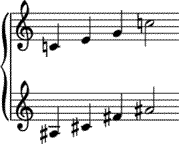
there are various staff formats:
pentagramma semplice
single staff
generally, used for solo instruments such as flute, violin, trumpet, etc.
pentagramma doppio
double staff
generally, used for solo instruments such as piano, harp, harmonium, etc.
pentagramma triplo
triple staff
used for music written for an organ with a pedal keyboard
pentagramma multiplo
muti-staff
used for multipart scores (e.g. string quartets, choral scores, orchestral scores, etc.)
Pentameter
poetry consisting of five feet in each line
Pentateuch
volume containing the first five books of the Bible - Genesis, Exodus, Leviticus, Numbers and Deuteronomy
Pentathlon
(Greek) an athletic contest of the ancient world combining five different exercises - jumping, running, throwing the discus, throwing the spear and wrestling. They formed part of the various games held in ancient Greece which were named for the centre in which they took place. Music and singing competitions were not on the programme of the Olympic Games but they were a speciality of the Games at Delphi. Well before the appearance of sports competitions, musical competitions were organised in Delphi. These comprised singing accompanied by the cithara, flute solos or singing with flute accompaniment. Music and singing remained a feature of the Pythian Games even after the integration of sports competitions. Poetry and drama competitions also figured on the programme.
for example, escala pentatónica (Spanish: pentatonic scale)
Pentatonic scale
(from the Greek, literally 'of or using only five notes') in music, a pentatonic scale is a scale with five notes per octave. Pentatonic scales are very common and are found all over the world, including but not limited to the tuning of the Ethiopian krar and the Indonesian gamelan, the melodies of African-American spirituals, Celtic folk music and the music of French composer Claude Debussy
pentatonic major scale (also called 'primary pentatonic scale'), a major scale omitting the fourth and seventh notes
pentatonic minor scale, a minor scale omitting the second and sixth notes
pentatonic minor major 6 scale, a minor scale omitting the second and seventh notes
pentatonic minor 7 flat 5 scale, also called the 'pentatonic blues scale'
pentatonic major sharp 9 flat 7 scale, a pentatonic scale comprising 2 triads, C major and Eb major
(Greek) an interval of five whole tones, augmented or extreme sixth
Pentimento (s.), Pentimenti (pl.)
(from Italian pentirsi, 'to repent') in art, an alteration made in the process of executing a painting, discovered when an alteration made by the artist (for example, the hiding of some detail) becomes apparent in the course of time through the increasing translucence of the paint with age. The term has sometimes been used in a modern sense to describe the appearance of the sides of buildings with painted advertising. Often they are painted over with newer ads and the paint wears away to reveal the older layers
Pentimento from which some of this entry has been taken
Pentozalis
a Cretan war dance that takes its name from its five (pente) basic steps, the zala, as they are known locally
Peon
(Spanish m.) a Mexican serf, a debtor held in servitude by his creditor until the debt is paid off
Peplos
(Greek) a rich robe or shawl worn by women in ancient Greece, hanging in folds and sometimes drawn over the head
Peplum
(Latin) a woman's overskirt, supposed to resemble the ancient peplos
the term is applied more generally to (a woman's jacket with) a flared skirt covering the upper part of the skirt beneath
Pepys Manuscript
although very much smaller and less elaborate than the Eton, Lambeth and Caius Choirbooks, the Pepys and Ritson Manuscripts contain shorter and rather simpler pieces, presumably for smaller and less able choirs. The Pepys MS is so-called because it was numbered among the diarist's books; he described it as containing 'monkish music of Edward IV's time.' Although Pepys associated his MS with the reign of Edward IV (1461-1483) the book was probably begun a year or two earlier on internal evidence. The MS was probably completed some time after 1465, because it refers to the composer Hawte as 'Knight' and 'Sir William Hawte', and he was knighted in that year
(Latin) by virtue of some non-essential circumstance, contingently
per annum
(Latin) (a sum of money paid) every year, yearly
per arsin et thesin
see arsin et thesin, per
per augmentationem
(Latin) by augmentation
per biscantum
(Latin) an old term for music in two parts
Perc., perc
abbreviation of 'percussion'
percale
(French from Persian) a soft closely-woven cotton fabric
per capita
(Latin, literally 'by heads') a division of a legacy, a payment, a fine, etc. amongst a group of individuals who are each to be treated, or are each to benefit equally
Perce
(French f.) bore
Percenter
also tenpercenter, an agent (colloquial)
Percentery
also tenpercentery) a talent agency (colloquial)
per centum
(Latin) per hundred, by the hundred, in each hundred (usually indicated by the symbol %)
Percepção musical
(Portuguese) ear-training
Percepción auditiva
(Spanish f.) auditory perception
percepibile
(Italian) perceivable
Perceptible
(English, French, Spanish) capable of being perceived by the senses or intellect
Perception of loudness
see 'Weber-Fechner Law', 'decibel'
Perception of pitch
see 'Weber-Fechner Law'
Perception of rhythm/meter
Kramer (1998) noted that "performers and listeners use the information in a composition to understand where beats fall and how strongly accented they are, but we do not literally hear beats. We experience them - by means of mental processing of information...We react physically and emotionally to meter, but we do not literally sense it with our eardrums"
Perceptive listening
the ability to discern musical characteristics
Perceptum (s.), Percepta (pl.)
(Latin) in psychology, something percieved, a meaningful impression obtained through the senses
Percettibile
(Italian) perceptible
Percheron
(French) a breed of horse resembling a lightly-built cart-horse (from the le Perche region of Normandy, France)
per contra
(Latin) on the other hand, on the other side of the argument
(Latin, 'by the court') where the court gives an order or decision on the whole operating as a single body without any particular judge being the author
Percusión
(Spanish f.) percussion, rhythm section (in a band)
instrument à percussion or instrument de percussion (French: percussion instrument)
Percussion acoustique
(French) non-electronic percussion
Percussion, body
see 'body percussion'
Percussion clef
see 'indefinite pitch clef'
Percussione (s.), Percussioni (pl.)
(Italian f.) percussion
Percussion électronique
(French) electronic percussion
Percussion instruments
Perkussionsinstrument (s.), Perkussionsinstrumente (pl.) or Schlaginstrument (s.), Schlaginstrumente (pl.) (German), Schlagzeug (German), batteria or stromenti a percossa (Italian), instruments à percussion (French), instrumentos de percusión (Spanish), percusión (Spanish) or batería (Spanish)
instruments that produce sound by being struck. Some have definite pitch while others have an indefinite pitch. Where the pitch of percussion instruments can be determined this will be by a complex set of variables depending on the dimensions and material of the instrument itself. For example, the pitch of a drum is determined by the size and thickness of the drum head, the tension, and to some extent the depth of the body. The pitch of a xylophone tone bar is determined by the material's density and flexibility, length and thickness, and shape. A xylophone bar is also normally amplified by a tuned resonator set underneath
(Italian) gradually dying away and, in its current usage, also becoming slower
(Italian) morendo, diminuendo
per diem
(Latin) (a sum of money paid) every day, daily, for a day's work
perdiéndose
(Spanish) perdendosi
perdendosi
(Italian) gradually dying away and, in its current usage, also becoming slower
(Italian) morendo (Italian), diminuendo (Italian), sich verlierend (German), verebbend (German), en se perdant (French)
perdere
(Italian) to lose, to miss, to ruin, to waste
perdere la bussola
(Italian) to lose one's bearings
perdersi
(Italian) to lose oneself, to get lost, to disappear, to go to ruin, to miscarry
perdersi d'animo
(Italian) to lose heart
perder terreno
(Spanish) to lose ground
perdiendo
(Spanish) perdendo
perdifiato
(Italian) at the top (or pitch) of one's voice, with all one's strength
Perdigiorno
(Italian m.) an idler, a time-waster
per disteso
(Italian) in full detail
Perdita
(Italian f.) loss, waste (time)
Perditempo
(Italian m.) waste of time, time lost
Perditore (m.), Perditrice (f.)
(Italian) a loser
Perdizione
(Italian f.) ruin, perdition, destruction
perdonabile
(Italian) pardonable, excusable
perdona el atraso
(Spanish) I'm sorry about the delay
perdonare
(Italian) to forgive, to excuse, to pardon
Perdono
(Italian m.) a pardon, forgiveness
perdre
(French) to lose, to get out of, to break, to mislay, to forget (date, name), to shed (fur), to waste (money), to miss (an event)
perdre confiance
(French) to lose one's confidence
perdre connaissance
(French) to lose consciousness, to pass out
perdre conscience
(French) to lose consciousness
perdre courage
(French) to lose heart, to lose courage
perdre ... de vue
(French) to lose sight of ...
perdre du poids
(French) to lose weight
perdre du temps (à faire ...)
(French) to waste time (doing ...), to waste one's time (doing ...)
perdre du terrain
(French) to lose ground
perdre espoir
(French) to lose hope
perdre la boule
(French) to go crazy
perdre la parole
(French) to lose the power of speech
perdre la raison
(French) to go out of one's mind
perdre la tête
(French) to go crazy
perdre la vie
(French) to lose one's life
perdre la vue
(French) to lose one's vision
perdre le fil
(French) to lose the thread (of a conversation)
perdre le goût de manger
(French) to lose interest in, to not feel like eating
perdre le goût de travailler
(French) to lose interest in, to not feel like working
perdre le nord
(French) to get confused
perdre l'équilibre
(French) to lose one's balance
perdre le souffle
(French) to be out of breath
perdre les pédales
(French) to get mixed up
perdre l'esprit
(French) to lose one's mind, to go out of one's mind
perdre l'occasion de
(French)to miss the opportunity to
perdre patience
(French)to lose patience
perdre pied
(French)to be out of one's depth (literally and figuratively)
perdre sa langue
(French) to lose one's tongue
perdre sa page (en lisant)
(French) to lose one's place (in a book, musical score, etc.)
perdre sa place
(French) to lose one's place
perdre ses moyens
(French) to crack up, go insane
perdre son pantalon
(French) to have one's trousers falling down
perdre son temps (à faire ...)
(French) to waste time (doing ...), to waste one's time (doing ...)
perdre toute notion d'heure
(French) to lose all sense of time
perdre un ami de vue
(French) to lose touch with a friend
perdu (m.), perdue (f.)
(French) hidden away, out of sight, hidden but on the watch (a hidden sentry), (lying) in ambush
perdurare
(Italian) to last, to persist, to persevere, to continue
perdurevole
(Italian) durable, lasting
perdutamente
(Italian) desperately, hopelessly, madly
Père
(French m.) (the) father (always preceded by a name, and opposed to fils (French: (the) son))
Père de famille
(French m.) the father of a family
Peredyshka
(Russian) a breathing-space
peregrinare
(Italian) to travel, to wander, to go abroad
Peregrinazione
(Italian f.) peregrination
Peregrinata
(Italian f.) a singularity, a rarity
peregrino
(Italian) rare, precious, uncommon
Peregrinus
the words for 'pilgrim' (in the sense of 'wanderer') in modern European languages derive from the Latin peregrinus, which has among its main meanings 'foreigner' or 'stranger'
see tonus peregrinus
perezoso
(Spanish) lazy
perf(s).
abbreviation of 'performance(s)', 'performed (by)'
(from the Latin perfectus) intervals of a unison, octave, fourth, and fifth when they are exactly in tune and neither augmented nor diminished
the term 'perfect' refers to intervals that, because of their extremely simple pitch relationships, are possessed of a high degree of consonance. The just fifth is a member of the harmonic series, as is the octave, and the frequency ratios that define the pure fifth (3:2) and the octave (2:1) are very simple. The fourth, which is the complement to the fifth, is also expressed, in terms of frequencies with a similarly simple ratio (4:3). What distinguishes 'perfect' intervals from seconds, thirds, sixths and sevenths is that when a 'perfect interval' is inverted, it remains perfect. Augmented, diminished, major and minor intervals all change their quality under inversion. The very earliest attempts at harmony in Gregorian chant involved only the octave and the fifth. The fourth, although 'perfect' because its quality is invariable under inversion, is considered a stylistic dissonance in certain contexts, namely in two-voice textures and whenever it appears above the bass
a concept from Medieval music defining the relationship of 3:1
Perfect binding
or 'adhesive binding', a technique for binding books by a machine that cuts off the backs of the sections and glues the leaves to a cloth or paper backing
a concord or union of sounds which is consonant, including the unison, octave, perfect fifth and perfect fourth
Perfect concords
the unison, octave, perfect fifth and, sometimes, the perfect fourth
Perfect consonances
the unison, octave, perfect fifth and, sometimes, perfect fourth
Perfecting
or backing-up, printing the second side of a sheet
Perfection
(English, French f.) making, becoming or being perfect
Perfect interval
perfektes Intervall (German n.), reines Intervall (German n.), intervalle juste (French), intervallo giusto (Italian), intervalo justo (Spanish), the interval of a unison (also called 'standard prime'), a fifth, a fourth or an octave. The ratios of frequencies they correspond to, are prime (1:1), 4th (4:3), 5th (3:2), and octave (2:1)
(German f.) perfection (the state of being perfect)
Perfervidum ingenium
(Latin) extreme enthusiasm, ardent temperament
perfetto (m.), perfetta (f.)
(Italian) perfect, complete
Perfezione
(Italian f.) perfection
Perfezionista
(Italian m./f.) perfectionist
Perfidia
(Italian) a passage featuring brilliant figuration for one or more treble instruments pver a pedal note (pedal tone) in the bass. The term is found in works attributed to Torelli, and similar passages (though unlabelled) occur in the sonatas of Corelli
perfide Albion
(French) treacherous England (the traditional (French) view of England)
Performance
in performing arts, a performance generally comprises an event in which one group of people (the performer or performers) behave in a particular way for another group of people (the audience). Sometimes the dividing line between performer and the audience may become blurred, as in the example of "participatory theatre" where audience members might get involved in the production. Singing choral music, and performing in a ballet are examples. Usually the performers participate in rehearsals beforehand. Afterwards audience members often clap, indicating appreciation. However, sometimes this rule is reversed. In Japan, the greatest compliment is complete silence
Elizabeth Wallfisch, writing on the King's Music web site has some illuminating comments about the performance of music. "I go on a lot about 'style'. The word is dry, the concept is everything. What do I mean by it?"
understanding that there is a rhetorical language in all music, whatever the period
it is not exclusively to do with 'Baroque' music, it is fundamental in all music making, right up to today and tomorrow
it is speaking, in the language of the music of all periods
it is appropriate gesture for the music of all periods
it is playing respectfully to the composer of the piece of music and to the period in which it was written
perhaps it is also playing with the understanding that the composer may be in the room with you, and would love to have his music brought to life by a talented, fresh, enthusiastic player
it is playing with even the minimum of historical information about the appropriate gestures of the periods in which the music is written, giving life to the text as a result
it is putting a face on every single note played so that it says something, and has the power to move the listener
it is playing with love
it is playing with affection, perhaps 'AFFEKTION' is the better word
it is having fun, playing to the listener, with the listener, drawing the listener into the world of magic that is music
Performance from which the first extract has been taken
multimedia art form involving visual as well as dramatic and musical elements
Performance dance
also known as concert dance, a category of dances in which an audience watches but does not participate
Performance edition
also called 'practical edition', an inexpensive alternative to the far more expensive 'scholarly' or 'library' editions which are usually hard-bound and full of critical commentary
Performance markings
or 'performance marks', signs in the score that indicate the composer's wishes as regards tempo and dynamics, articulation and phrase marks, expression, fingering, whether or not to use the mute, and so on
the term 'marks' seems more appropriate for small individual symbols, like accents, dots for staccato, and so on. 'Markings' or 'indications' may be a better general term. While the two words 'marks' and 'markings' are often interchangeable, it is more usual to use the terms 'dynamic markings' (or 'dynamics'), 'tempo indications' (for words such as andante, allegro) amd 'metronome markings'. Where a composer chooses to use explicit indications of expression and articulation one might called these 'expressive markings/indications'
Performance marks
see 'performance markings'
Performance musicale
(French f.) music performance
Performance practice
(from the German Aufführungspraxis) the study and application of conventions, as far as these can be understood from contemporaneous evidence, that guided the original performances of musical works, particularly in matters of instrumentation (specific instruments, their playing technique, the balance between different parts, etc.), notation and ornamentation (where these are not explicit), elements of improvisation (for example, realising a figured bass), timbre (for example, the appropriate kind of voice production), tuning, temperament and pitch. There are similar conventions that can be applied to the performance of dance and theatre
some have argued that these matters are important to a proper understanding of what the music meant when it was originally written (and, by extension, the meaning that it should have for us today) and that this is something that should concern us. The counterargument lies in the fact that we, the listener and performer, are not living in the past and that there is no way we can separate the past from the present. So, when deciding, as we must, in the absence of recordings from the period, the sound world in which these works were created and the cultural norms that informed the original performers and their audience, we can only understand these things in terms of the present
Performance score
a score, containing all the parts, from which all the performers are meant to play. If a piece is sold as a performance score, there are no separate parts available
Performing arts
those forms of art which differ from the plastic arts insofar as the former uses the artist's own body, face and presence as a medium, and the latter uses materials such as clay, metal or paint which can be molded or transformed to create some art object. Performing arts include the acrobatics, busking, comedy, dance, magic, music, opera, film, juggling, marching arts, such as brass bands, theatre, and circus arts
or P, after Lothar Perger, the cataloguer of music by Johann Adolph Hasse (1699-1783) and Johann Michael Haydn (1737-1806)
Pergola
(Italian) a covered walk formed of growing trees trained over trellis-work
Periconas
Chilean dance from the Quellón region that combines Spanish music and dance forms with aboriginal Chilean music and dance
Pericope
(Greek, "section") in biblical studies, a story, brief passage, or selection from gospel narrative or passage found embedded inside another story, narrative, or passage
passages of gospel text inserted at the head of a homily or sermon in medieval texts
(Spanish, literally 'ripped parrot') the name given to the merengue that continued to use the accordion at a time when the piano and brass instruments were added to larger merengue orchestras
Perigordino
(Italian) périgourdine
Périgourdine
(French) an ancient Franco/Flemish singing-dance in compound duple time
per il flauto solo
(Italian) for solo flute
per impossible
(Latin, literally 'by an impossibility') supposing it were possible, which it is not
using an argument when considering the hypothetical result of conditions which can never exist
Perinatal
the period around birth, especially five months before and one month after
Périnet Valves
the Périnet valve is named after François Périnet, the Parisian who invented this type of piston valve in 1838 and patented it the following year. The valve loops are arranged in such a way that the inlet tubing is positioned on a different level than the outlet tubing. The piston is held at rest by a spring, which is placed either on top (top-sprung) or below (bottom-sprung) the piston. The Périnet valve is now the standard for trumpets in most countries (except Germany and Austria), and is often simply called the "piston valve."
Period
a complete musical thought, concluded by a cadence, having from two phrases, each usually two to eight bars (measures) in length, called the 'antecedent' (often ending in a half cadence) and the 'consequent' (often ending in an authentic cadence)
also terminal double bar or final barline, a type of double barline with a thin line followed by a thick line, is used to mark the very end of a piece of music or of a particular movement within it
Periode
(German f.) period
Période
(French) period
Periodenbau
(German) composition, the construction of a musical period
Periodical
publications issued on a regular basis are periodicals. Weekly magazines, scholarly journals and newspapers are all examples of periodicals. Serials are any periodicals, books, yearbooks, or indexes that are issued in a series. So all periodicals are serials but all serials are not periodicals
Periodic essay
the forefather of modern periodicals like magazines and literary journals, these publications contained essays appearing at regular intervals (monthly, quarterly, and so on). The subject-matter varied from current events, literary criticism, social commentary, fashion, geographic and architectural features of London, childhood memories, and so on
musical phenomena with the quality or state of being periodic, that is they recur at regular intervals
Periódico
(Spanish m.) newspaper, paper (newspaper)
periódico (m.), periódica (f.)
(Spanish) periodic, periodical
Periódico de ayer
(Spanish m.) yesterday's paper
Periodic phrasing
organization of phrases of a musical work into pairs of an equal number of measures (usually 4 + 4, sometimes 8 + 8), in an antecedent-consequent arrangement. In such an arrangement, the first phrase is open-ended and requires the second phrase (often based on a similar theme or idea) to achieve closure
Periodic sentence
a long sentence that is not grammatically complete (and hence not intelligible to the reader) until the reader reaches the final portion of the sentence
sometimes written pp, abbreviation for pro pro curationem (Latin: through another, by proxy, by the action of an official agent or deputy)
used to indicate that a letter or document has been signed by an agent on behalf of the principal. The correct sequence is (principal) per pro (agent), but usage has reversed this so that now it is understood to be (agent) per pro (principal)
per/pro
(Latin) a variant of per pro, which is taken to mean 'for and on behalf of'
per pro curationem
see per pro
per quanto
(Italian) however (much), as far as
per quanto io sappia
(Italian) as far as I know
per questo
(Italian) for this reason
per recte et retro
(Latin, literally 'forward then backward') by retrogression, the antecedent or subject reversed note for note
Perreo
(Spanish) a Puerto Rican sexually explicit dance associated with reggaeton
in English, an architectural term for a platform in front of the main entrance of a building, usually approached by a double flight of steps
Perroquet
(French m.) a parrot
Perruche
(French f.) a budgerigar
Perruque
(French f.) a wig
in English, the term is applied especially to a full-bottomed wig, and hence, by association, to a pompous but essentially vacuous person
Perry
an cider-like drink made from pears rather than apples
Pers
(Dutch) press
per saltum
(Latin) by a jump, at a single step, without any intermediate stages
Persan
(French m.) Persian (language)
persan (m.), persane (f.)
(French) Persian
per se
(Latin) by itself, in itself, without reference to anything else
in law, denoting that the topic should be taken alone
persécuter
(French) to persecute
Persécution
(French f.) persecution
persévérer
(French) to persevere
Persévérance
(French f.) perseverance
Persian music
Persia's early musical culture was highly developed, and had for centuries been mixing with the ancient musical culture of neighboring India. Like Islamic music, Persian music relied on improvisation, employed the lute, and used female slave musicians. According to Atheneaus, King Darius of Persia had 329 musicians in his harem. But we have little direct information; it appears that the existing treatises on Persian music were burned by the Muslims
the term applies particularly to a shutter constructed with moveable slates like a Venetian blind
Persiflage
(French m. pl.) raillery, mockery, light-hearted banter, frivolous discussion of a subject
persister à
(French) to persist in
Persona (s.), Personas (pl.)
(Spanish f.) person, people (plural form), entity (law)
es una persona muy sensible (Spanish: he is a very sensitive person)
dos o más personas (Spanish: two or more people)
no lo conozco en persona (Spanish: I don't know him personally
Persona (s.), Personae (pl.)
(Latin, 'mask') a person's 'public image', that part of the personality which is in touch with the outside world, the expression of the personality
in examining the composition and performance of musical works, the question of persona is raised: whose persona does the music represent--that of the composer, the performer, or (in the case of vocal music) the character portrayed by the performer? With respect to musical borrowing, the relevant question is: whose voice or persona is speaking in the borrowed material, the original composer's or the borrower's? In the case of self-borrowing by a vocal composer, it is the composer's own voice, rather than that of the poet whose text he or she originally set, that speaks through the borrowed material. In an instrumental transcription of a vocal work, the vocal melody retains its original textual associations, thereby preserving the original composer's voice despite the removal of the text. When the situation is reversed, as in a popular vocal arrangement of an instrumental classic, the original composer's persona is still felt, as is the case with arrangements of Chopin and Tchaikovsky melodies. Concerning the transcription of an existing instrumental work for a new instrumental combination, the integrity of the transcription (its preservation of the original composer's voice) rests on its use of a restricted choice of instrumentation. Lastly, folk-tune or anthem borrowings can seem ridiculous if they are too obvious, where the original composer's voice completely overpowers the borrower's persona, disrupting the new piece. Puccini's use of The Star-Spangled Banner in Madama Butterfly is a prime example of this [paraphrase of material from: Cone, Edward T. The Composer's Voice. Berkeley: University of California Press, 1974]
another word for person, a character in a literary work often one not meriting identification, although also used for an important or influential person (one whose actions and opinions have a marked influence on a course of events)
Personaje
(Spanish m.) personage
Persona jurídica
(Spanish f.) legal entity
Personalabteilung
(German f.) human resources, personnel department
Personaleingang
(German m.) staff entrance
Personal ending
in linguistics and grammar, a verb inflection that shows if the subject is first person, second person, or third person
Personal symbol
another term for a private symbol
Persona mayor
(Spanish f.) grown-up
Persona muta (s.), Personae mutae (pl.)
(Latin) a character in a play who has no speaking part
Persona muy educada
(Spanish f.) very polite person
Persona non grata (s.), Personae non gratae (pl.)
(English, Spanish f., from Latin) unwelcome guest, a representative who is personally unacceptable to the authority with whom he (or she) is expected to do business, etc.
Personas asistentes
(Spanish f.pl.) the audience
Personas de todas las edades
(Spanish m.pl.) people of all ages
Personas interesadas
(Spanish f.pl.) those interested, interested parties
Personification
a trope in which abstractions, animals, ideas, and inanimate objects are given human character, traits, abilities, or reactions. A special sub-type of personification is prosopopoeia, in which an inanimate object is given the ability of human speech. Apostrophe is a special type of personification in which a speaker in a poem or rhetorical work pauses to address some abstraction that is not physically present in the room
(from French) the total force of people required for the conduct of some enterprise, etc.
Personne manipulatrice
(French f.) manipulative person
Personne n'est parfait
(French) Nobody's perfect
Personne polyvalente
(French f.) multitasker
Personne qui donne le ton
(French f.) trendsetter
Personne qui écoute
(French f.) listener
Personne qui excelle en tout
(French f.) all-rounder
Personne sexy
(French f.) sexpot (colloquial)
perspektivische Zeichnung
(German f.) perspective
per stirpes
(Latin) (Law) the division of a legacy, etc., so that each branch of a family receives the same amount, and then that amount is then divided equally between the members of that branch
persuader de
(French) to persuade to
Persymphans
Moscow's experimental Persymphans ('First Symphonic Ensemble') employed an inward-facing arrangement in which the violins and violas sat with their backs to the audience. Formed in February 1922, this much-publicized group dispensed with a traditional conductor. Instead it took collective decisions regarding tempos, dynamics, balance, and other interpretive factors. In Marxist terms, its workers controlled their (cultural) production directly
(Italian m., literally 'understudy') a term, common in the eighteenth century, applied to a character in an opera who remians silent or makes occasional interjections during an aria or recitative
also called arpa indigena (indigenous harp), originally a Spanish import probably introduced by the Jesuits. The Peruvian diatonic harp has had an indigenous association since colonial times in Peru. Physical and musical differences are noticable from Píura and Ancash in the north, Canta and Junín in the central region, to Ayacucho and Cuzco in the south. The harp in Peru has several roles: as a solo instrument, accompaniment for a singer (usually the harpist himself), or as an ensemble instrument. In the last role it is often hoisted upside down and played while parading or during festivals. The number of strings, their materials and techniques of fastening into the harp box, vary in Peru, but there are usually between 30 and 35 that are made from metal, gut, or nylon
a Renaissance compositional technique in which successive phrases of the text are set to overlapping points of imitation, brought to perfection by Giovanni Pierluigi da Palestrina (1525-1594) as part of the stile antico
(Latin, literally 'foot') accompaniment for a round, often carrying a melodic ostinato figure
(Latin, literally 'foot') in thirteenth-century England, a tenor part
Pes (s.), Pedes (pl.)
(Latin, literally 'foot') the first section of a canso, the section itself made up of two phrases, the first which ends inconclusively on an ouvert cadence, on the note above the final, the second of which ends conclusively on a clos cadence, on the final - there are usually two pedes at the start of a canso
(French m.) on a keyboard, the weight of the touch
when the keys are depressed, the performer is must apply a certain amount of force to sound each note. Where the force is great, the touch is said to be heavy and most players would find it hard work to play very quickly or very loudly; where the force needed is small, the touch is said to be light and most players would find it difficult to employ a wide dynamic range
(Hebrew) psaltery (mentioned in Daniel 3:7), and believed to refer to the nebel
pesa tres kilos y algo
(Spanish) it weighs three kilos and a bit
Pesca de alta mar
(Spanish f.) deep-sea fishing
Pescado azul
(Spanish m.) blue fish
Pesinden
(Javanese) female singers who perform with gamelan orchestras
Pes flexus
see 'neumatic notation'
Peso del braccio
(Italian m.) the weight of the arm
Peso del corpo
(Italian m.) the weight of the body
Pesrev
see 'Ottoman classical music'
Pétale
(French m.) petal
Pétanque
(French f.) bowls
pétarader
(French) to backfire
Pétard
(French m.) firework, banger
the term has been applied to a work of art designed to startle
Petenera
a cante which is outside of mainstream flamenco. The name derives from Andalucian folklore and is believed to be a corruption of the word patenera, who originally sang the cante and came from Paterna de la Rivera (near Jerez de la Frontera). Playing of the petenera is considered, by the superstitious, to be unlucky. The general mood of this form is one of sadness due to its associated legend which tells of a beautiful young prostitute named Dolores who died a violent death at the hands of one of her lovers. Every year in July, the people in the village of Paterna pay homage to this form of cante and to Dolores by hosting a national peteneras song competition
péter
(French) to go bang (familair), to snap (break), to break wind
Peterhouse Partbooks, The
despite the loss of the tenor, the Peterhouse partbooks (Cambridge University Library, Peterhouse MSS. 40, 41, 31, 32) are a most important and informative source. They contain five-part music by Fayrfax, Ludford, Taverner, Tye and Tallis, and various minor contemporaries, some of whom are known only from this source. A date of 1540-7 is generally accepted, and certainly nothing later could reasonably stand, because the reference to Henry VIII in Taverner's Christe Jesu has not been modernised
a small collar shape with two equal rounded lapels indented in the middle
Petersham
a thick corded ribbon used to stiffen belts, button bands, etc.
an overcoat made of a rough, heavy woolen cloth
pétillant (m.), pétillante (f.)
(French) fizzy (water)
pétiller
(French) to crackle (a fire), to sparkle (eyes, champagne)
pétiller d'intelligence
(French) to sparkle with intelligence
Petit (m.), Petite (f.)
(French) small child, junior (in school), kitten, pup
petit (m.), petite (f.)
(French) small, little, trivial, insignificant
when used in phrases such as petit bourgeois, it implies contempt or disparagement
Petit allegro
in ballet, the smaller jumps and travelling steps of an allegro
Petit-ami
(French m.) boy-friend
Petit à petit, l'oiseau fait son nid.
(French) Every little bit helps.
Petit battement
in ballet, fast, small beats of the working leg in front of and behind the supporting leg
Petit beurre
(French m.) a plain sweet biscuit
Petit blanc (s.), Petits blancs (pl.)
(French m.) a member of a community of mixed race (one of which is European)
Petit bourgeois (m.), Petite bourgoise (f.)
(French) a member of the lower middle classes, a person assumed to have very limited mental horizons
Petit bout de chou
(French m.) little kid
Petit bout de femme
(French m.) mere slip of a woman
Petit bout de zan
(French m.) little kid
Petit bout d'homme
(French m.) mere scrap of a man
Petit-chalumeau
(French m.) the smaller of the two chanters on a musette de cour, the addition of which Hotteterre le Romain attributes to his father Martin Hotteterre (c.1640-1712)
see grand-chalumeau
Petit chat
(French m.) kitten
Petit corps
(French m.) wing, tenor joint
Petit déjeuner
(French m.) breakfast
Petit doigt
(French m.) little finger
Petite amie
(French f.) girl-friend, the female friend of a middle-aged man (with the implication that the friendship is not entirely Platonic)
Petite bourgeoisie
(French f.) the lower middle classes, assumed to have a very limited mental horizon
Petite branche
(French f.) wing, tenor joint
Petit echappé
in ballet, when the legs are opened in the air before returning to the floor
Petite clarinette
(French f.) soprano clarinet
Petite enfance, la
(French f.) infancy
Petite entrée
(French f.) the privilege of admission (to Court, etc.) on a familair footing for informal private functions
Petite flûte
(French f.) piccolo, Pikkoloflöte (German f.), piccolo, ottavino (Italian m.), flauto piccolo (Italian m.), Pikkolo (German n.), kleine Flöte (German f.), flautín (Spanish m.)
Petite maison
(French f.) a 'love-nest', a flat or villa maintained for the residence of a mistress
Petite maîtresse
(French f.) a woman who is full of affectation
Petite mesure à deux temps
(French f.) 2/4 time
Petite nature
(French f.) in art, not quite life-size, between full-size and half-size
petite note précédent l'entrée d'instrument
(French) cue note
Petite partition
(French f.) a musical score not primarily intended for performance use, with the notation and/or text reduced in size, i.e. a pocket or study score
Petite repr.
abbreviation of petite reprise (French: coda)
Petite reprise
(French f.) in French and French-style baroque music, a coda or extended second ending, a compositional device where a phrase is immediately repeated, often with voice exchange, followed then by the final cadence
Petite trompette
(French f.) echo trumpet
Petit four
(French m., literally 'a little oven') a small highly decorated fancy cake or biscuit
Petitio
(Latin) order
Petitio principii
(Latin) an assumption from the start, begging the question
Petit maître
(French m.) a dandy, a fop, a man full of affectation
Petit mal
(French f.) a mild form of epilepsy
Petit peuple
(French m.) people in a small way of business, the lower classes
Petit point
(French m.) (embroidery executed in) tent-stitch
Petit poulet
(French m.) a young fowl
Petits chanteurs
(French m. pl.) choristers
Petits soines
(French m. pl.) little attentions, little services (usually performed by a man for a woman)
Petit verre
(French m.) a glass of liqueur (not the liqueur-glass itself)
Peto
(Spanish) thick protective padding worn by horses participating in a bull-fight
Petraia
(Italian f.) stone quarry, heap of stones
Petrarca (Petrarch), Francesco (1304-1374)
Italian scholar, poet, and one of the earliest Renaissance humanists. Petrarch is often popularly called the "father of humanism". While Petrarch's poetry was set to music frequently after his death, especially by Italian madrigal composers of the Renaissance in the sixteenth century, only one musical setting composed during Petrarch's lifetime survives. This is Non al suo amante by Jacopo da Bologna, written c.1350
a conceit used by the Italian poet Petrarch or similar to those he used. In the Renaissance, English poets were quite taken with Petrarch's conceits and recycled them in their own poetry. Examples include comparing eyes to the stars or sun, hair to golden wires, lips to cherries, women to goddesses, and so on. His oxymora, such as freezing fire or burning ice, were also common
(Italian) to imitate Petrarch, to write in the Petrarchian manner
petrarchesco
(Italian) Petrarchian, Petrarch's
Petrine doctrine
Roman Catholics (which would include virtually all medieval Christians in western Europe) have traditionally believed the Petrine doctrine. The Petrine doctrine is the belief that Saint Peter was given special authority by Christ that has since passed on to each Pope. The Orthodox Greek church did not share this belief
a carving or line drawing on rock (especially one made by prehistoric people)
Petronian motet
a motet that divides the breve into three shorter notes, following the innovations proposed by Petrus de Cruce (fl. c. 1290) which results in a patter song in which the top voice sings as fast as is possible, the motetus moves somewhat more slowly and the tenor moves the slowest of the three
Petronian notation
innovations proposed by Petrus de Cruce (fl. c. 1290) to the notation system of Franco of Cologne (fl. c.1250-1280)
petroso
(Italian) stony
Petrous
(of bone especially the temporal bone) resembling stone in hardness
Petrushka chord
not an individual chord, but rather a succession of intervals, it is defined as two simultaneous major triad arpeggios separated by a tritone - the lower voice is under first inversion. In Petrushka Stravinsky used C Major on top of F-sharp Major (i.e. C Major/F-sharp Major polychord)
(Italian) chest, as in voce di petto, 'chest voice'
Pettorale
(Italian m.) breastplate, breast-band (horse), pectoral
pettorale
(Italian) pectoral, breast
Pettoruto
(Italian m.) proud, haughty, with the chest thown out
petulante
(Italian) arrogant, overbearing, impertinent
Petulanza
(Italian f.) arrogance, impertinence
peu
(French) little, a little, rather
peu animé, un
(French) somewhat faster
peu à peu
(French) little by little, gradually, by degrees, nach und nach, poco a poco
peu de chose
(French) nothing much
peu de temps après
(French) shortly after
peu de temps avant
(French) shortly before
peu enviable
(French) unenviable
Peuple
(French m.) people, characteristic of the working classes, plebeian
peupler
(French) to populate
Peuplier
(French m.) poplar
Peur
(French f.) fear
peureux (m.), peureuse (f.)
(French) fearful, timid
peu suivi
(French) poorly-attended
peut-être (que)
(French) perhaps, maybe
Pevchy dyak
(Russian) an ancient name for the occupation of singer. There were singers at the court of the tsars and in the choirs of the churchs associated with patriarchs, metropolitans and archiereus (bishop of the Orthodox Church)
Pewter
any of numerous silver-grey alloys of tin with various amounts of antimony, copper, and sometimes lead, used widely for fine kitchen utensils and tableware
Pewter plug
pertaining to keyed wind instruments, a nineteenth-century type of key in which the flat leather, or formed stuffed-leather pad, was replaced by a tapered plug of pewter or other soft metal riveted loosely to the key end. The tonehole covered by such a key was then lined with a similarly tapered metal bushing or sleeve that supposedly ensured an airtight seat. Plug keys were liberally used during the first three quarters of the nineteenth century, usually only for foot joints, although some flutes, especially if made in England, were outfitted completely with plug keys. It is rare to find plug keys applied to any woodwind other than the flute, the wind instrument most popular with amateurs. While amateur flutists may initially have found their durability an advantage, the reverse was true when repairs required costly professional assistance
Peyote song
a form of Native American music, now most often performed as part of the Native American Church. They are typically accompanied by a rattle and water drum, and are used in a ceremonial aspect during the sacramental taking of peyote
Peyote song from which this extract has been taken
Peytral
part of the barding, or mail and armour, worn to protect the horse of a knight, the peytral was designed particularly to protect the chest of the horse
(Italian) concerted pieces, in which each instrument has occasional solos
Pezzi de bravura
(Italian) compositions pieces designed to display a player's skill and dexterity
Pezzi staccati
(Italian) any detached number drawn from an opera, oratorio, etc.
Pezzo (s.), Pezzi (pl.)
(Italian m.) literary or musical composition, piece, number (from an opera, oratorio, etc.), portion, fragment, coin, cannon, piece (in chess), space of time, short article (in a journal)
(Italian m.) sections of a wind instrument
pezzo a pezzo
(Italian) piece by piece
Pezzo concertato
(Italian m.) concert piece
Pezzo di mezzo
(Italian m.) middle joint (of a wind instrument), Mittelstück (German n.), second corps (French m.), cuerpo superior (Spanish m.), cuerpo medio (Spanish m.)
Pezzo di reversa
(Italian m.) crook (used on a brass instrument to alter the pitch)
Pezzo di ricambio
(Italian m.) spare part, spare piece
Pezzo di rispetto
(Italian m.) spare part, spare piece
Pezzo grosso
(Italian m.) important person, bigwig
Pezzo imposto
(Italian m.) compulsory piece
Pezzo inferiore
(Italian m.) lower joint (of a wind instrument), Unterstück (German n.), Fußstück (German n.), troisième corps (French m.), patte (French f.), cuerpo inferior (Spanish m.)
Pezzola
(Italian f.) handkerchief
Pezzuola
(Italian f.) handkerchief
P.F., pf
abbreviation of 'pianoforte', piano (instrument)
p.f.
abbreviation of più forte, poco forte
pf.
an instruction to play piano and then, suddenly, forte
Pfahlrohr
(German n.) Arundo donax, Arundo bifaria, Arundo donax var. versicolor, Arundo glauca, Arundo latifolia, Arundo sativa, Arundo versicolor, Cynodon donax, Donax arundinaceus, Donax donax, Scolochloa arundinacea, Scolochloa donax, bamboo reed, baranal (Hindi), bansi (Punjabi), caña (Portuguese f., Spanish f.), caña común (Spanish f.), caña cañabrava (Spanish f.), caña de roca (Portuguese f.), caña vieira (Portuguese f.), cane, giant cane, canne de Provence (French f.), distaff cane, donako (Esperanto), gaha nal (Bengali), gardener’s garters, great reed, Indian grass, Italienskt rör (Swedish), jättiruoko (Finnish), Kaemperolr (Danish), Persian reed, Provence reed, qasba (Maltese), reed, Riesenschilf (German n.), roseau géant (French), shembeko (Ethiopian), spanisches Rohr (German n.), Spanish cane, Spanskrör (Swedish), Teberau gading (Malay) - used for over 5,000 years to make the single and double reeds used in numerous wind instruments this is the ‘reed’ referred to in the Bible. Today the giant reed is used to make clarinets, bagpipes and organ-pipes [Swedish terms corrected by Lars Hellvig]
Pfeife
(German f.) pipe, fife, flute, fischietto (Italian m.), Querpfeife (German f.: fife), Flöte (German f.: whistle, pipe, flute), sifflet (French m.), pifano (Spanish m.)
Pfeifen
(German f. pl., literally 'pipes') in early Middle Ages organs, made from bronze, copper or wood, later from tin, lead or metal alloys, occasionally also from ivory (as , for example, in the Prospekt or main organ display). The length of a pipe is given in feet. Large church organs can have as many as 6000 pipes with some as long as 30 metres
pfeifend
(German) whistling
Pfeifen-deckel
(German) the stopper or covering of an organ pipe
Pfeifenfuß (s.), Pfeifenfüße (pl.)
(German m.) foot, feet (measurement of the pitch of organ pipes)
Pfeifenorgel
(German f.) pipe organ
Pfeifer
(German m.) fifer or piper
pfiffig
(German) artful
Pflichtstück
(German m.) compulsory piece
pfmr(s)
abbreviation of 'performer(s)'
pfp.
abbreviation for piano-forte-piano, where the sound starts quietly before swelling and then finally dying away
Pft., Pfte
abbreviation of 'pianoforte'
Phaamon
(Hebrew) bells attached to the hem of the high priest's garment (Exodus 28:33)
Phach
(Vietnam) a feature of ca tru or 'tally card singing', the phach is an instrument, played by the singer, made of wood or bamboo that is beaten with two wooden sticks
Phagotum
see phagotus
Phagotus
or phagotum, a kind of bellows-blown bagpipe invented by Afranio degli Albonesi of Pavia in early 16th-century Italy
Phagwa
or Holi, a Hindu festival whose origins can be traced back to the Hindu holy scriptures Vishnu Purana. Percussion instruments, particularly dholak (drum), kartaal, jhaal and majeera have always had an important role in the celebrations but today chowtal singing often accompanies Phagwa celebrations. These songs are dedicated to the Hindu deities, Lord Shiva, Lord Krishna and Lord Rama. When depicted in popular Hindi film, the men sing and dance in the streets, while the women move from house to house applying abir to the faces and clothing of their friends and families in a bewildering array of colours, red, green, blue, yellow, pink, purple and orange
Phantasia
a term used sometimes by Portuguese composers to denote non-imitative works
Phantasie
(German f.) fantasia, fancy, imagination, reverie
Phantasiebilder
(German n. pl.) pictures of the imagination
Phantasiestücke
(German n. pl., literally 'fantasy pieces') a title used by a number of romantic composers, e.g. Wagner, Liszt, Schumann, Reinecke, for a composition of a fanciful, romantic nature
at the lower end of the ears response, low notes can sometimes be heard when there is no sound at that frequency. This is due to the ear synthesising the low frequency sound from the differences of audible harmonics that are present. This effect is used in some commercial sound systems to give the effect of extended low frequency response when the system itself cannot reproduce that frequency adequately
(French) dimmer (electrical control for lighting), dipped headlights
Pharmacopoeia
(Latin from Greek) a book containing authorative formulae for the preparation of drugs and medicines
Pharos
(Greek) a (Greek or Roamn) lighthouse, named for the Pharos, the name of an island off Alexandria, the site of a famous lighthouse built by Ptolemy Philadelphus
Pharynx
(English, French m.) the pharynx (plural: pharynges) is the combined part of the digestive system and respiratory system of many animals. It is situated immediately posterior to the mouth and nasal cavity, and is cranial to the esophagus, larynx, and trachea. Because both food and air pass through the pharynx, special adaptations are necessary to prevent choking or aspiration when food or liquid is swallowed. In humans the pharynx is important in vocalisation
(German f.) Abkantung (German f.), Randel (German n.), chanfrein (French f.), smusso (Italian m.), chamfer, a bevelled surface at an edge or corner
Phasenrauschen
(German n.) phase noise
Phasing
a compositional technique in which a musical pattern is repeated and manipulated so that it separates and overlaps itself, and then rejoins the original pattern, i.e. getting 'out of phase' and then back 'in sync'
a term meaning the same as 'beating', the lower frequency difference tone heard when two pipes supposedly at the same pitch are in fact slightly out of tune with each other
or phasing shifting, a term that describes relative phase shift in superposing waves. Waves may be of electromagnetic (light, RF), acoustic (sound) or other nature. By superposing waves using different phase shifts the waves can add (0° shift = "in phase") or cancel out each other (180°). A modulation of the relative phaseshift while superposing waves thus causes an amplitude modulation
(German f.) as the name of an orchestra, Die Kölner Philharmonie, Philharmonic (English, as the name of an orchestra, The Royal Philharmonic), Filarmónica (Spanish, as the name of an orchestra, Orquesta Filarmónica de Montevideo), Filarmonica (Italian, as the name of an orchestra, Accademia Filarmonica Romana), Philharmonique (French, as the name of an orchestra, Orchestre Philharmonique de Monte-Carlo)
Philharmoniker
(German m.) a member of a philharmonic society, or orchestra
a word used by poet and school inspector Matthew Arnold (1822-1888) in an attack on the cultural values of the nineteenth century. His mocking division of the English into three groups or classes, Barbarian (the aristocracy), Philistine (the middle classes), and Populace (the lower classes), present a set of analogies all closely related to satiric definitions and descriptions
Philly soul
see 'Philadelphia soul'
Philocarty
an archaic term used in the early 20th century to describe postcard collecting
Philomousos
(Greek) a lover of music
Philosophe
(French m./f,) a philosopher, although the term implies someone tending towards freethinking
the term has come also to be associated with those who dabble in philosophy, i.e. an amateur philosopher
philosophe
(French) philosophical
Philosophical pitch
or 'Sauveur's Philosophical Pitch, C-512', also called 'scientific pitch', fixed middle C at exactly 256 Hz (arrived at by computing the ninth power of 2) and resulted in the A above it (a') being tuned to approximately 430.54 Hz. It gained some popularity due to its mathematical convenience (the frequencies of all the Cs being a power of two) but it never received the same official recognition as diapason normal (a'=435 Hz) and was not as widely used
Philosophic Land Association [1832-1836]
an 'interim' community set up by 32 members of the Land Association. They rented premises including a chapel and school room. The group's leader, William Cameron, a Scottish tailor, was a communal enthusiast - he had been a member of The Edinburgh Practical Society and the Spa Fields Community. He wrote his own proposal for a community entitled The First Trumpet and went on to support the Chartist Land Plan
Philosophie
(French f.) philosophy
philosophique
(French) philosophical
Philosophy
(Greek, 'love of wisdom') traditional areas of Western philosophic inquiry include the following areas:
logic
the use of critical thinking, particularly binary yes/no thinking and inductive/deductive reasoning, as a means of testing ideas and debate - logos
epistemology
the study of how we know things with any certainty and what limitations there may be to our ability to think, perceive, and understand
ontology
the study of being and what constitutes objective and subjective existence, and what it means to exist
ethical forensics
the study of what is right and wrong, why it is right or wrong, and whether a common basis for of absolute morality can be found outside the individual mind in the laws of nature or the community
empirical thought
the practice of controlling observable phenomena to test hypotheses with repeatable experiments (an idea that has become profoundly important for scientific proof, though it is not, as many people mistakenly argue, the only basis for scientific proof)
metaphysics
speculative thought about matters outside the perceivable physical world
a lute, normally three-stringed, used in the performance of mor lam
Phlegmatic
unemotional and stolidly calm
Phobia
(Greek) a morbid fear or aversion
the form exists in Greek only as a suffix
Phobie
(French f.) phobia
Phon
(English, German n.) a unit of apparent loudness, equal in number to the intensity in decibels of a 1,000 Hz tone judged to be as loud as the sound being measured and which takes account of the variable human sensitivity to different frequencies
Phonagogos
(Greek) opening statement or subject, for example, in a fugue
Phonal-Postal
(French) see 'talking postcard'
Phonaskie
(Greek) practice in vocalisation
Phonaskos
(Greek) teacher of singing and declamation
Phonaskus
(Latin) teacher of singing and declamation
Phonation
physiological process whereby the energy of moving air in the vocal tract is transformed into acoustic energy within the larynx
production of voiced sound by means of vocal fold vibration
Phonautograph
a device created by a Parisian inventor, Édouard-Léon Scott de Martinville (1817-1879). The device etched representations of sound waves into paper covered in soot from a burning oil lamp. Lines were scratched into the soot by a needle moved by a diaphragm that responded to sound. The recordings were never intended to be played
the smallest sound unit in a language that conveys meaning. Thus adding the phoneme /t/ to the word "spa" will change the meaning. Phonemes are abstract representations of sounds, stored in the brain, and realized in actual speech as "phones", which may be affected by surrounding sounds
Phonetic notation
representing speech sounds by means of symbols that have one value only
employing for speech sounds more than the minimum number of symbols necessary to represent the significant differences in a musical notation
representing music using symbols that represent the sound based on each symbols visual representation of that sound rather than its symbolic meaning
Phonetics
(from the Greek 'phone', literally 'sound/voice') the study of sounds (voice). It is concerned with the actual properties of speech sounds (phones) as well as those of non-speech sounds, and their production, audition and perception, as opposed to phonology, which operates at the level of sound systems and abstract sound units (such as phonemes and distinctive features). Phonetics deals with the sounds themselves rather than the contexts in which they are used in languages
phonetics has three main branches:
articulatory phonetics
concerned with the positions and movements of the lips, tongue, vocal tract and folds and other speech organs in producing speech
acoustic phonetics
concerned with the properties of the sound waves and how they are received by the inner ear
auditory phonetics
concerned with speech perception, principally how the brain forms perceptual representations of the input it receives
Phonetics from which this information has been taken
Phonetic transcription
written symbols that linguists use to represent speech sounds. One common transcription system is the IPA (International Phonetic Alphabet)
Phonetik
(Greek) system of singing, or of harmony
phonétique
(French) phonetic
Phonic
of or pertaining to sound
of the nature of sound
acoustic
Phonics
(Latin) the art ofg treating musical sounds, either singly, or in combination
phonique
(French) phonic
Phonograph
a sound-reproducing machine that could play analogue recordings that were produced either in the shape of a cylinder or later in the shape of a flat disc in a variety of plastic materials
(German m.) phonolite [entry provided by Michael Zapf]
Phonologie
(French f.) phonology
phonologique
(French) phonological
Phonologue
(French f.) phonologist
Phonology
the study of sounds and sound-systems (for example, in a language)
Phonometer
an instrument for measuring sound
Phonomêtre
(French m.) an instrument for measuring sound
Phonopostal
a type of French novelty postcard in which a self recorded message could be placed on an attached black lacquer record. A special device was needed to both record and play these messages because, due to their rectilinear shape, they did not properly fit on a gramophone. These cards were developed by the Pathe Company prior to World War One
Phoque
(French m.) (animal) seal
Phorminx
similar to the ancient Greek kithara but the arms are straighter and more parallel, and were often elaborately carved, the wooden soundbox of the phorminx has a softer, rounder curve to it and almost always displays unique circle or 'eye' designs on its face
Phosphore
(French m.) phosphorus
Photo cell
or photocell, a light sensor (photodetector) that varies its resistance between its two terminals based on the number of photons of light it receives
Photochromie
also known as the 'Vidal Process', a variation of the photochrom process invented in 1875 by Leon Vidal. It was a hybrid of chromolithography with elements of the photographic reproductive methods used to create woodburytypes. It produced very high quality reproductions but it was a difficult and expensive process and rarely used
Photochrom process
a continuous tone ten color lithographic process developed in Switzerland in the 1880s by Orell Fussli & Company. Litho-stones were coated with a photosensitive Syrian asphaltum, exposed to a negative, and then processed as a normal lithograph. It was primarily used for the colour printing of postcards and prints
Photoconductive cell
also called 'electric eye', 'magic eye', 'photocell' or 'photoelectric cell', a transducer used to detect and measure light and other radiation
Photocopie
(French f.) photocopy
photocopier
(French) to take a photo of
Photocopieuse
(French f.) photocopier
Photo d'identité
(French f.) passport photograph
Photoengraving
a process used to make printed circuit boards, printing plates, foil-stamping dies and embossing dies. It is also used to make nameplates, presentation plaques and other decorative engravings. A similar process called photo lithography is used to make integrated circuits
(French) dimmer (electrical control for lighting), dipped headlights
Photoglyphic engraving
a photogravure process developed by W.H. Fox Talbot in 1858. Prior to the invention of the crossline screen, small ink cells were created by using an aquatint dusting of gum copal powder whose granules were melted onto the metal plate, leaving narrow channels between them that could be etched
Photogrammetry
the art and science of obtaining measurements from aerial photographs
Photogravure
a form of intaglio printing in which a photographic image is chemically etched into a metal plate
Photo League, The
a non-profit, volunteer organisation based in New York, (1936-1951) of amateur and professional photographers committed to the transformative power of photography to effect social change. Many of the artists, relatively unknown at the time, became the most important photographers of the twentieth century. The Photo League was an outgrowth of the Film and Photo League. Members were drawn to the League because of its function as a cooperative centre for education and exhibitions
Photolithography
a printing method by which an image is transferred to a lithographic printing surface by photochemical means. This process was used with litho-stones and litho-plates including those for offset lithography
Photo-mezzotype
a printing process similar to the collotype. It reproduced richly toned images from photographs
Photo supply house
a business that would warehouse negatives and sell them on demand. They were a forerunner to the stock photography industry that developed in the 1920s. Most of these photos were not copyrighted; the photographer had little to no say on how they would be used and the images were often sold to different publishers at the same time
Photothyristor
a light-activated silicon-controlled rectifier
Phototypie
(German, literally 'photo-type') an alternative name for the collotype process when used in Europe
Photovoltaics
the field of technology and research related to the application of solar cells for energy by converting sun energy (sunlight, including the sun's ultra-violet radiation) directly into electricity
Phrase
(French f.) sentence
Phrase
(French f., German f.), frase (Italian), Phrase (German), phrase (French)
(French f.) sentence
(German f.) platitude
a short musical idea similar to a sentence in spoken language; also a style of performance that gives shape to the musical phrases
a long curved line that connects the notes of a phrase
the term is often applied to slurs although often slurs which are less extensive are to be found under phrase marks but never the other way round
Phrase modulation
also called direct or abrupt modulation, phrase modulation is a modulation in which one phrase ends with a cadence in the original key, and begins the next phrase in the destination key without any transition material linking the two keys
Modulation from which this short extract has been taken
the rhythmic aspect of phrase construction and the relationships between phrases, a term popularized by William Rothstein in his book Phrase Rhythm in Tonal Music
(French) a ready-made phrase, a commonplace, a cliché
phrasieren
(German) to phrase (music)
Phrasierung
(German f.) phrasing
Phrasierungsbogen
(German m.) slur
Phrasing
to shape the notes of a line and thus give contrast to various elements within it. A phrase is a group of notes that constitute a melodic unit. In singing, phrasing is a singer's ability correctly to observe a melody's division into these units. It can often give an indication of a singer's breath control: whether for example, a baritone can produce the final section of Ford's monologue in Verdi's Falstaff without breaking the phrase
when DJing, phrasing refers to the timing of a DJ's mixes with respect to song structure. Song transitions are lined up to prevent any of the main melodic or rhythmic elements of either song from clashing inappropriately, so smoothing the transition between songs
Phrasing referent
see topoi
Phrenology
the study of the shape and protuberances of the skull, based on the now discredited belief that they are indicative of the strengths of different faculties
Phrygia
a kingdom in the west central part of Anatolia, in what is now modern-day Turkey. The Phrygians (Phruges or Phryges) initially lived in the Southern Balkans, according to Herodotus, under the name of Bryges (or Briges). They changed their kingdom's name to Phruges after their final migration to Anatolia, via the Hellespont. Phrygia developed an advanced Bronze Age culture. The earliest traditions of Greek music derived from Phrygia, transmitted through the Greek colonies in Anatolia, and included the Phrygian mode, which was considered to be the warlike mode in ancient Greek music. According to myth, the Phrygian Midas, the king of the "golden touch", was tutored in music by Orpheus himself
phrygische Kadenz (German f.), also called the 'Phrygian half close', a chord progression, that only occurs in minor keys, where the subdominant chord (in first inversion) is followed by the dominant chord, i.e. iv6-V. The root of the final chord is approached from the semitone (half step) above. The iv6 represents the chord based on the fourth degree of the scale (in first inversion) and the V represents the chord based on the fifth degree of the scale. In the tonality of E minor, a Phrygian cadence would be the subdominant iv6 E minor chord (C-E-A) moving to the dominant I C major chord (B-D#-F#) [corrected by Ken Ward]
Phrygian cap
a soft, red, conical cap with the top pulled forward, worn in antiquity by the inhabitants of Phrygia, a region of central Anatolia. In sculpture, paintings and caricatures it represents freedom and the pursuit of liberty. During the 18th century, the red Phrygian cap evolved into a symbol of freedom, held aloft on a Liberty Pole during the American Revolutionary War and adopted, in France, during the French Revolution
Phrygian cap from which this material has been taken
Phrygian dominant scale
see 'Spanish Phrygian scale'
Phrygian mode
phrygischer Modus (German m.), one of the ancient Greek modes, so-called because it was fabled to have been invented by the Phrygian, Marsyas
in Greek music theory it was based on the Phrygian tetrachord: a series of rising intervals of a whole tone, followed by a semitone, followed by a whole tone. Applied to a whole octave, the Phrygian mode was built upon two Phrygian tetrachords separated by a whole tone. This is the same as playing all the white notes on a piano keyboard from D to D: D E F G | A B C D. Placing the two tetrachords together, and the single tone at bottom of the scale produces the Hypophrygian mode (below Phrygian): G | A B C D | (D) E F G. Placing the two tetrachords together, and the single tone at the top of the scale produces the Hyperphrygian mode (above Phrygian), which is effectively the same as the Hypodorian mode: A B C D | (D) E F G | A. Confusingly, the ancient-Greek Phrygian mode is the same as the medieval and modern Dorian mode
a mode consisting of the rising interval sequence S-T-T-T-S-T-T, (T=tone or whole-step, S=semitone or half-step)
Phrygian mode from which the second entry has been taken
a rising row of four notes with successive intervals: semitone-tone-tone
phrygien (m.), phrigienne (f.)
(French) Phrygian
Phrygisch
(German n.) Phrygian (scale)
phrygisch
(German) Phrygian
phrygische Kadenz
(German f.) Phrygian cadence
phrygischer Modus
(German m.) Phrygian mode
phrygische Tonart
(German f.) Phrygian mode
phrygische Tonleiter
(German f.) Phrygian scale
Phthisis
an old term for tuberculosis and similar conditions
Phthongos
(ancient Greek) a note
Phusion
see 'nu-jazz'
Phylactery (s.), Phylacteries (pl.)
either of two small leather cases containing texts from the Hebrew Scriptures (known collectively as tefillin) - traditionally worn (on the forehead and the left arm) by Jewish men during morning prayer
Phylum (s.), Phyla (pl.)
(Latin from Greek) a group of organisms related by descent from a common ancestral form (as, for example, the primary division of the animal kingdom)
Physharmonika
(German f.) a reed organ first named (in 1821) and made by Anton Häckl of Vienna, similar to the harmonium developed in France by François Debain in the early 1840s
Physicien (m.), Physicienne (f.)
(French) physicist
Physiognomy
the divining of character from facial lineaments, elaborately codified by the Swiss pastor Johann Kaspar Lavater (1741-1801) in the 1770s
Physiologie
(French f.) physiology
Physionomie
(French f.) face
Physique
(French m.) physical constitution, bodily build (as, for example, that aspect of physical appearance that might be used to characterize a person or a race
Physique
(French f.) physics
physique
(French) physical
physiquement
(French) physically
Pi
or pii, free reed instrument, one of the oldest Thai instruments. It is an oboe usually made of hardwood with six holes. It is an instrument capable of a wide range of expression
(Latin) a well-intentioned deceit, something dishonest done in the interest of religion or morality
piagnevole
(Italian) mournful, doleful, lamentable
piagnucolando
(Italian) whimpering
piailler
(French) to squeal, to squawk
pianamente
(Italian) softly, gently, quietly
Pianet
originally designed by Ernst Zacharias, an electric piano in which the sound is generated by an array of metal reeds which are plucked by foam pads, which have been impregnated with adhesive. The pads are connected to metal rods connected to the keys. On pressing a key, the pad is released, creating a tension which makes the reed vibrate. Electrostatic pickups mounted directly below the reeds transmit the sound to an amplifier
a device that uses perforated cards to play the piano. The device is operated by turning its handle
Pianiste
(French m./f.) pianist
Pianist's cramp
see 'focal hand dystonia'
Piano
(English, French m., Spanish m., German n.) the 'pianoforte' or 'piano' (the latter being the commonly used abbreviated form) was invented in about 1726 by Bartolomeo Cristofori, its name an abbreviation of piano et forte (literally 'soft and loud'). A modern piano is a wonder of engineering with more than 5,000 moving parts, of which some 3,080 are adjustable. Early pianos had wooden, then part-metal frames but modern pianos today have a metal frame strong enough to withstand the approximately 18 tons of pressure being exerted by the 230 or so steel strings. In a large concert grand, the total pressure may be as greater as 30 tons of pressure, an average tension of about 160 pounds per string. The strings vary in thickness with the lower strings carrying one or two covers, generally copper or iron over a steel core
there is a common belief that a performer can produce tones of different quality by some special skill or technique in the way a piano key is manipulated after it has been depressed. This is not true because if the force of the blow on the key is the same, the tonal result will be the same whether the force is applied by a concert artist or a child. Once a key has been depressed, the performer loses all further control over the volume and quality of the tone of that note although the way the key is released will affect the damping
while the manner of holding down a key makes no difference in the tonal effect, the force with which a key is struck can make a difference. Tests have shown that the character of tone, as well as the volume, is often affected by the force of the blow on the key, by varying what part of the finger you use to strike the key. If you use the hard tips of your fingers, you get a sharper more percussive sound. If you use the flat, more-fleshy part of your finger, you get a softer, mellower tone. And this can be done independent of how loud or soft you play the note (i.e., how much force you strike the key with). In other words, the harmonic mixture of the tone may vary with or without changes in the volume; therefore, the overall tonal pattern of an entire chord can be affected by varying the force used on just one note in the chord. This explains why one artist might produce a more appealing effect than another artist playing the same composition on the same piano. The word "touch" applies to the performance of the piano as well as to the performance of the musician. When we say a piano has a good touch, we mean that the action has been so well made and so perfectly regulated that it responds instantly and accurately to any demands the most expert performer can make
(Italian) piano, pianissimo, pianississimo, pianissississimo, pianississississimo, from soft to extremely soft
terms equivalent to piano (Italian) include leise (German), doucement (French)
when playing piano, a string player will lighten the weight of their bowing, a pianist the weight of their touch, a wind-player the strength of their blowing. However there are other ways of producing a piano effect, including reducing the sounding length of the note [information by provided by Yaquira Worley]
see 'cancel'
Piano acoustique
(French m.) acoustic piano
piano a ...
(Italian) quietly to ...
Piano accordion
the instrument most often indicated by the term 'accordion', but it is one of the most recent inventions among accordion types, appearing late in the nineteenth century and not accepted worldwide until the early twentieth century. It has a right-hand keyboard similar to a piano; this facilitates learning for musicians already familiar or proficient on the piano
(French m.) also piano du pauvre or accordéon, piano accordion
Piano à claviers renversés
(French m.) a double grand piano with two keyboards, one above the other, the ascending scale of the upper one running from the right to the left
Piano accordion
armonica a clavitura (Italian f.), Akkordeon mit Klaviatur (German n.), accordéon à clavier (French m.), acordeón con el teclado (Spanish m.), an accordion that has a keyboard resembling that of a small piano
Piano acoustics
those physical properies of the piano which affect its acoustics
(French m., literally 'piano with a tail') grand or horizontal piano
Piano as a percussion instrument
early twentieth century composers developed theories about the piano as a percussion instrument: see, for example, Igor Stravinsky (1882-1971) Poetics of Music: In the Form of Six Lessons , trans. Arthur Knodel and Ingolf Dahl (London: Oxford University Press, 1942); Béla Bartók (1881-1945), a statement About the 'Piano' Problem (1927) and an essay about Mechanical Music (1937), reprinted in Benjamin Suchoff, ed. Bartók's Essays (London: University of Nebraska Press, 1976)
Piano blues
a variety of blues styles, sharing only the characteristic that they use the piano as the primary musical instrument. Boogie woogie is the best known kind of piano blues, though barrelhouse, swing, R & B, rock and roll and jazz are strongly influenced by early pianists who played the blues
Piano blues from which this extract has been taken
Piano carré
(French m.) a square piano
Piano clásico
(Spanish m.) classical piano
Piano classique
(French m.) classical piano
Piano crapaud
(French m.) baby grand piano
Piano de cola
(Spanish m.) grand piano, piano à queue (French)
Piano de concert
(French m.) concert grand piano
Piano de media cola
(Spanish m.) boudoir grand piano, piano demi-queue (French)
Piano demi-queue
(French m.) boudoir grand piano
Piano diagonal
(French m.) piano oblique
Piano digital intégré
(French m.) integrated digital piano (a piano with MIDI capabilites)
Piano di studi
(Italian m.) syllabus
Piano du pauvre
(French m.) also piano à bretelles or accordéon, piano accordion
Piano droit
(French m.) upright piano
Piano duet
a piece performed by two pianist playing on two pianos
if two players are playing on the same piano the correct description is 'piano, four hands'
Piano électrique
(French m.) electric piano
Piano eléctrico
(Spanish m.) electric piano
Piano ex forte
see coelestin d'amour
Pianoforte (s.), Pianoforti (pl.)
piano (Italian), pianoforte (Italian), Klavier (German), piano (French)
a piece performed by two players playing on one piano
Pianographe
or 'pianograph', a form of 'melodiograph', invented by Guerin and applied to a piano
Piano island
the nickname given to 'Gulangyu Island', just south of Xiamen, southeast China, so called because at one time it had more pianos per capita than any other part of China and is the site of a famous piano museum
Pianola
(Italian f., English, German, n.) or 'player piano', after the Great War, the Steinway Duo-Art Pianola, a player-piano, was introduced as a result of the contract, made in 1909, between the Aeolian Corporation and the Steinway Company. Aeolian purchased pianos in extended cases from Steinway, and then fitted their newly-perfected Duo-Art mechanism in them. Their mechanism made it possible for the piano to be controlled by information stored on paper rolls, which could record or play-back a musical performance. A rival system, the Ampico, was introduced at about the same time by the American Piano Company
listen to the performances of the great pianists and arrangers of the past, converted from the original player piano rolls to modern MIDI format
Piano mécanique
(French m.) pianola
Piano nobile
(Italian m.) the main floor of an Italian house on which the grand reception rooms are situated. In a Renaissance building, this will be the first floor above ground level, in order to remove them from the odours of the street and offer a better view. In Italy, especially in Venetian, and the larger, palazzi, the floor above the piano nobile is sometimes referred to as the secondo piano nobile (second principal floor), especially if the loggias and balconies reflect those below on a slightly smaller scale. In these instances, occasionally in museums etc, the principal piano nobile, is described as the primo piano nobile to differentiate it. These terms while often used are technically incorrect as the piano nobile always contains the grandest rooms, therefore the secondary floor by its very name cannot be as grand. This term is not used in Britain
Piano nobile from which this extract has been taken
Piano oblique
(French m.) a piano on which the strings are angled, to improve the length
Piano, optophonic
see 'optophonic piano'
Pianopedal
(German n.) the soft pedal (on a piano)
Piano pedals
pedal
description
right pedal
the sustaining pedal, also called the 'damper pedal', it raises all of the dampers at once, allowing all notes which are played to sound on after the keys have been released
left pedal
always some type of soft pedal, in vertical pianos, and some grands, the left pedal moves the hammers at rest closer to the strings, decreasing their travel, and thus striking force. In most grands, the left pedal shifts the entire action sideways, causing the treble hammers to hit only two of their three strings, and the lower strings to hit only one of their two strings. This type of soft pedal is called the una corda (literally 'one string') pedal
third or middle pedal
usually called the sostenuto pedal, it sustains only those notes which are depressed prior to and while holding the pedal down, and does not sustain any notes depressed after holding it down. This is like having a third hand to sustain certain notes, while playing others In some pianos, the middle pedal is a bass sustaining pedal, which lifts only the bass dampers. Some uprights use the middle pedal as a practice pedal, which lowers a thick piece of felt between the hammers and strings, muffling the tone. A special feature is the 'honky-tonk' effect produced with the middle pedal being used to lower metal studded tap strips between the hammer and the string. This is often called a 'zither', 'harp' or 'mando'
piano pianissimo
(Italian) triple piano (i.e. ppp)
Piano poi forte
(Italian) soft, then loud
Piano pop
see 'piano rock'
Piano préparé
(French m.) prepared piano
Piano quart de queue
(French m.) baby grand piano
Piano quartet
in its most common form, a piano quartet is formed of three strings players (violin, viola and 'cello) together with a pianist
Piano quintet
in its most common form, a piano quintet is formed of a quartet of strings players (2 violins, viola and 'cello) together with a pianist
Piano reduction
a piano part designed to reproduce as much as possible of a complete orchestral score, often used at the rehearsals of choirs, solo performers, dancers, etc.
Piano regolatore
(Italian m.) town plan
Piano rock
or piano pop, a term for a style of music that is based around the piano, and sometimes around piano-related instruments, such as the Fender Rhodes, the Wurlitzer electric piano, and keyboard-based synthesizers
the medium used to operate the player piano or pianola, band/fairground organs, calliopes and hand-cranked organs and orchestrions and pipe organs as well
Paino rolls from which this extract has been taken
Piano score
see 'vocal score'
a piano reduction
Pianosnaar
(Dutch, literally 'piano string') music wire
Piano spielen
(German) to apply the soft pedal
Pianostemmer
(Dutch) piano tuner
Pianostuk
(Dutch) piano piece
piano subito
(Italian, literally 'suddenly quiet') used after f, an abrupt, not graded, change to piano
Piano systeem
(Dutch) grand staff
pianoter
(French) to tap out (air), the tap away (typewriter), to tap one's fingers
Piano transpositeur
(French m.) see transpositeur
Piano trio
in its most common form, a piano trio is formed of two strings players (violin and 'cello) together with a pianist
Piano vertical
(Spanish m.) upright piano, piano droit (French)
Piano-vocal score
see 'vocal score
Pianozug
(German m.) feu celeste (French), a mechanism for reducing the volume of sound on early pianos, consisting of a thin strip of leather or felt interspersed between the hammers and the strings
pian piano
(Italian) very softly, with a low voice
pian pianissimo
(Italian) exceedingly soft and gentle
piantare in asso
(Italian) to leave in the lurch
Pianto
(Italian m.) plaint, lamentation, weeping
Piastre
(French) the European name for various Oriental units of currency
Piatti
(Italian m. pl.) cymbals
Piatti accennare dolcemente
(Italian m. pl.) cymbals touched gently
Piatti battuti insieme
(Italian m. pl.) clashed cymblas
Piatti chiodati
(Italian m. pl.) rivet or sizzle cymbals
Piatti cinesi
(Italian m. pl.) Chinese cymbals
Piatti con bacchetta battuti
(Italian m. pl.) cymbals beaten with sticks
Piatti solo
(Italian m. pl.) cymbals alone
Piatti strisciati
(Italian m. pl.) striped cymbals (cymbals with a brighter sound, often used as crash, ride, splash or hi-hat cymbals)
Piatti turchi
(Italian m. pl.) Turkish cymbals
Piatto
(Italian m.) cymbal
Piatto a pedale
(Italian m.) foot-operated cymbal
Piatto charleston
(Italian m.) Charleston cymbal
Piatto cinese
(Italian m.) Chinese cymbals
Piatto lasciar vibrare
(Italian m.) ringing cymbals
Piatto sospeso
(Italian m.) suspended cymbals
Piatto turco
(Italian m.) Turkish cymbal
Piazza (s.), Piazze (pl.)
(Italian f.) a public square, especially that in an Italian town
a colonnade, epecially that round an internal courtyard in a building
PIB
abbreviation of produit intérieur brut (French: GDP - gross domestic product)
Pibcorn
or 'pibgorn', a folk instrument of the hornpipe family with a single reed chanter and a mouthpiece and bell made from cow's horn, popular in the Middle Ages
abbreviation of 'piccolo', 'motion picture' (also pix)
Picadils
the scalloped or tabbed edge at the neck and armhole, fashionable in late sixteenth- and early seventeenth-century dress. The name 'Piccadilly' was given to this London thoroughfare because of a tailor there who specialized in making picadils
Picado
similar to pizzicato, the striking of a guitar string while playing flamenco music, alternating between the index finger and the middle fingers. Picados is normally executed apoyando (with 'rest strokes')
as a musical term, picado is sometimes confused with staccato (which means to shorten a note to half its written length, in order to lighten it rhythmically). Picado is more a combination of staccato and sforzato, in other words, an accented staccato
(Spanish m.) a horseman who opens a bull-fight by provoking the bull with a spear
Picardische Terz
(German f.) Picardy third
Picardy third
(from the French, tierce de picardie) the use of the major third in the last chord of a piece in a minor key, commonly used up to the mid eighteenth century
(English, French) (a type of fiction) dealing with the adventures of rogues and vagabonds
Picaresque narrative
any narrative (including short stories) that has the same traits as a picaresque novel
Picaresque novel
(from Spanish picaro, a rogue or thief) also called 'picaresque narrative' and Räuberroman (German m.), a humourous novel in which the plot consists of a young knave's misadventures and escapades narrated in comic or satiric scenes.
Picaro
(Spanish, 'thief') also called picaroon, a knave or rascal who is the protagonist in picaresque novels
Picc.
abbreviation of piccolo
Picc, Picc.
abbreviation of Piccoloflöte (German - petite flûte (French)), piccolo (flute)
(Italian f., literally 'little death') a temporary oblivion (for example, achieved by means of intoxicants, narcotics, etc.)
Picche
(Italian f. pl.) spades (suit in cards)
picchettato
(Italian) also picchiettato or picchiettando, usually marked by dots and a slur below or above them, a type of staccato which on bow stringed instruments is executed in one bow-stroke by means of slight movements of the wrist, spiccato
picchiettato
(Italian) picchettato
picchiettando
(Italian) picchettato
picciolo (m.), picciola (f.)
(Italian) little
piccolino
(Italian) little
piccolo (m.), piccola (f.)
(Italian) little, small
Piccolo
a prefix that denotes an instrument playing one octave above that of the standard member of the same family, as for example, piccolo flute (usually called 'piccolo'), piccolo trumpet and piccolo clarinet
piccolo flute, octave flute, flauto piccolo (Italian m.), ottavino (Italian m.), Oktave-Flöte (German f.), Pikkolo (German n.), kleine Flöte (German f.), petite flûte (French f.), flautín (Spanish m.)
(French f.) piccolo flute
(Italian) a 2 ft. organ stop, of wooden pipes, producing a bright and clear tone, in unison with the fifteenth
Piccolo clarinet
the piccolo clarinets are members of the clarinet family, smaller and higher pitched than the more familiar soprano clarinets in Eb and D. None is common, but the most often used piccolo clarinet is the Ab clarinet, playing nearly an octave higher than the familiar Bb clarinet. Shackleton also lists obsolete instruments in C, Bb, and A. Some writers call these sopranino clarinets or octave clarinets. The boundary between the piccolo and soprano clarinets is not well-defined, and the rare instruments in G and F might be considered as either. Clarinets pitched in F, G, and Ab appear in Italian marching bands and several of the operas of Gioacchino Rossini, which employ backstage bands in addition to the orchestra; they are referred to in the scores as clarinetto piccolo in Fa, Sol, and La b, respectively
octave flute, flauto piccolo (Italian m.), ottavino (Italian m.), kleine Flöte (German f.), Oktave-Flöte (German f.), Pikkolo (German n.), kleine Flöte (German f.), petite flûte (French f.), flautín (Spanish m.)
a member of the transverse flute family. It is the highest-pitched wind instrument in the orchestra, its range (an octave above that of the concert flute) reaches far higher than the human voice. In the orchestra the piccolo was used in the Classical period (second half of the eighteenth century) to imitate sounds of nature such as birdsong or storms and for special effects. In the Romantic period (nineteenth century) it became an established part of the woodwind section in the orchestra
Piccolo Flute from which the extract above has been taken
a small Heckelphone pitched in F an octave above the English Horn (a fourth above the oboe)
Piccolo oboe
a keyed version of the usually keyless musette, a folk oboe or shawm used in various regional folk music traditions of France, pitched in E-flat or F above the oboe
a smaller snare drum or side drum, tarole or tamburo piccolo (Italian), tambour petit (French)
Piccolo trombone
a member of the trombone family, pitched in high Bb, used by German Brass
Piccolo trumpet
small trumpet that sounds an octave above the regular trumpet and an octave above its written music, now commonly pitched in 'B flat' but can be found also in the keys of 'A', 'F' and 'G'. The range of the 'C' piccolo trumpet is d'' to b''''
abbreviation of Piccolo-Trompete (German: piccolo trumpet - trompette piccolo (French))
Pichenette
(French f.) flick
Pichet
(French m.) jug
Pick
small piece of plastic (or other material including metal, bone or shell) that is used to strum or pluck stringed instruments of the guitar family
the action in plucking a string with pick or finger on a stringed instrument typically of the guitar family in bluegrass music
Pick articulation
the upstroke (when the pick is said to be 'pulled') and the downstroke (when the pick is said to be 'pushed')
Pickelhaube (s.), Pickelhauben (pl.)
(German) a German spiked helmet as worn during the First World War
Pickguard
or 'scratchplate', piece of material placed on the body of the guitar to protect it from pick scratches, and to hide wiring and pickups
Pickling
a metal surface treatment used to remove impurities, such as stains, inorganic contaminants, rust or scale, from ferrous metals, copper, and aluminum alloys. A solution called pickle liquor, which contains strong acids, is used to remove the surface impurities. It is commonly used to descale or clean steel in various steelmaking processes
or pick scrape, a guitar tecnique most often performed in the rock or metal music genres. A pick slide is performed by holding the edge of the pick against the strings (usually the wound strings) and moving along the neck, most often towards the headstock
a guitar playing technique wherein the side of the guitar pick is used to fret notes on the guitar neck. It is very similar to finger tapping except the pick is used, rather than the finger
Pick tapping from which this extract has been taken
Pick-up
(English) or 'pickup', a single or group of notes that come before the first strong metrical beat, usually the first beat of the bar (measure)
(English, French m.) device which, when attached to an acoustic musical instrument, converts sound vibrations into an electrical signal
(French m.) a record-player
picorer
(French) to peck
Picot
(French) a small loop of twisted thread forming part of an edge to lace or ribbon
Picota
(Spanish f.) a style of Mexican dance from the highland region of Tamaulipas, principally from Villa de San Carlos. The dance was originally a ritual dance of the most ancient inhabitants of Tamaulipas, the Mayas. The music is played with a clarinet and drum. With high jump steps, turns and sudden shifts, as well as cotton costumes the dancers combine indigenous and Spanish characteristics
Picotement
(French m.) pricking, smarting
picoter
(French) to pick, to make smart (eyes)
Picquet
a European dance
Pictograph
a picture that represents a word or an idea, a hieroglyph, a graphic character, a graph that represents numerical data using pictures
Pictographic notation
musical notation depicting general melodic shape, rather than specific notes
Pictography
the study of writing systems that use pictographs
Pictoral language
Chinese is a pictoral language (words are not written phonetically but as pictures); the language of painting is pictorial although it is not verbal but visual (it is sensed, not comprehended)
Pictor ignotus
(Latin) painter unknown
Picturesque
term covering a set of attitudes towards landscape, both real and painted, that flourished in the late 18th- and early 19th-centuries. It indicated an aesthetic approach that found pleasure in roughness and irregularity, and an attempt was made to establish it as a critical category between the 'beautiful' and the 'Sublime'. Picturesque scenes were thus neither serene (like the beautiful) nor awe-inspiring (like the Sublime), but full of variety, curious details, and interesting textures - medieval ruins were quintessentially Picturesque. Natural scenery tended to be judged in terms of how closely it approximated to the paintings of favoured artists such as Gaspard Dughet, and in 1801 the Supplement to Samuel Johnson's Dictionary by George Mason defined 'Picturesque as: 'what pleases the eye; remarkable for singularity; striking the imagination with the force of painting; to be expressed in painting; affording a good subject for a landscape; proper to take a landscape from.' The Picturesque Tour in search of suitable subjects was a feature of English landscape painting of the period, exemplified, for example, in the work of Girtin and (early in his career) of Turner, and the Picturesque generated a large literary output; much of it was pedantic and obsessive and it became a popular subject for satire
(French f.) a term coined by the French playwright Eugene Scribe (1791-1861) to articulate the formula he devised for the writing of a well-made play, one that was to be a mainstay of popular theatre for over 100 years
(French f.) François Couperin's Le Tic-Toc-Choc ou Les Maillotins is a pièce croisée from his Dixhuitiéme Ordre published in his Troisième Livre of 1722. Couperin writes, "In this 3rd book are to be found pieces which I call Pièce-croisées ... those that are so designated should be played on two Manuals, one of which should be pulled out or withdrawn [i.e. uncoupled]. Those who have a Harpsichord with only one Manual, or a spinet, will play the upper part as written, and the Bass an octave lower; when the Bass cannot be taken an octave lower, then the upper part will have to be moved up an octave. Pieces of this kind, moreover, are suitable for two flutes or oboes, as well as for two Violins, two Viols and other instruments of equal pitch, it being understood that those who play them will adapt them to their own range"
Pièce d'eau
(French f.) an ornamental lake with a fountain
Pièce de monnaie
(French f.) a coin
Pièce de rechange
(French f.) a spare part
Pièce de résistance
(French f.) the most substantial dish in a meal
the term has come to have a more general meaning, namely, the most important item (the ultimate) in a collection, series or programme
Pièce de spectacle
(French f.) a work of art designed to gratify by grandeur and splendour
Pièce détachée
(French f.) part
Pièce de théâtre
(French f.) a play
Pièce d'identitié
(French f.) identity paper
Pièce d'occasion
(French f.) a literary or musical work composed for a special occasion
Pièce jointe (s.), Pièces jointes (pl.)
(French f.) enclosure (in a letter, etc.) (often abbreviated PJ)
Pièce montée
(French f., literally 'a set piece') a tiered cake, something specially prepared or assembled (usually from a number of consituent items)
Pièce noire
(French f.) a dramatic work with a tragic theme and a tone of unrelieved pessimism
Pièce qui manque de rythme
(French f.) (theatre) a play that lacks tempo, a slow-moving play
Pièce rose
(French f.) a dramatic work with an optimistic tone and a happy ending
Pièces justificatives
(French f. pl.) supporting documents (most commly used in the plural form although the singular form is found)
Pied (s.), Pieds (pl.)
(French m.) foot, hoof, trotter (anatomical features), foot (unit of length), leg (of a piece of furniture), stand (camera), tripod (camera), stem (glass), foot (base), bottom (foot, base), base (column, structure), (salad) plant
(French m.) (in poetry) (metrical) foot
(French m.) spike (on a cello), end-pin (on a cello), pique (French f.), Stachel (German m.), puntale (Italian m.)
a term used to describe the pitch of organ pipes
pied à pied
(French) every inch of the way
Pied d'athlète
(French m.) athlete's foot (medical condition)
Piede
(Italian m.) foot
a term used to describe the pitch of organ pipes
Pied en l'air
(French m.) a particular step in the galliard
Piedfort
(from French, literally heavyweight) or piedforte, a coin, token or medal, which has been struck using standard dies on a planchet which is thicker than normal (usually double thickness). As a coin it is often exactly twice its normal weight and thickness
Pied Friars
also called the Friars of Blessed Mary or the Friars De Domina; disbanded and the members obliged to join one of the major orders in the early 14th century
Piedmont
Gebirgsvorland (German n.), generally, an area of land formed or lying at the foot of a mountain or mountain range, and particularly the gentle slope leading from the base of a mountain to a region of flat land
parts of Virginia and North and South Carolina and Georgia and Alabama in the United States of America
the region of northwestern Italy that includes the Po valley
Piedmont blues
a type of blues music characterized by a unique fingerpicking method on the guitar in which a regular, alternating-thumb bass pattern supports a melody using treble strings. The Piedmont blues typically refers to a greater area than Piedmont, which refers to the East Coast of the United States from about Richmond, Virginia to Atlanta, Georgia. Piedmont blues musicians come from this area, as well as Maryland, Delaware, West Virginia, Pennsylvania and Florida
(French m. pl.) feet, as in avec les pieds (French: 'with the feet', in organ playing)
Pieds, cinq positions des
see 'position'
pieds nus
(French) or nu-pieds, barefoot, barefooted
piena
see pieno
pienamente
(Italian) fully, in a full and majoestic style
pieni Intervalli
(Finnish) minor interval
pieno (m.), piena (f.)
(Italian) full
a mixture stop on the organ
pieno coro
(Italian) full chorus
Pier
supporting pillar of any cross-section, from square to multishafted
Pierced gamba
an organ stop, of the Gamba species
Piercing saw
a small, fine-gauge saw blade with uniformly spaced, angled teeth, inserted in a jeweler's saw frame and used to cut precious metal and other similarly soft materials
Pierna
(Spanish f.) leg
Pierre
(French f.) stone
Pierrot (m.), Pierrette (f.)
(French) a clown with a whitened face and a long loose-sleeved costume, a feature particularly of travelling entertainment, and derived from the character of a common servant named Pedrolino, created by the Italian Giuseppe Giaratone in the 1600s. A French actor Jean Gaspard Debureau turned this awkward mischievous servant into a silent suffering lover called Pierrot in the early 1800s. After his death his son Charles continued this character's tradition by opening a school for mimes. The Russian performer Alexander Vertinsky created a black Pierrot variation in 1916
Pietà
see Ospedaletto
or Pieta, in art, a representation of the Virgin Mary holding the dead body of Christ
Pietà
(Italian f.) pity, tenderness, mercy
Pietas
(Latin) dutiful affection, devotion to the memory of a dead friend, quality of revering those things that deserve reverence
the Latin term indicates not only devotion to the gods, but also devotion to one's gens (family) and patria (homeland or country), i.e. patriotism and familial responsibility
a movement within Lutheranism, lasting from the late 17th century to the mid-18th century and later. It proved to be very influential throughout Protestantism and Anabaptism, inspiring not only the Anglican priest John Wesley to begin the Methodist movement, but also Alexander Mack to begin the Brethren movement. The Pietist movement combined the Lutheranism of the time with the Reformed, and especially Puritan, emphasis on individual piety, and a vigorous Christian life. The name 'Pietist' was originally a pejorative term given to the adherents of the movement by its enemies as a form of ridicule. Many Pietists soon maintained that the new 'spiritual birth' must always be preceded by agonies of repentance, and that only a regenerated theologian could teach theology, while the whole school shunned all common worldly amusements, such as dancing, the theatre and public games
Pietism from which this some of this extract has been taken
pietosamente
(Italian) pitifully, piteously, tenderly, mercifully, calmly (implying a rather slow and sustained movement
pietoso
(Italian) pitiful, piteous, tender, merciful
Pietra commessa (s.), Pietre commesse (pl.)
(Italian f.) in art, (a piece of) mosaic-work
Pietra dura (s.), Pietre dure (pl.)
(Italian f.) in art, mosiac-work in which hard semi-precious stones are set into a background, usually of black marble
(Spanish f.) part, room (in a hotel), bedroom (in a dormitory)
Pieza de alojados
(Spanish f.) guestroom
Pieza de recambio
(Spanish f.) spare part
Pieza de repuesto
(Spanish f.) spare part
Pieza musical
(Spanish f.) piece of music
piezo-elekrischer Tonabnehmer
(German m.) piezo-electrical transducer (a device that respond to changes in pressure by producing an electrical signal)
Pifana
(Corsica) also pivana, a fife generally made from a goat horn
Pífano
(Spanish m.) small high pitched flute used in Spanish military bands
(Spanish m.) whistle, fife, pipe, fischietto (Italian m.), Pfeife (German f.: pipe, fife), Querpfeife (German f.: fife), Flöte (German f.: whistle, pipe), sifflet (French m.)
small hand-carved bamboo flutes, found in the Andes region and also in Brazilian bandas de pífanos who performed traditional instrumental baião
Pífara
(Italian, mentioned in John Florio's Queen Anna's New World of Words (1611)) any kind of pipe, fife or flute
Piffaro
(Italian m.) mouth-blown double-bladed reed-pipe of the shawm (oboe-like) type or a cornetto
(Italian m.) (Italian m.) piffero (Italian m.), fiffaro (Italian m.), fiffero (Italian m.), fife, Querpfeife (German f.), fifre (French m.)
in its plural form piffari, a group of wind instruments, usually shawms and cornetti, used for civic occasions
Pifferare
(Italian m.) a piper who plays pastoral airs in the streets at Christmas, one of which melodies forms the basis of Handel's Pastoral Symphony in the Messiah
pifferare
(Italian) to play upon the fife
Pifferaro (s.), Pifferari (pl.)
(Italian m.) a wind player, especially a cornettist or shawm player
Pifferina
(Italian) a small piffero
Pifferino
(Italian) a small piffero
Piffero
(Italian m.) piffaro (Italian m.), fiffaro (Italian m.), fiffero (Italian m.), fife, Querpfeife (German f.), fifre (French m.)
(Italian m.) an organ stop of 4 ft. scale
Pifferone
(Italian) a large piffero
Pigeon breast
a chest deformity marked by a projecting sternum, often occurring as a result of infantile rickets
Pigment
a colourant consisting of insoluble particles made up of many molecules. They are commonly ground into a resin, oil, or varnish base to create inks and paints. Pigments are generally more stable and lightfast than dyes of the same colour
Pigotts [1928-40]
founded by Eric Gill, a loose artists colony and farmstead, centered initially around Gill's extended family. The colony survived after Gill's death in 1940
Pigtail crooks
see 'crooks'
Pii
see pi
Pi joom
also called the pi so and pi chum - a single free reed pipe with finger holes similar to the Chinese bawu
(German n.) piccolo, ottavino (Italian m.), flauto piccolo (Italian m.), kleine Flöte (German f.), petite flûte (French f.), flautín (Spanish m.)
Pikkoloflöte
(German f.) piccolo, ottavino (Italian m.), flauto piccolo (Italian m.), Pikkolo (German n.), kleine Flöte (German f.), petite flûte (French f.), flautín (Spanish m.)
Pilaf
(from the Turkish) also pilaff, pilav or pilaw, an Oriental dish consisting of rice boiled with pieces of meat, raisins and other ingredients
Pilaster strip
a shallow rectangular column, without base or capital, projecting from a wall
Pile ou face?
(French) Heads or tails?
Pilgrimage
a journey to a holy place from motives of devotion, to obtain supernatural help, or as a form of penance
Pilgrim badge
a small lead badge which indicated that its owner had visited a particular shrine
Pilgrim songs (German)
German pilgrim songs appear to conform to two musical types:
leis
a vernacular litany with the refrain kyrie eleis, which existed as early as the ninth century, although the dance forms probably developed in the thirteenth century but are evidenced from the fourteenth century on
reigen
a popular round-dance form
both use responsion between a soloist or soloists (vorsinger) and the collective gathering
little is known of questions regarding the performance of most pilgrim songs. However, the flagellant 'liturgy', as performed twice daily on their 33½-day journey by penitents in the Summer of 1349, has been recorded. The most detailed accounts are the Straßburger Chronik of Fritsche Closener (written in 1362) and the Chronikon of Hugo von Reutlingen. While Closener is careful not to call the flagellants 'pilgrims', it is clear that the redemptive 33½-day journey was perceived by contemporaries as an alternative kind of pilgrimage, legitimised by the Heavenly Letter that was read at the end of each enactment of the flagellation ritual. The study by Beat Kölliker (1977) is the first to emphasise that the songs have a coherent overall structure with a cumulative bewußtseinsverändernde Wirkung, that enables singers and listeners to identify with various roles: Christ, usurer, murderer, thief, penitent. The flagellants' main song, the Hauptleis appears to have had three main functions: fostering solidarity among flagellants, gaining acceptance for the group as it enters a town for the first time, and enabling participants to try out alternative identities, locating themselves in an eschatological context
a rhythmic form named for the Cuban town in the eastern province of Cuba, which formed the basis of a popular dance based on the motions of pounding sugarcane
Pilotis
(French pl.) in architecture, reinforced concrete columns used to support the weight of a building so as to leave the ground-space free
Pimba
a Portuguese term used for a variety of popular Portuguese solo singers and bands, influenced by Portuguese folklore, though some Pimba singers call themselves 'poetic' or 'romantic artists'
(French m.) a mordent, particularly the lower mordent (begin on the note, proceed to the note below and then return to the main note)
(French) vibrato
pincé
(French) pinched, pizzicato
(French) on the harp, plucked
Pincé bemolisé
(French m.) a pincé with the auxiliary note flattened
Pincé dièsé
(French m.) a pincé with the auxiliary note sharpened
Pincé étouffé
(French m.) an acciaccatura
Pince-nez
(French) a pair of spectacles held on the bridge of the nose by a spring clip
a word formerly singular but now construed as being plural
pincer
(French) to press
Pincé renversé
(French m.) an upper mordent
Pince-sans-rire (s. & pl.)
(French m./f.) a person of dry and michievous humour
Pinch bar
a crowbar with a pointed projection at one end
Pinchcock
a clamp used on a flexible tube to control the flow of fluid through it
Pinch harmonic
a guitar technique in which the nail or thumb slightly catches the string after it is picked, creating a high pitched sound in any position
Pinch harmonic from which this short extract has been taken
Pincullo
or pingullo, small six hole wooden flute resembling a whistle, found throughout Andean region and originating in Ecuador. The name is also used generically for other types of Andean vertical whistle flute
the name given to música típica, popular music, in Panama
Pine
(German Kiefer, French Pin, Dutch Den, European Species: Pinus sylvestris (Scotch pine), P. rigida (Pitch Pine), American Species: P. strobus (Eastern white pine), P. taeda (Loblolly pine), P. resinosa (Red pine), and many more: Average Weight: 26 pounds per cubic foot) a common building and furniture material in Alpine regions, also the source for turpentine
(Chinese) a Chinese yarn or tall tale. The genre typically involves a strong narrative presence and colloquial or idiomatic Chinese. The tone is realistic, but the content is typically fantastic or hyperbolic
Pingju
(China) a local opera style from North and Northeast China
Ping-pong
while most steel drums or steel pans have only 3 or 4 notes, the ping-pong, which is the small lead pan (playing the top part), may have many more, in some cases up to 32 different notes
Ping shot
one of the two standard types of rim shots in marching percussion, in which a drum stick hits the head and the rim at the same time, with the head very close to the rim, to produce a high pitched sound
see 'gock'
Pinguid
oily, of or pertaining to fat
Pingullo
see pincullo
Pin in block
the term is used to describe early methods of including key mounts as an integral part of the tubing or body materials of woodwinds, whether carved from wood or ivory. Oversize ferrules or beads were left during the outer turning operation and designated to be channeled and drilled to mount one or more keys. The entire ferrule supporting such keywork either remained in place, partly as a decorative device, or had most of its circumference cut away, leaving only a block with a channel for the key. In either case, each key was usually mounted with a brass pin as the fulcrum or pivot
Pink noise
pink noise is a random noise source characterized by a flat amplitude response per octave band of frequency (or any constant percentage bandwidth), i.e., it has equal energy, or constant power, per octave. Pink noise is created by passing white noise through a filter having a 3 dB/octave roll-off rate. See white noise discussion for details. Due to this roll-off, pink noise sounds less bright and richer in low frequencies than white noise. Since pink noise has the same energy in each 1/3-octave band, it is the preferred sound source for many acoustical measurements due to the critical band concept of human hearing
Indian institutions for looking after old and disabled cattle
Pinkslip
to lay off or fire from a job (colloquial)
Pinkullo
see pincullo
Pinna (s.), Pinnae (pl.)
(Latin) a wing-like structure forming part of a living organism (for example, applied in a human being to the upper part of the external ear and to the lateral cartilage of the nose
Pinnacle
steep pyramidal or conical ornament to a spire, buttress or parapet
Pinner
a woman's cap with two long flaps pinned on
Pino Oregón
(Spanish m.) Oregon pine
Pinquillo
see pincullo
Pin registration
a process of aligning small pinholes in the printing substrate with mounting pins (locating pins) in the printing plate to achieve precision registration. This method was adaptable for use with flexography and with rotary letterpress and offset lithography
Pinschophone
a bass flute with an extension down to G, and a T-shaped head joint, a contrabass flute
Pinselstrich
(German m.) brushstroke
Pintle
a pin or bolt forming the pivot of a hinge
Pinto
(Spanish m.) a piebald horse
pinto
(Spanish) piebald
Pintura
(Spanish f.) painting
Pinx.
abbreviation for pinxit (Latin: he/she painted (it) - always accompanied by a name and appended to a painting), pinxerunt (Latin: they painted (it) - always accompanied by a name and appended to a painting)
Piobaireachd
see 'pibroch'
Pìob mhór
great Highland bagpipe of Scotland with a conical chanter and 3 drones
(the word pipa describes the plucking motion of the right hand: pi means 'to play forward', and pa, 'to play backward') before the Sui (581-618) and the Tang Dynasties the pipa was a general term referring to those plucked-string instruments played as the name implies. A scholar surnamed Du Zhi of the period of the Three Kingdoms (220-280) mentioned that the pipa had been invented by the labourers working on the construction of the Great Wall during the Qin Dynasty (221-206 BC). The pipa we know today has its origin from Persia in the fourth century. Instruments such as the pipa and the konghou (lyre) were introduced into China from the western regions. This lute-like instrument bears four strings, (normally tuned to A, D, E, A), with a pear-shaped body made of hard wood (often mahogany), its surface is covered with paulownia. The pipa measures almost four feet long and a foot across the belly. The neck normally has six ledges made of wood, horn, or ivory, and the belly has twenty-six bamboo frets. The strings are typically plucked, with picks attached to each of the player's five fingers, with the instrument held vertically in the lap. The pipa is considered the most expressive of the Chinese plucked string instruments and is often called the king of Chinese instruments
a hollow tube or cylinder that forms part of a musical instrument, for example, an organ pipe, a pan-pipe, a three-holed pipe, a pitch-pipe, etc.
Pipe and tabor
the combination of a three holed pipe played with one hand and a small drum slung round the neck and struck with a small drum-stick held in the other hand
used only in organ flue pipes, this is a metal rod that extends in front of the mouth and is connected to the ears. Large pipes need this extra piece to focus the tone because the larger mouth in these pipes can make the tone unstable
Pipeolion harmonica
invented by Christian Weiss, Trossingen, and introduced in 1907, this harmonica has ten brass horns each containing two reeds
this is the bottom opening of an organ pipe which rests in a hole on the top of the wind chest
Pipiolu
Italian whistle
Pipkin
(in use 1565-1595) a taffeta hat trimmed with ostrich feathers and decorated with jewels. It had a moderate crown, a narrow, fairly flat brim, and was worn over a caul
piquant (m.), piquante (f.)
(French) prickly, pleasantly stimulating, exciting keen interest or curiosity, (in cooking) sharply flavoured
"We say that something beautiful is piquant to mean that it moves us greatly." - Dictionnaire de l'Académie Françoise (1694)
(French f.) a feeling of resentment, anger at some slight (real or imagined)
(French f.) or pied (French m.), Stachel (German m.), puntale (Italian m.), spike (on a cello), endpin (on a cello)
Piqué
(French) a stiff cotton fabric woven with a raised pattern, ornamental work (usually in tortoiseshell) inlaid with numerous minute pints of gold
piqué (m.), piquée (f.)
(French, literally 'prick' or 'simulate') spiccato (Italian), similar to pointé (French), staccato (Italian), sharply detached, picchiettato (Italian), gestochen (German), gestoßen(German), abgestoßen (German), détaché (French), jerky (for example, manner of speech or manner of playing a musical line), piqué (French)
(French, literally 'prick' or 'stimulate') to play a sequence of even notes as though the rhythm was dotted
(French, literally, 'pricked' or 'pricking') in dance, a movement executed by stepping directly on the point or demi-pointe of the working foot in any desired direction or position with the other foot raised in the air, as, for example, in piqué en arabesque, piqué développé and so on
(French) to sting, to bite (insect), to give an injection, to give a jab, to give a shot
(French) to arouse curiosity, to stir up, to nettle, to pique, to hurt (pride)
(French) to pick up (an accent), to pick up (an illness), to catch (a cold, etc.), to get (illness)
(French) in music, to play staccato
"To prick, to make a slight hole with something pointed. ... We say piquer a horse to mean spur a horse and urge him to a gallop. ... Piquer is also said about things that affect the tastebuds in such a way that the tongue seems to be pricked. And so we say that "the wine pricks" to mean that it makes the tongue tingle agreeably. ... Figuratively, means to annoy, to irritate, to anger." - Dictionnaire de l'Académie Françoise (1694)
(Italian m.) tuning pin, wrest pin, Stimmnagel (German m. - tuning pin, wrest pin), cheville (French f.), clavija (Spanish f.)
Pirouette
(French f., literally 'whirl' or 'spin') pirueta (Spanish, Portuguese), in dance, a complete turn of the body on one foot, on point or demi-pointe. Pirouettes are performed en dedans, turning inward toward the supporting leg, or en dehors, turning outward in the direction of the raised leg. Correct body placement is essential in all kinds of pirouettes. The body must be well centered over the supporting leg with the back held strongly and the hips and shoulders aligned. The force of momentum is furnished by the arms, which remain immobile during the turn. The head is the last to move as the body turns away from the spectator and the first to arrive as the body comes around to the spectator, with the eyes focused at a definite point which must be at eye level. This use of the eyes while turning is called "spotting." Pirouettes may be performed in any given position, such as sur le cou-de-pied, en attitude, en arabesque, à la seconde, etc.
Pirouette from which this information has been taken
Pirouette à la seconde, grande
(French f., literally 'large pirouette in the second position') in dance, this pirouette is usually performed by male dancers. It is a series of turns on one foot with the free leg raised to the second position en l'air at 90 degrees
Pirouette piquée
(French f., literally 'pricked pirouette') in dance, a term of the French School which is the same as piqué tour en dedans. This is a pirouette in which the dancer steps directly onto the point or demi-pointe with the raised leg sur le cou-de-pied devant or derrière, in attitude, arabesque or any given position. This turn is executed either en dedans or en dehors
Pirueta
(Spanish f., Portuguese f.) pirouette (French f.)
piruetear
(Spanish) to pirouette
Pirula
(Corsica) a reed flute
Pis aller
(French) a last resource, that which must be accepted if nothing better can be found, a course of action to be adopted if the worst comes to the worst
pisar
(Spanish) to tread on, to press on, to press, to tread, to step
pisar las tablas
(Spanish) to tread the boards (theatrical term)
Pisatùra
see pisèra
Pisèra
(Sicilian/Italian) or pisatùra, a term that is applied both to the manual operations linked to the work of threshing and the set of songs, exclamations and declamations of incitement to the animals performed by the cacciante during the work and whose driving force is the rhythm of the "turning" in the yard
(Latin) a stone basin with a drain serving for the priest's ablutions and for washing the mass vessels, usually to be found in a niche on the south side of the altar
Pisé
(French) clay mixed with gravel and rammed between shutterings so as to form a wall, the building of a wall in this way
Pishogue
(Irish) or pishoge, magic, witchcraft, a spell, an incantation
Piso más alto
(Spanish m.) top floor
Pist
abbreviation of Piston (German: cornet - piston (cornet à piston) (French))
Pista
(Italian f.) floor (for dancing)
Pistachio
(from the Spanish pistacho and Italian pistacchio) the green kernel of the tree Pistacia vera used as a flavouring
Pista de aterrizaje
(Spanish f.) runway
Pista de baile
(Spanish f.) dance floor
Piste
(Finnish) augmentation dot
(French) the track or trail left by an animal, a race-track, a ski-run
Piste d'un enregistrement
(French f.) track (on a recording)
pisteellinen Nuotti
(Finnish) dotted note
Piste-métronome
(French f.) click track
Piston
(English, French m.) piston (valve), pistone (Italian m., Spanish m.), Ventil (German n.), Pumpventil (German n.), cylindre (French m.), pistón (Spanish m.),
see 'pistons'
see 'piston valves'
(German m.) valve cornet
(French) 'influence' used in obtaining employment
Pistón
(Spanish m.) piston (valve), pistone (Italian m., Spanish m.), Ventil (German n.), Pumpventil (German n.), cylindre (French m.), piston (French m.)
Pistoñ
bass bombarde
Pistone (s.), Pistones (pl.)
(Spanish m.) piston (valve), rotary values (on French horns), pistone (Italian m.), Ventil (German n.), Pumpventil (German n.), cylindre (French m.), piston (French m.), pistón (Spanish m.)
Pistone (s.), Pistoni (pl.)
(Italian m.) piston (valve), rotary values (on French horns), Ventil (German n.), Pumpventil (German n.), cylindre (French m.), piston (French m.), pistone (Spanish m.), pistón (Spanish m.)
Piston flute
see 'slide whistle'
Pistons
on an organ a piston is one of the numbered thumb buttons or toe studs on the console which can memorize a combination of stops. The organist can choose the stops to use by turning them on and then set them on one of the numbered pistons. (Most organ consoles have a Set button on the lower left corner of the bottom manual which is used for this purpose.) Then, the organist can recall those stops at any time by pressing that piston. There are general and divisional pistons
Piston valve
valves used on brass instruments to redirect air through different lengths of tubing fall into two types, rotary in which the moving piece turns clockwise and anti-clockwise, or piston in which the moving piece moves up and down, in each case against a spring.. The first piston valve instruments were developed just after the start of the nineteenth century. The Stölzel valve (invented by Heinrich Stoelzel in 1814) was an early variety. In the mid nineteenth century, the Vienna valve was an improved design. However most professional musicians preferred rotary valves for quicker, more reliable action, until better designs of piston valves were mass manufactured in towards the end of the nineteenth century. Since the early decades of the nineteenth century, piston valves have been the most common on brass instruments
in indoor theatres during the Renaissance, the most expensive and prestigious bench seating was the pit - an area directly in front of the stage
Pitch
in film, TV, etc., anything from a one-line description to a two- to three-page treatment of an idea (generally the hook that will attract the support of a promoter, producer, etc.)
Pitch (linguistics)
a semi-musical tone or quality used in some languages to distinguish meaning
Pitch (sound)
the term 'pitch' has both a subjective and an objective sense. Concert pitch is an objective term corresponding to the frequency of a musical note a' (also called A4 or La3, which is at present set to equal 440Hz, where Hz is a unit of frequency such that 1Hz corresponds to one cycle per second). Such a standard will define the pitch of every other note on a particular musical scale where the temperament is also defined. Thus, for example, in an ascending equal-temperament scale, each semitone is higher in frequency than the previous semitone such that the ratio of their frequencies is always 2^(1/12) (called 'the twelfth root of two'). Twelve successive ratios, when compounded, define the pitch interval of 2:1 for an octave. Musicians consider sounds with no obvious tonal prominence to be of indeterminate pitch; for example, the side drum, cymbals, triangle, castanets, tambourine, and likewise the spoken word
pitch is also a subjective frequency ordering of sounds. Perceived pitch is dependent on frequency, waveform and amplitude or changing amplitude. Numbers can be assigned to perceived pitch relative to a pure frontal tone of 1000Hz at 40dB (1000 mels) thereby establishing a pitch scale
psychoacoustic and phenomenological evidence indicates that pitch consists of two components:
pitch height
what gives us a sense which of two notes in an interval has the higher frequency
pitch chroma
what tells us a note, whatever its octave, is a C, a C sharp, a D, and so on
Acoustics FAQ from which this extract has been taken
Pitch, absolute
see 'absolute pitch'
Pitch aggregate
a collection of pitches, so called whether they are sounded simultaneously or not
Pitch, Bach
see 'Bach pitch'
Pitchbend
a synthesizer performance technique that involves sliding the pitch of a sound up or down by means of a controller, often a wheel
Pitch chroma
see 'pitch'
Pitch class
a general method of referring to all pitches which exist in an octave relationship. (i.e. C2, C4, and C7 are all pitch class C)
(English, Pitch-Class-Set (German)) two pitch classes sets are equivalent if their content is identical. In order to determine that their content is identical the axioms of octave and enharmonic equivalence are applied (entry corrected by Karen Bottge)
in music theory, pitch class space is the circular space that results when we ignore the difference between octave-related pitches. Mathematically, it is a quotient space that results from identifying or "gluing together" pitches sharing the same pitch class. In this space, there is no distinction between tones that are separated by an integral number of octaves. For example, C4, C5, and C6, though different pitches, are represented by the same point in pitch class space
an unbroken range of sound from the lowest to the highest audible frequencies, without distinguishing separate tones of fixed pitch, as, for example, in Sprechstimme
using the term 'early music' for all music performed having a regard to the performance practices of the period, present-day musicians, playing that repertoire, often work to a particular standardised 'early pitch' even though, for any particular date, pitch varied considerably throughout Europe depending on whether the performance was taking part in a court, a church, a concert-hall or an opera house
pitch (in Hz)
description of repertoire
a'=392 Hz
French baroque
a'=415 Hz
general baroque
a'=430 Hz
Classical
a'=435-440 Hz
Romantic
Pitch, French
see 'French pitch'
Pitch-fork
see 'tuning fork'
Pitch height
see 'pitch'
Pitch inventory
a list of the different pitches used in a composition or in one of its parts [entry by Mark Arvizu]
Pitch matrix
a pitch matrix is a square in which each pitch of the sieved set is placed, much like a twelve-tone row matrix, horizontally across the top of the square. However, the set is also written vertically down the first column of the matrix. The square is then completed through transposition of each row in accordance with the first pitch of that row from the sieved set
Pitch names
English/US
Italian
French
German
Dutch
Danish
Swedish
Finnish
Spanish
Catalan
c double flat
do doppio bemolle
ut double-bémol
Ceses
ceses
ceses
cessess
ceses
do doble bemol
do doble bemoll
c flat
do bemolle
ut bémol
Ces
ces
ces
cess
ces
do bemol
do bemoll
c
do
ut
C
c
c
c
c
do
do
c sharp
do diesis
ut dièse
Cis
cis
cis
ciss
cis
do sostenido
do sostingut
c double sharp
do doppio diesis
ut double-dièse
Cisis
cisis
cisis
cississ
cisis
do doble sostenido
do doble diesi
d double flat
re doppio bemolle
ré double-bémol
Deses
deses
deses
dessess
deses
re doble bemol
re doble bemoll
d flat
re bemolle
ré bémol
Des
des
des
dess
des
re bemol
re bemoll
d
re
ré
D
d
d
d
d
re
re
d sharp
re diesis
ré dièse
Dis
dis
dis
diss
dis
re sostenido
re sostingut
d double sharp
re doppio diesis
ré double-dièse
Disis
disis
disis
dississ
disis
re doble sostenido
re doble diesi
e double flat
mi doppio bemolle
mi double-bémol
Eses
eses
eses
essess
eses
mi doble bemol
mi doble bemoll
e flat
mi bemolle
mi bémol
Es
es
es
ess
es
mi bemol
mi bemoll
e
mi
mi
E
e
e
e
e
mi
mi
e sharp
mi diesis
mi dièse
Eis
eis
eis
eiss
eis
mi sostenido
mi sostingut
e double sharp
mi doppio diesis
mi double-dièse
Eisis
eisis
eisis
eississ
eisis
mi doble sostenido
mi doble diesi
f double flat
fa doppio bemolle
fa double-bémol
Feses
feses
feses
fessess
feses
fa doble bemol
fa doble bemoll
f flat
fa bemolle
fa bémol
Fes
fes
fes
fess
fes
fa bemol
fa bemoll
f
fa
fa
F
f
f
f
f
fa
fa
f sharp
fa diesis
fa dièse
Fis
fis
fis
fiss
fis
fa sostenido
fa sostingut
f double sharp
fa doppio diesis
fa double-dièse
Fisis
fisis
fisis
fississ
fisis
fa doble sostenido
fa doble diesi
g double flat
sol doppio bemolle
sol double-bémol
Geses
geses
geses
gessess
geses
sol doble bemol
sol doble bemoll
g flat
sol bemolle
sol bémol
Ges
ges
ges
gess
ges
sol bemol
sol bemoll
g
sol
sol
G
g
g
g
g
sol
sol
g sharp
sol diesis
sol dièse
Gis
gis
gis
giss
gis
sol sostenido
sol sostingut
g double sharp
sol doppio diesis
sol double-dièse
Gisis
gisis
gisis
gississ
gisis
sol doble sostenido
sol doble diesi
a double flat
la doppio bemolle
la double-bémol
Ases
ases
ases
assess
ases
la doble bemol
la doble bemolle
a flat
la bemolle
la bémol
As
as
as
ass
as
la bemol
la bemolle
a
la
la
A
a
a
a
a
la
la
a sharp
la diesis
la dièse
Ais
ais
ais
aiss
ais
la sostenido
la sostingut
a double sharp
la doppio diesis
la double-dièse
Aisis
aisis
aisis
aississ
aisis
la doble sostenido
la doble diesi
b double flat
si doppio bemolle
si double-bémol
Heses [some sources give Bes but this is incorrect]
[we thank Erik Magnus Johansson for pointing out errors in our original Swedish pitch names]
Erik Magnus Johansson informs us that 'regarding the tone names b and its inflections there are today in Sweden two
ways of naming them:
1
h
hiss
hississ
b
hessess
2
b
biss
bississ
bess
bessess
The first is still the most used but the second is becoming more and more
common especially among younger musicians'
Christos Kontas tells us that, in Greece, pitch naming follows Italian solfeggio
Pitch, nominal
see 'nominal pitch'
Pitch pipe
a device, a square-bored duct flute that is used to set any pitch of the chromatic scale, especially by a cappella vocal groups just before they start a piece, or a free-reed instrument that has fewer notes and might, for example, be used to tune a guitar
in singing, distance between one's highest and lowest pitches
frequency range
Pitch scaling
or pitch shifting, the process of changing the pitch without affecting the speed
Pitch space
in music theory, pitch spaces model relationships between pitches
Pitch space from which this extract has been taken
Pithos (s.), Pithoi (pl.)
(Greek) a large wide-mouthed rounded jar used by the ancient Greeks for storing wine of oil
Pitié
(French f.) pity, mercy
"The passion of the soul that is moved by tendresse, compassion, upon seeing the pain or the misery of another person. ... Pity is a sort of sadness mingled with love for those who suffer. ... Sometimes involves disdain and scorn. We usually look with eyes full of pity or scorn upon those who do not share our opinions." - Furetière (1702)
'finger snapping' to accompany flamenco song and dance. Pitos may be in either regular or counter time (contra-tiempo)
Pito de caña
(Spanish m.) a duct flute, used by shepherds, children and dulzaineros (double reed pipe players), who use it to rehearse at home because it is much quieter. It can have anything from 4 to 8 holes
Pito de centeno
(Spanish m.) a simple reed pipe made from a dry shaft of rye, with a plug at one end and a series of holes at the other. It is a shepherd's pipe or children's toy, found mainly in Castile and León
Pito de vara
(SPanish m.) slide whistle
Pito herreño
(Spanish m.) from the Canary Islands, a traverse flute from the island of El Hierro
Pito maragato
(Spanish m.) from Maragateria, in León, Spain, three-holed wooden duct pipe from the Iberian peninsula generally heard being accompanied by a tamboril, a small tabor drum. Similar instruments include the gaita charra from Salamanca, the chifla from Zamora, the gaita extremeña, the flauta rociera from Huelva, the Aragonese chiflo and the Basque txistu although their tunings differ
Piton
(French) an iron spike to which a rope can be attached when climbing a precipitous slope
Pitos
small castañuelas from León and Zamora, about the size of a thumb
Pitos de paragüeiros
(Spain m. pl.) a wooden triangular whistle in the shape of a horse used in Galicia by traveling knife and blade sharpeners who would announce their trade by playing the whistle
Pittoresque, le
(French) in art, the quality in an arrangement of natural objects which makes it a fit subject for a pictoral representation
Pitung eelong
(Philippines) or kaleleng, nose flute
pitoyable
(French) pitiful (although there is also an archaic meaning, namely 'to feel pity towards someone', for example, the poor)
pitoyablement
(French) in a pitiful manner, wretched, puny
più
(Italian) more
when used alone as a musical marking, più is understood to imply più mosso
più andante
(Italian) slower than andante
più allegro
(Italian) more quickly, faster, quicker, more lively
più assai
(Italian) much more
più che aumentato
(Italian) double augmented (as applied to an interval)
più che diminuito
(Italian) double diminished (as applied to an interval)
più che tosto
(Italian) as soon as
più forte
(Italian) more loudly, louder, plus fort (French), lauter (German)
più forte possibile
(Italian) as loud as possible, so laut wie möglich (German), le plus fort possible (French)
più lento
(Italian) more slowly
più lontano
(Italian) further away
più marcato del principio
(Italian) more marked than the first time
più mosso
(Italian) more movement, quicker
più mosso ancora
(Italian) still more movement, even quicker
più moto
(Italian) more movement, quicker
più piano
(Italian) softer, more softly, leiser (German), plus doucement (French)
più piano possibile
(Italian) as soft as possible, so leise wie möglich (German), le plus doucement possible (French)
più presto
(Italian) quicker, faster, more rapidly
più qua
(Italian) later, later on
più sostentuto
(Italian) meno mosso
più tardi
(Italian) later, later on
più tosto
(Italian) more movement, quicker, sooner, inclined to, more rapid
più tosto allegro
(Italian) rather quicker
più tosto lento
(Italian) rather slower
piuttosto
(Italian) rather
piuttosto allegro
(Italian) rather fast
più veloce
(Italian) quicker
più vicino
(Italian) nearer (as of sounds coming nearer and therefore growing louder)
più vivo
(Italian) more animated, more lively
Piva
(Italian f.) bagpipe, cornamusa (Italian f.), Dudelsack (German m.), Sackpfeife (German m.), cornamuse (French f.)
a composition imitating the style of bagpipe music
in fifteenth-century Italy, a couple dance with pastoral associations, named for the instrument (a small bagpipe) known to have been used as its accompaniment. The quickest dance of the period, it was often ornamented with spins, turns and other feats of virtuosity by the male dancer
see misure
Píva
(Italian, mentioned in John Florio's Queen Anna's New World of Words (1611)) any kind of pipe or bag-pipe
Pivana
see pifana
Pivot
see 'pivot chord'
Pivot chord
or 'pivot', a chord that is placed in a transition between two keys, serving a different function in each key
in chromatic modulation, the diminished seventh chord often acts as a pivot chord
Pivot chord modulation
or 'common chord modulation', a type of modulation that moves from the original key to the destination key (usually a closely related key) by way of a chord both keys share. For example, G major and D major share 4 chords in common: GMaj, Bmin, DMaj, Emin
Modulation from which this short extract has been taken
Pix
container for the storage of consecrated wafers for the mass
Pizicato
(Portuguese) pizzicato
pizz.
abbreviation of pizzicato (Italian: plucked)
Pizza
(Italian) a cake of dough covered with various vegetables and herbs and then baked
Pizzaguerra
(Italian f.) a mischief-maker
Pizzica
(Italian f.) a popular dance from Salento, Italy, the precursor of the tarantella. The name pizzica comes from the pizzicato, a farm worker that has been bitten by a tarantula spider. The pizzicato fell ill and in order to heal, he or she would enter into a trance and dance for hours until recovered. The typical instruments used were tamburello, guitar, fisarmonica and violin
pizzicare
(Italian) (in music) to twang (string), to pluck (a string), to play pizzicato
Pizzicato
(Italian m., French m., German n., Spanish m., literally 'pinched') gezupft (German), gezwickt (German), zupfend (German), pincé (French)
(Italian) see 'plucking'
instrument
technique
bowed string instruments
the term pizzicato simply refers to plucking the strings
see also pizzicato quasi guitara, two-handed pizzicato, left-hand pizzicato, slurred pizzicato, snap pizzicato
classical guitar
a technique where the side of the hand below the little finger is placed across all of the strings very close to the bridge as the the strings are plucked with the fingers. This produces a muted sound and is referred to as palm-muting in electric guitar parlance
keyboard instrument
pizzicato may be employed (although rarely seen) as one of the variety of techniques involving direct manipulation of the strings known collectively as 'string piano'
see arraché (French), anreissen (German)
Pizzicato from which the piano entry has been taken
Pizzicato chord
on a stringed instrument, when pizzicato is directed and the player is playing two or more notes together (written as a chord i.e. one note head immediately above another), the chords will be 'strummed' from the lowest note upwards unless indicated otherwise
Pizzicato glissando
on a stringed instrument, after the note is plucked the left hand finger slides up or down the string
Bartók also made use of pizzicato glissandi in his Music for Strings, Percussion and Celesta
Pizzicato quasi guitara
where the strings of a violin or viola are strummed like those on a guitar. It is called for in the 4th movement of Rimsky-Korsakov's Capriccio Espagnol (Scena e canto gitano), where the violins are instructed to play pizzicato "quasi guitara", the music consisting of three- and four-note chords, which are fingered and strummed much like the instrument being imitated
Pizzicato from which the piano entry has been taken
Pizzicato secco
on a stringed instrument, where after a string is plucked it is quickly damped
Pizzicato tremolo
on a stringed instrument, when after the string is plucked, the player moves the finger rapidly back and forth against the string