| M | after Carl H. Mennicke, cataloguer of music by Carl Heinrich Graun (1701-1759), Karl Heinrich Graun (1704-1759) & Johann Adolph Hasse (1699-1783) |
| meta-catalogue of music by Vagn Holmboe (1909-96) prepared by Paul Rapoport |
| or MS, reference to the catalogues of music by Johann Melchior Molter (1696-1765) prepared by Klaus Hafner |
| after Gian Francesco Malipiero (1882-1973), the cataloguer of music by Antonio Vivaldi (1678-1741) & Claudio Monteverdi (1567-1643) |
| after Frederick Marvin, the cataloguer of music by Antonio Soler (1729-1783) |
| after F. Munter, the cataloguer of music by Ignaz von Beeke (1733-1803) |
| after Murray, the cataloguer of music by Francesco Antonio Rosetti-Rösler (1750-1792) |
| M | developed in 1986 by David Zicarelli, Joel Chadabe, and Antony Widoff at Intelligent Music, M was the first realtime software for interactive composition |
|
| M. | abbreviated form of 'manual' (on the organ), main (French: hand), mano (Italian: hand), mezzo (Italian: 'half' or 'medium') or 'metronome' (usually M.M.) |
| MA, M.A. | abbreviation of Magister Artium (Latin: Master of Arts) |
| Ma | (Italian) but, as in allegro ma non troppo (Italian: fast, but not too much so) |
| (Japanese, literally 'space') it is used in music to describe a period of silence. In taiko drumming, ma is the period between hits on the drum. It is important to appreciate this silence when playing taiko, just as you would appreciate the sound of a hit on the drum. Since ensemble taiko is focused on rhythm, the ma of a piece is critical to adding drama, excitement, and tension. Ma can be a rhythmic rest, or an extended silence, to be broken at the player's discretion. If the player concentrates on hearing the ma between each hit, in addition to the hits themselves, he or she will create a much more effective and satisfying sound |
| Maandblad | (Dutch) monthly publication |
| maandelijks | (Dutch) monthly |
| Maat | (Dutch) bar, measure |
| maat houden | (Dutch) keep time |
| Maatschappij | (Dutch) company, society |
| Maatsoort | (Dutch) time signature, meter |
| Maatstreep | (Dutch) barline |
| maatvast | (Dutch) keeping time |
| Mâau | (Wallis and Futuna, French overseas territory) specialists who teach the traditional music of Polynesia |
| Mabinogi | (Welsh, 'Four Branches') the four branches or four parts of The Mabinogion, a medieval collection of Welsh myths and legends important in Celtic studies |
| maboul | (French) mad (familiar) |
| macabre | (French) gruesome, reminiscent of the danse macabre or 'Dance of Death' |
| Macarena | a song by Los del Río about a woman of the same name, originally released in 1993, as a new flamenco rumba pop fusion theme with fully Spanish lyrics, with a great success in Spain and Mexico |
- Macarena from which this extract has been taken
|
| Macaron | (French m.) a macaroon (a small cake), badge |
| Macaronic | text spoken or written using a mixture of languages, although the term is occasionally used of hybrid words, which are in effect internally macaronic |
|
| Macaronis | (French m. pl.) macaroni (a pasta) |
| Macaroons | cakes made from ground almonds or coconut, sugar, and egg white, baked on rice paper. The macaroon originated in Italy, where they are known as amaretti |
| Macchina | (Italian f.) machine, mechanism |
| (Italian f.) valve (mechanism found on some brass instruments), Ventilmaschine (German f.), mécanisme du piston (French m.), mecanismo del pistón (Spanish m.) |
| Macchina da scrivere | (Italian f.) typewriter |
| Macchina del vento | (Italian f.) wind machine |
| Macchina per il tuono | (Italian f.) thunder machine |
| Mace | the large ornamented tapered rod or baton used by a drum major in a marching band or military band |
| Macédoine | (French f.) or macedonia, a salad composed of small pieces of fruit or of vegetables |
| Macédoine de fruits | (French f.) fruit salad |
| Macedonian folk music |
|
| macérer | (French) to soak, to pickle (in vinegar) |
| Machair | (Gaelic) a strip of costal plain, a sandy tract almost at sea-level |
| Machalath | (Hebrew) found in the titles of Psalms 53:1 88:1, and believed to be a type of lute or guitar |
| Mâchefer | (French m.) clinker |
| mâcher | (French) to chew |
| Ma chère | see mon cher |
| Machete | (Spanish) a broad, heavy knife or cutlass |
| see cavaquinho |
| machiavélique | (French) machiavellian |
| Machiavellian | as an adjective, the word refers generally to sneaky, ruthless, and deceitful behavior, especially in regard to a ruler obsessed with power who puts on a surface veneer of honor and trustworthy behavior in order to achieve evil ends |
|
| Machiavelle | (also spelled machiavel) a villain, especially an Italian aristocratic power-monger, or a deceitful betrayer, who behaves according to the principles established by Niccoló Machiavelli |
|
| Machicot | (French) leader of the choir in church |
| Machicotage | (French) extemporised ornamentation of plainsong by the celebrant |
| Machim | see cavaquinho |
| Machimbo | see cavaquinho |
| Machin | (French m.) thing (familiar), what's his name (familiar) |
| machinal | (French) automatic |
| machinalement | (French) automatically |
| Machine à coudre | (French f.) sewing-machine |
| Machine à écrire | (French f.) typewriter |
| Machine à laver | (French f.) washing-machine |
| Machine à rythme | (French f.) rhythm unit, rhythm machine |
| Machine à sous | (French f.) fruit machine, slot-machine (US) |
| Machine à tonnerre | (French f.) thunder machine, thunder-sheet |
| Machine à vent | (French f.) wind machine |
| Machine head | also 'tuners' or 'tuning machines', a system of worm gears used to control the tension of the strings on string instruments, used since the eighteenth century in particular on guitar and double bass |
| Machine music | a variety of Western European movements appeared at the beginning of the early twentieth century, associated with extreme statements and political stances |
|
| Machine-outil | (French f.) machine tool |
| Machine pour le tonnerre | (French f.) thunder machine |
| machiner | (French) to plot |
| Machinerie | (French f.) machinery |
| Machine stop | a mechanism operated by a pedal or knee lever found in some eighteenth-century French and English harpsichords. It affects several registers simultaneously and is used to obtain a sudden piano effect |
| Machiniste | (French m.) stage-hand (in a theatre), driver |
| Macho | (Eglish, Spanish m.) male (in English, someone who is aggressively masculine, virile or rough) |
| the male or smaller of any two paired percussive instruments (bongos, clave,timbales, etc.) |
| Mâchoire | (French f.) jaw |
| mâchonner | (French) to chew at |
| Machree | (Irish) or mochree, my darling |
| mächtig | (German) mighty, powerful |
| Machtpolitik | (German f.) power politics |
| Machtübernahme | (German f.) a taking-over of power by violent means, a putsch, a coup d'état |
| mâchurer | (French) to blacken (the face) |
| Machwerk | (German) a term of disparagement for music that is thought mundane, the product of labour and study rather than that of imagination or inspiration |
| Macinko | see masenko |
| Macintosh | or 'Mac', a shower proof coat similar to the trench, often buttoned up from the knee to the breast with large lapels |
| Mackle | or macule, a double or blurred impression caused by shifting paper or type |
| Ma cocotte | (French) my sweet, my dear |
| Maçon | (French m.) builder, bricklayer |
| Maçonnerie | (French f.) brickwork, stonework, masonry |
| maçonnique | (French) Masonic |
| Macramé | (Turkish, from Arabic) (the art of making) a fringe of knotted thread |
| macrobiotique | (French) macrobiotic |
| Macrocosm | the natural universe as a whole, including the biological realms of flora and fauna, weather, and celestial objects such as the sun, moon, and stars |
| Macron | (Greek) a diacritical mark in the form of a short horizontal line (¯) placed over a vowel to indicate that it is long |
| Macrón | (Spanish) or raya alta (Spanish f.), macron |
| Macuilxochitl | (literally 'Five flower') Aztec god of music and dance, actually another name for Xochipilli |
| Macule | a patch of skin that is altered in colour but usually not elevated and that is a characteristic feature of various diseases (for example, smallpox) |
| (printing) see 'mackle' |
| Maculelê | a circle dance from Brazil in which dancers carry and strike one another's sticks; not to be confused with and a combat dance without sticks called capoeira |
|
| maculer | (French) to stain |
| Macumbo | an Afro-Brazilian ritual dance |
| macushla | see acushla |
| Madaal | see madal |
| Madal | (Nepal) a drum, suspended horizontally from the neck of the player by means of a cord, played in a sitting or standing position. The player uses both hands |
- Madal from which this extract has been taken
|
| Madalam | see maddalam |
| Madama Dorè | a canzo a ballo (song for dancing) from the thirteenth century, sung at weddings, which became a children's game known throughout Italy. The king sends his emissary to bring back Madame Dorè's beautiful daughters to marry a succession of men, beginning with the chimney sweep |
| Madame (s.), Mesdames (pl.) | (French f.) madam, Mrs |
| the singular form, madame, is used in English for the proprietress of a brothel - the word is then preceded by the definite article |
| Madame est servie. | (French) Dinner is served. |
| Madame Rentz's Female Minstrels | a blackface minstrel troupe composed completely of women. M. B. Leavitt founded the company in 1870 |
|
| Madchester | a term coined for a music scene that happened in Manchester, UK, at the end of the 1980s and the beginning of the 1990s. The scene mixed indie and dance music |
|
| Maddalam | barrel drum from Indonesia |
| or madhalam, an abbreviation for shuddha madalam or suddha maddalam, a heavy, two-sided drum, from Southern India, that is tied around the waist of the person playing. Each side of the drum produces a different note and the player stands while performing |
| Made-for | a colloquial phrase usually meaning a TV movie (that is, a move made-for-television) |
| Madeleine | (French f.) a small shell-shaped sponge-cake |
| Mademoiselle (s.), Mesdemoiselles (pl.) | (French f.) miss, Miss |
| the term is also used for a French governess in an English family and for a native French mistress in a girl's school |
| Madera | (Spanish f.) wood, bois (French), Holz (German), legno (Italian) |
| Maderas | (Spanish f. pl.) woodwind (collectively) |
| Maderas que cantan | (Spanish f. pl.) the marimba in Mexico is a cultural symbol woven into the fabric of everyday life in the state of Chiapas. It is indeed difficult to walk down any street within the state without hearing las maderas que cantan or what Chiapans affectionately call 'the wood that sings'. Chiapas is one of Mexico's most isolated and exotic states, which only adds resonance to the combination of reality and legend that surrounds the marimba, its music, and the people who play the instrument. In the Mexican tradition, generally several musicians perform on a single instrument |
|
| Madère | (French m.) Madeira (wine) |
| Madhalam | associated with Panchavadyam, a heavy, two-sided drum, from Southern India, that is tied around the waist of the person playing. Each side of the drum produces a different note and the player stands while performing |
| Madhya | in Indian music, 'medium' (for example, between 'fast' and 'slow') |
| Madiba | a Mandinka wrestling rhythm |
| Madison | a novelty line dance that was popular in the late 1950s to mid 1960s |
| Madone | (French f.) madonna |
| Madonna | (Italian) a picture or statue of the Virgin Mary |
| Madrastra | (Spanish f.) stepmother |
| Madre | (Spanish f.) mother, bed (of a river), origin (figurative), cradle (figurative), (coffee) grounds, dregs, main channel |
| Madre adoptiva | (Spanish f.) adoptive mother |
| Madre alquílada | (Spanish f.) surrogate mother |
| Madre de família | (Spanish f.) mother, housewife |
| Madre de leche | (Spanish f.) wet-nurse |
| Madreperla | (Spanish f.) mother-of-pearl |
| Madre política | (Spanish f.) mother-in-law |
| Madrépora | (Spanish f.) white coral, madrepore |
| Madreselva | (Spanish f.) honeysuckle |
| Madre soltera | (Spanish f.) unmarried mother |
| Madre superiora | (Spanish f.) mother superior (nun) |
| Madriale | (Italian m.) a madrigal |
| Madrialetto | (Italian m.) a short madrigal |
| Madrigal, Madrigaux (French pl.) | (English, French m., Spanish m., German n.) a fourteenth-century Italian style where secular verse is set for two or three unaccompanied voices, in two sections, the first being repeated two or three times, the second performed only once, where the top line is generally more florid than the line(s) below |
| a sixteenth- and seventeenth-century contrapuntal setting of verse (usually secular) for several equally important voice parts, usually unaccompanied and unrelated to the earlier form |
|
| Madrigal comedy | a late sixteenth- and early seventeenth-century musical entertainment of linked madrigals illustrating a common, usually comic, theme or story. The term is of twentieth-century origin |
|
| Madrigal drama | see 'madrigal opera' |
| Madrigale | (Italian m.) madrigal |
| Madrigalkomödie | (German f.) madrigal comedy |
| madrigaleggiare | (Italian) to compose madrigals |
| madrigalesco | (Italian) in the style of a madrigal |
| Madrigalessa | (Italian f.) a long madrigal |
| Madrigaletto | (Italian m.) a short madrigal |
| Madrigalino | (Italian m.) a short madrigal |
| Madrigalism | the use of illustrative devices including 'text painting', for example, through changes in texture, tone, range, or volume to musically mirror what the text is describing, used particularly in madrigals |
| Madrigali spirituali | madrigals on sacred texts, for eaxample, Gesualdo's most famous sacred composition, the set of Tenebrae Responsories (1611) |
| Madrigal opera | also called 'madrigal drama', a sequence of madrigals performed as a staged drama, an early experiment in opera |
| Madrileña | (Spanish) a dance from the province of Madrid |
| Madrilène | (French) a dance from the province of Madrid |
| Mad scenes | an enormously popular device in nineteenth-century Italian and French romantic opera, that provided an opportunity for exciting and demanding vocal writing for great singers. The most famous examples are in Lucia di Lammermoor and Anna Bolena by Gaetano Donizetti (1797-1848), and I Puritani by Vincenzo Salvatore Carmelo Francesco Bellini (1801-1835). They are nearly always for soprano |
|
| Maelstrom | (old Dutch) a whirlpool (both the Danish and Swedish forms are probably from the Dutch) |
| the term is now applied to describe any influence drawing someone or something irresistibly to destruction |
| Maelzel | Johann Nepomuk Maelzel (1772-1838), inventor of a mechanical metronome |
| Maenad | also known as bacchae or thyiads, maenads were female worshippers of Dionysus or Bacchus |
|
| Maestà | (Italian f.) majesty, dignity |
| a representation of the Virgin and Child seated on a throne surrounded by censing angels |
| maestade | (Italian) majesty, dignity |
| maestate | (Italian) majesty, dignity |
| maestevolissimo | (Italian) extremely majestic, extremely dignified |
| maestevole | (Italian) majestic, dignified, noble |
| maestevolmente | (Italian) majestically |
| maesto | abbreviated form of maestoso (Italian: majestic, dignified, noble) |
| maestosamente | (Italian) majestically |
| maestosissimo | (Italian) exceedingly majestic |
| maestoso | (Italian) majestic, dignified, noble, majestically |
| Maestra | (Italian f., Spanish f.) artiste, female performer |
| Maestrale | (Italian) the term is applied to the stretto in a fugue in which all the voices take part, and in which the subject is heard complete in each voice |
| (Italian) a strong cold north-wind, the equivalent of the French mistral |
| Maestra repetidora | (Spanish f.) female rehearsal director |
| maestrevole | (Italian) masterly, highly finished |
| Maestri | see maestro |
| Maestria | (Italian f.) art, skill, ability, authority, mastery, perfect command |
| Maestri secolari | (Italian pl.) teachers of secular music, teachers of instruments in a conservatorio |
| Maestro (s.), Maestri (pl.) | (Italian m./f.) master, teacher, conductor, an experience and skilful artist |
| in Italy, an honorific given to conductors, composer and impressarios |
| Maestro al cembalo | (Italian m./f.) a director who guides the performance while seated at a keyboard (usually a harpischord) |
| Maestro all'organo | (Italian m./f.) a director who guides the performance while seated at an organ |
| Maestro collaboratore | (Italian m./f.) a deputy to the director, for example a coach or répétiteur, originally called maestro sostituto |
| Maestro concertatore | (Italian m./f.) conductor, although this term has been replaced by direttore (d'orchestra) |
| Maestro de ballet | (Spanish m./f.) ballet master |
| Maestro de flamenco | (Spanish m./f.) the equivalent to a classical ballet master but who teaches dance from the Flamenco tradition, called the Flamenco master |
| Maestro del coro | (Italian m./f.) a choir-master or chorus-master |
| Maestro di ballo | (Italian m./f.) ballet master |
| Maestro di canto | (Italian m./f.) a singing-master |
| Maestro di capilla | (Spanish m.) maestro di cappella (Italian), Kapellmeister (German), maître de chapelle (French), choirmaster or director of music (English) |
| Maestro di cappella | (Italian m./f.) maestro di capilla (Spanish), Kapellmeister (German), maître de chapelle (French), choirmaster or director of music (English) |
| (Italian m./f.) a director or conductor of a chapel choir, although later applied generally to a director or conductor of music associated with a court rather than a chapel. The role of maestro di cappella might often include the writing of music for specific church or chapel services and for this reason the maestro di cappella may often be found to be a noted composer |
| the spelling maestro di capella is incorrect |
| Maestro di coro | (Italian m./f.) a director of the choir in an opera house |
| Maestro di corte | (Italian m./f.) the master of music at court |
| Maestro di musica | (Italian m./f.) a music master |
| Maestro d'organo | (Italian m./f.) organ virtuoso |
| Maestro repetidor | (Spanish m.) or repetidor (Spanish) rehearsal director |
| Maestro sostituto | (Italian m./f.) see maestro collaboratore |
| Maestro suggeritore | (Italian m./f.) the prompter |
| Maeta | `Are`are (Malaita, Solomon Islands) wood blocks |
| Mag | abbreviation of Magnificat (Latin) |
| Magas | (Greek) the bridge of a stringed instrument |
| Magadi vina | a simple bamboo-stick zither. Its image may be found on the walls of ancient temples. This instrument appears to be the progenitor of classical instruments such as the rudra vina. Today this instrument is very rare |
| Magadis | (Greek) an ancient Greek harp with 20 strings |
| Magasin | (French m.) shop, store, warehouse, magazine (of an army) |
| Magazine | (French m.) programme (broadcast) |
| see 'journal' |
| magg. | abbreviated form of maggiore (Italian: major) |
| Maggiolata | (Italian f.) a May song, a Spring song |
| maggiore | (Italian) major (in reference to key or interval), greater |
| Maggot | a fancy, a madrigal |
| Maghreb | (French m.) North Africa |
| Maghrebin (m.), Maghrebine (f.) | (French) North African (person) |
| maghrebin (m.), maghrebine (f.) | (French) North African |
| Magi | see magus |
| Magicien (m.), Magicienne (f.) | (French) Magician |
| magico | (Italian) magically |
| Magie | (French f.) magic |
| magique | (French) magic, magical |
| Magiscoro | (Italian) the chief of a choir or chorus |
| Magister Artium | (Latin) Master of Arts, MA |
| Magister Cappellae | (Latin) choirmaster, maestro di cappella |
| Magister Civium | (Latin) Bürgermeister |
| Magisterium | (Latin) the authority of the Church in matters of doctrine, the authoritative teaching of the Church |
| Magister Organi | (Latin) organist, maestro d'organo |
| Magister Puerorum | (Latin) master of the boys (the choir master responsible for training the boy singers) |
| magistral | (French) masterly, colossal |
| magistralement | (French) in a masterly fashion |
| Magistras | (Latin) the collective body of those in authority |
| Magistrat | (French m.) magistrate |
| Magistrature | (French f.) judiciary |
| Magna | (Italian) great |
| Magna Charta | (Latin) or Magna Carta, the Great Charter of liberties signed by King John in 1215 |
| Magna cum laude | (Latin, 'with great honour') with academic distinction |
| magnanime | (French) magnanimous |
| Magnanimitas | (Latin) nobility of intention, courage to do the right thing, fortitude |
| Magnanimité | (French f.) magnanimity |
| Magnat | (French m.) tycoon, magnate |
| Magnetband | (German n.) magnetic tape |
| Magnetbandgerät | (German n.) tape-recorder |
| Magnetkopf | (German m.) magnetic head |
| Magnetic recording | the storage of data using a magnetised medium |
|
| Magnétisme | (French m.) charisma |
| Magnetófono | (Spanish m.) tape or cassette recorder |
| Magnétophone | (French m.) tape or cassette recorder |
| Magnificat | (English, German n., Latin, 'it magnifies') the first word of the canticle Magnificat anima mea dominum (Latin: my soul doth magnify the Lord) which, since the fourteenth century, forms part of the Roman Catholic vespers service, a setting of the Biblical hymn of the Virgin Mary (Luke I, 46-55) |
| Magnifico | (Italian m.) a nobleman of Venice, an exalted personage |
| Magnifikat | (German n.) Magnificat |
| magno | (Italian) great |
| magno intervallo | (Italian) (divided) by a great interval (of space), (followed) after a great interval (of time) |
| Magnum | (Latin) a bottle containing two quarts of wine or spirits |
| Magnum opus | (Latin, 'great work') or opus magnum, the greatest work of an author's life, a great or important literary work |
| Magnus liber organi | (Latin, literally 'great book of organum') a collection of Notre Dame organa for special occasions throughout the Church year believed composed by Leonin with additions by Leonin's pupil, Pérotin |
|
| Magotee | a musical instrument used by the Pambatees or snake-charmers of the east Indies. A hollow calabash is fitted with a mouth-piece, similar to that of a clarinet, at one end and a tube with fingerholes, like those of a recorder, at the other. The player blows through the mouth-piece. Small mirrors or brightly coloured beads are fixed to the instrument which attract the attention of the snakes |
| Mago-uta | (Japanese) the song of the horseman, that features in kabuki to the accompaniment of the ekiro, or horsebells |
| Magruna | a North-African double-reed wind instrument |
| Magu | Aboriginal Australian term for the didjeridu |
| Magus (s.), Magi (pl.) | (Latin, from the Persian) a member of the ancient Persian preisthood, one skilled in astrology and magic, a wise man |
| Mahabharata | the story of the struggle between the five Pandawa brothers, Yudistira, Bima, Arjuna, Nakula and Sadewa, who rule the country of Amarta and the hundred Korawa brothers of Ngastina, led by Suyodana, Sakuni, Dorna and Karna, the dissident half-brother to the Pendawa, which ends with the disatrous battle (Baratayuda) lasted eighteen days during which the champions from each side face one another; this story provides one of the subjects for wayang theatre |
| Mahagita | (Burmese, literally 'the great or royal songs') a rich source of songs from the days of the Burmese kings (1800s). The Mahagita contains many different song types of which the Co, Bwe and Tahein ghan are the oldest. In addition, there are the more recent Patt Pyou songs, the Yodaya songs modeled on a musical style drawn from the Kingdom of Ayuthia in Thailand and many others |
| songs that formed the basis of the repertoire of the hsaing ensembles of Burma |
| Mahandja | leg-rattles from Mozambique, made from little packets of leaf fibres filled with seeds |
| Maharajah | (Hindi) an Indian prince |
| Maharanee | (Hindi) the wife of a maharajah |
| Mahatma | (Sanskrit) an adept in esoteric Buddhism, supposed to possess supernatural powers |
| a term similar in usage to the Christian term 'saint' |
|
Mahavir
(c.540-c.468 BC) | 24th Tirthankar or Prophet of Jainism who is popularly regarded as its greatest promulgator, originally named Vridhamana |
| Mahayajna | the great sacrifice or ritual of propitiation |
| Mahfils | (India) popular venues for gatherings of folk music |
| Mahogani | (German n.) mahogany, mogano (Italian m.), acajou (French f.), bois d'acajou (French m.), caoba (Spanish f.) |
| Mahogany | mogano (Italian m.), Mahogani (German n.), acajou (French f.), bois d'acajou (French m.), caoba (Spanish f.) |
| any of various tropical American evergreen trees of the genus Swietenia, valued for their hard, reddish-brown wood |
| Mahout | (Hindi) an elephant-driver |
| Mai | (Japanese) dance |
| Maidan | (Persian) an open space near a town, used for sports and exercise |
| maigre comme un clou | (French) thin as a rail. |
| Mail | (from Latin macula, 'spot' or 'mesh') or 'chainmail', a type of armour or jewellery that consists of small metal rings linked together in a pattern to form a mesh |
| the bags of letters and packages that are transported by the postal service, and hence, regular delivery of letters and small parcels |
| Mailänder Gesang | (German m.) Ambrosian chant |
| Mailloche (de batterie) | (French f.) mallet, beater or drum stick |
| Main (s.), Mains (pl.) | (French f.) hand |
| for example, main droite (French: 'right hand') or main gauche (French: 'left hand') |
| Main drape | also known as the 'act curtain' or 'front drape', the main drape serves as a visual and sound barrier between the audience and the activity on stage that is not intended for the audience experience. In addition, the main drape is an important part of the auditorium décor and helps set the tone for the evening's performance |
| Main droite | (French f.) right hand |
| Mainframe | a large powerful computer, often serving many connected terminals and used mainly by government institutions and large companies |
| Main gauche | (French f.) left hand |
| Mains croisées | (French f.) crossing hands |
| Mainspring | used since the 15th century as a reservoir of power for mechanical devices, a spiral torsion spring of metal ribbon that powers mechanical watches and some clocks |
| chief motivating force or incentive |
| Mainstream | (English, German m.) twentieth-century music, in particular, jazz, swing and pop; music that is currently popular |
| Mairie | (French f.) the adminstrative office of a French municipality |
| Mais | (French) but |
| mais | (French) but |
| mais alto | (Portuguese) louder |
| Maison | (French f.) house, home, building |
| Maison close | (French f.) a brothel |
| Maison d'à côté | (French f.) next-door |
| Maison de commerce | (French f.) firm, home-made (cooking) |
| Maison de convalescence | (French f.) convalescent home |
| Maison d'édition | (French f.) publishing house |
| Maison de passe | (French f.) a disorderly house, a hotel or boarding house that is in effect a brothel |
| Maison de rendezvous | (French f.) a hotel or lodging house offering accommodation to men and their mistresses |
| Maison de repos | (French f.) convalescent home |
| Maison de retraite | (French f.) old people's home |
| Maison de santé | (French f.) a nursing-home, a private hospital |
| Maison des jeunes | (French f.) youth centre |
| Maison de société | (French f.) a brothel |
| Maison dieu | (English, French f.) almshouse, or residence for the poor |
| Maisonette | misspelling of maisonnette |
| Maison mère | (French f.) parent company |
| Maisonnée | (French f.) household |
| Maisonnette | (French f.) small house, cottage |
| Maison tolérée | (English from the French f.) or maison de tolérance (which is more correct in French), a State-licensed brothel |
| Maïstor | in the Orthodox rite, a composer of church music who is often also an accomplished singer |
| Maître (m.), Maîtresse (f.) | (French) master (m.), mistress (f.) |
| the masculine is a form of address or reference to a French lawyer |
| Maître à penser | (French m.) a teacher whom one chooses, in order to learn not just a set of facts or point of view, but a way of thinking |
| Maître de ballet (m.), Maîtresse de ballet (f.) | (French) chefe do balé (Portuguese m./f.), ballet master (m.), ballet mistress (f.), the person responsible for the training of a company of dancers and for the conducting of rehearsals |
| Maître de chapelle | (French m.) the French equivalent of the terms Kapellmeister (German), director of music (in a church), maestro di cappella (Italian), maestro di capilla (Spanish) |
| Maître de musique | (French m.) music master, conductor, musical director |
| Maître d'hôtel | (French m.) manager of a hotel, head-waiter, steward (older meaning) |
| Maîtres chanteurs | (French m. pl.) master singers |
| Maîtresse de ballet | see maître de ballet |
| Maîtresse en titre | an acknowledged mistress, an 'official' mistress generally of a person of some social standing |
| Maîtresse femme | a competent, efficient woman |
| a masterful woman, a woman of the world |
| Maîtrise | (French f.) a French choir school (usually attached to a cathedral) and by extension a choir formed of members of such a school |
| (French f.) master of the choirboys |
| Maje krahi | (Albanian, 'cries') an important part of North Albanian folk song, originally used by mountaineers to communicate over wide distances, but are now considered
'songs'. Maje-krahi songs require the full range of the voice and are full of "melismatic nuances and falsetto cries" |
| Majesta | (Italian) majesty, dignity, stateliness |
| Majestically | with majesty, with dignity, with stateliness, maestoso (Italian), majestätisch (German), majestueusement (French) |
| majestätisch | (German) majestic, majestically, maestoso |
| Majesté | (French m.) majesty |
| "Character of grandeur and superiority that makes sovereigns revered. ... Also said about a grave and serious air with which one does something. ... One also says that verse is full of majesty when it is grave, full of pomp, and when it has great meaning." - Furetière (1690) |
|
|
| majestueusement | (French) majestically, with majesty, with grandeur, maestoso |
| majestueux (m.), majestueuse (f.) | (French) majestic, noble |
| majestuoso (m.), majestuosa (f.) | (Spanish) maestoso, majestic, stately |
| majeur | (Dutch) major |
| majeur (m.), majeure (f.) | (French) major (key or interval) |
| majeur-Akkord | (Dutch) major triad |
| majeur septiem Akkord | (Dutch) major seventh chord |
| majeur Toonladder | (Dutch) major scale |
| Majo (m.), Maja (f.) | (Spanish) a gaily-dressed Spaniard of the lower classes |
| Majolica | (English from the Italian maiolica) a fine Italian pottery glazed with a tin enamel and highly decorated |
| Major | maggiore (Italian), Dur (German), majeur (French), greater, as opposed to minor or lesser (particularly when discussing intervals, scales, keys and chords) |
| in the film industry, one of the eight major film studios (Disney, MGM, Paramount, Sony, 20th Century Fox, Dreamworks, Universal, Warner Brothers) |
| Major cadence | a cadence that ends on a major triad |
| Major chord | a chord that has a major third and a perfect fifth |
| Major flat nine (b9) pentatonic scale |  |
| this pentatonic can be used over C7, Eb7, F#7 or A7, where the symmetric diminished scale would be used |
| Major intervals | the intervals between the tonic and the second, third, sixth and seventh degrees of a major scale |
| Major key | tono maggiore (Italian), Dur Tonart (German), ton majeur (French), a key that has major intervals between both the first and third degrees and first and sixth degree |
| Major minor major ninth chord | a ninth chord consisting of a major triad, minor seventh, and major ninth, a dominant ninth chord in a major key |
| Major-minor relatives | also called 'Aeolian twins' (by Ger Tillekens), a term used to describe the pairing of major keys with their relative minors, for example, the scales of C major and a minor, that have the same notes in common (C, D, E, F, G, A and B). Relative major-minor pairs of chords, like A minor (A-C-E) and C Major (C-E-G), share two notes, which makes it easy to keep a sense of the original key when shifting between them which explains why they can take each other's place in a chord progression. So major-minor relatives, though separated melodically, are closely related harmonically |
|
| Major minor seventh chord | the V7 chord, for example, G-B-D-F, so named because it has a major triad with a minor third above the fifth. The seventh above the root is minor |
| Major mode | a mode that has major intervals between both the first and third degrees |
| Major modus | (Latin) see 'major mode' |
| Major ninth chord | equivalent to a dominant ninth chord in a major key |
| Major orders | the higher ranks of the Christian ministry, comprising the orders of bishop, priest, deacon and sub-deacon |
| Major pentatonic scale | a five-note scale consisting of the 1st, 2nd, 3rd, 5th and 6th degrees of a major scale |
|
| Major scale | scala maggiore (Italian), Dur Tonleiter (German), gamme majeur (French) |
 |
| a mode consisting of the rising interval sequence T-T-S-T-T-T-S, (T=tone or whole-step, S=semitone or half-step) |
|
| Major second | the interval of a tone (a whole step) |
| Major semitone | synonymous with 'diatonic semitone' (for example, C to D flat) |
| Major seventh chord | a seventh chord consisting of a major triad plus a major seventh |
| Major sixth | an interval of four tones and one semitone (four steps and a half step) |
| Major sharp nine (#9) flat seven (b7) pentatonic scale |  |
| this pentatonic scale comprises 2 triads, C major and Eb major |
| Major tetrachord | also called 'Dorian tetrachord', a rising row of four notes, with successive intervals T-T-S (T=tone or whole-step, S=semitone or half-step) |
| Major third | an interval of two tones (two steps) |
| tonus cum diapente or hexachordo maior |
| Major triad |
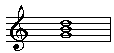 | | a chord consisting of a major third above which is placed a minor third. The example shown here is the G major triad |
|
|
| Major triple (meter) | a meter that is synonymous with double triple meter or 3/2 |
| Majuscule | a large letter or a capital letter |
| in medieval manuscripts, any script composed entirely of capital letters |
| Makam (s.), Makamlar (pl.) | (Turkish, from the Arabic maqâm (s.), maqâmat (pl.)) based on the use of untempered intervals (with as many as 53 microtones amplifying the western octave), a given makam follows a particular scale and a set of associated musical practices. A makam has no intrinsic (allegorical) value and is not bound to certain times of the day or year, as is the related Indian raga |
| the melody type used in Turkish music; that is, it is the concept used to codify phenomena of scale structure, interval structure, and melodic characteristics that underly composition and improvisation. Its counterpart in Arab music is maqam; in Byzantine music, echos; in Assyrian music, makam; in Uyghur music, muqam; in Uzbek music, shashmakom; and in Indian music, raga. All of these concepts roughly correspond to mode in Western music, although they may differ in detail depending on the specifics of the music theory to which they belong |
|
| Makamia | the Greek form of the Turkish makamlar |
| Maké | the small drum in gwo ka that embellishes the central rhythm played on the larger boula |
| Makellarikos horos | see hasapiko |
| Makimono | (Japanese) a Japanese painted scroll, so arranged as to unroll horizontally and reveal a series of pictures |
| Makina | an electronic music genre originating in Spain, similar in sound to UK Hardcore but with elements of bouncy techno and other differences. The makina sound is usually characterized by its resonating synthesized sounding chords, and has a weaker but higher octave sounding punchier kick drum than the similar United Kingdom produced tracks. Makina is also popular in North East England, where both gabber and bouncy techno had been played for many years previously |
- Makina from which this extract has been taken
|
| Makossa | Cameroonian dance rhythm from the Duala region |
| Cameroon's most popular pop style |
|
| Makusé | Pygmy music designed to bring luck to a hunting camp |
| Makuta | the makuta drums, brought to Cuba by Congo or Bantu people, are one of the ancestors of the conga drums. The makuta drums can have a tubular, cylindrical or barrel-shaped body. They have a single head with the lower end open. The head is tensioned by the heat of a fire since the membrane is tacked onto the shell of the drum. more recent models are commonly tensioned with a more complex system of lugs and turnscrews. Makuta festivals are ceremonial celebrations which originated and still exist in societies of the Congo people and their descendants. They were very common during the nineteenth century and were still not infrequent during the early decades of the 20th. In Cuba the word makuta indicates a festive gathering. The term also refers to a kind of ritual staff to which is attached a spherical receptacle containing magical elements or objects. This staff or makuta is used at certain moments in the ceremony to strike the ground in a rhythmic accompaniment to a song or dance. The makuta drums bear individual names: caja, ngoma and nsumbi |
|
(Cuba) an Afro-Cuban dance rhythm
[corrected by Donald Skoog] |
| a grand crown worn by male dancers representing a hero, king, minister or prince in the ancient Indian dance art of yakshagana, an amazing combination of dance, music, spoken word, costume-makeup and stage technique. It is among the oldest traditional and popular folk dance forms of Karnataka with a history dating back to the 14th century AD |
| Makuti | see pungi |
| Mal | (German n.) time, occasion |
| (German n.) mark |
| mal accordé (m.), mal accordée (f.) | (French) out of tune |
| mal acompañado | (Spanish)in bad company |
| Maladaptive | coping or responding in a damaging way, such as a maladaptive response to fear of speaking by always avoiding speaking situations |
| Malade | (French m./f.) sick person, patient (of a doctor) |
| malade | (French) sick, ill, bad (arm, throat, etc.), diseased (plant) |
| Malade imaginaire | (French m./f.) a hypochondriac, one who imagines himself (or herself) to be an invalid |
| Maladie | (French f.) illness, disease |
| maladif (m.), maladive (f.) | (French) sickly, morbid (fear) |
| Maladresse | (French f.) clumsiness, awkwardness, lack of tact, a blunder (particularly in a social setting) |
| Maladroit (m.), Maladroite (f.) | (French) clumsy (person) |
| maladroit (m.), maladroite (f.) | (French) clumsy |
| mala fide | (Latin) in bad faith, with intent to deceive, fraudulently |
| Malagasy hip hop | |
| Malagueña | (German f., Spanish f.) a improvised song based on a repetitive chordal accompaniment |
| see flamenco |
| Mal agüero | (Spanish m.) bad omen |
| Malaise | (French f.) an ill-defined and inexplicable feeling of discomfort, either physical or mental |
| Malakat | long trumpetlike wooden ceremonial horns from Ethiopia |
| Mal aliento | (Spanish m.) bad breath |
| Malanconia | (Italian) melancholy, sadness |
| Mala pata | (Spanish f.) bad luck |
| Malapropism | misusing words to create a comic effect or characterize the speaker as being too confused, ignorant, or flustered to use correct diction |
|
| mal à propos | (French) inopportunely, unseasonably, inappropriately, inopportune, unseasonable, inappropriate |
| Malas artes | (Spanish f.) trickery |
| Malas condiciones higiénicas | (Spanish f.pl.) unsanitary conditions |
| Malas notacias | (Spanish f.pl.) bad news |
| Malattie di petto | (Italian) pulmonary diseases, diseases of the chest |
| Mala uva | (Spanish f.) bad mood |
| mal avenido | (Spanish) at odds |
| mal avisado | (Spanish) ill-advised |
| mal avisé de | (French) ill-advised to |
| Malayo-Polynesian | another term for Austronesian |
| Malaysian hip hop | |
| mal café | (Spanish) foul temper, awful mood |
| mal coiffé | (French) with untidy hair |
| mal conçu | (French) badly planned |
| Mal d'amour | (French m.) the pangs of love, love-sickness |
| Mal de mer | (French m.) sea-sickness |
| Mal di gola | (Italian m.) sore throat |
| Mal di pancia | (Italian m.) stomach-ache |
| Mal di petto | (Italian m.) consumption |
| mal disposé | (French) in a bad mood |
| maldisposto | (Italian) ill-disposed |
| Mal di testa | (Italian m.) headache |
| Mal du pays | (French m.) or maladie du pays (now rarely used), home-sickness |
| Mal du siècle | (French m.) weariness of life, pessimistic depression, world-weariness |
| Male | (Italian m.) evil, pain, illness, harm |
| Male alto | see 'alto' |
| maledetto | (Italian) cursed, awful (horrible) |
| maledire | (Italian) to curse |
| Maledizione | (Italian f.) curse |
| Maledizione! | (Italian) damn! |
| maleducato | (Italian) ill-mannered |
| Malessere | (Italian) indisposition, uneasiness (figurative) |
| Maleficence | doing or causing evil |
| Maleficio | (Italian m.) witchcraft |
| Maleficium | (Latin) the doing of evil by means of magic, sorcery, a malicious enchantment |
| malefico | (Italian) evil, harmful |
| Malenconico | (Italian) melancholy, sadness |
| Malentendu | (French m.) a misunderstanding, a misapprehension |
| mal équipé | (French) poorly equipped |
| malerisch | (German, 'picturesque') (a painter or a picture) expressing form by colour and tone, not by contour |
| Maleviziotis | the traditional dance of Iraklion, Crete |
| malevolo | (Italian) malevolent |
| malefamato | (Italian) of ill repute |
| malfatto | (Italian) badly done, ill-shaped, malformed |
| Malfattore | (Italian m.) wrongdoer |
| Malfeasance | wrongful conduct by a public official |
| malfermo | (Italian) unsteady, poor |
| malformato | (Italian) misshapen |
| Malgarbo | (Italian m.) rudeness |
| Malgoverno | (Italian m.) misgovernment |
| malgrado | (Italian) in spite of, although |
| malgré | (French) in spite of, although |
| malgré lui | (French) in spite of himself, against his will |
| malgré moi | (French) in spite of myself, against my will |
| malgré tout | (French) in spite of everything, all things considered |
| Malheur | (French m.) misfortune, clalmity, ordeal, hardship, accident, mishap, adversity, ill luck |
| un malheur ne vient jamais seul (French: it never rains but it pours, troubles never come singly) |
| Un malheur est si vite arrivé (French: accidents happen so easily, mishaps happen so easily) |
| Le malheur des uns fait le bonheur des autres (French: one man's joy is another man's sorrow) |
| C'est dans le malheur qu'on connaît ses amis (French: a friend in need is a friend indeed) |
| Malhoun | see milhûn |
| Malhun | see milhûn |
| Malia | (Italian f.) spell |
| Malian hip hop | |
| malignare | (Italian) to malign |
| Malignità | (Italian f.) malice, malignancy |
| maligno | (Italian) malicious, evil, malignant |
| Malimba | an African thumb-piano |
|
| Malinconia | (Italian f.) melancholy |
| malinconicamente | (Italian) dejectedly, gloomily, with an expression of melancholy |
| malinconico | (Italian) melancholy, dejected, sad, gloomy |
| malinconioso | (Italian) in a melancholy or dejected manner |
| malinconoso | (Italian) in a melancholy or dejected manner |
| Maling | (China) horse bell |
|
| malintenzionato | (Italian) ill-intentioned |
| Malinteso | (Italian m.) misunderstanding |
| malinteso | (Italian) mistaken |
| Malivata | a contemporary presentation of the hunters' music and dance from Eastern Tanzania incorporating variety of props and other visual elements from the Southern Region of Africa |
|
| Malizia | (Italian f.) malice, cunning, trick |
| malizioso | (Italian) mischievous, malicious |
| malleabile | (Italian) malleable |
| malle in arnese | (Italian) in bad condition |
| Malleolus (s.), Malleoli (pl.) | a rounded bony prominence, such as those on either side of the ankle joint |
| Mallet | mazza (Italian f.), mazzuolo (Italian m.), Schlägel (German m.), mailloche (French f.), mazzo (Spanish m) |
| a beater used to strike percussion instruments, that has a cylindrical or spherical head that comes in a variety of materials (soft cloth or yarn - soft or hard rubber - woods of varying hardness) to produce a wide range of timbres: |
| unwrapped mallets | used on glockenspiel, xylophone and other instruments with keys | made of durable material, have heads made of brass, kelon, nylon, acrylic, wood, or other hard materials |
| wrapped mallets | used on marimba, vibraphone and other instruments with softer keys | have heads of kelon, nylon, acrylic or other medium-hard materials wrapped in softer materials like yarn, cord or latex |
| softer or thicker mallets | used on an instrument's lower registers |
| harder or thinner mallets | used on an instrument's higher registers |
|
| Mallet instruments | also called 'mallet percussion instruments', 'keyboard percussion' or 'tuned percussion', pitched instruments played with mallets, for example, xylophone, glockenspiel, marimba, tubular bells, crotales, steel drums and vibraphone |
| Mallet percussion instruments | see 'mallet instruments' |
| Mal mariée | (French f.) an unhappily married woman |
| malmenare | (Italian) to ill-treat |
| malmesso | (Italian) shabbily dressed (person), poorly finished (house, etc.) |
| malnutrito | (Italian) undernourished, ill-nourished |
| Malnutrizione | (Italian f.) malnutrition |
| Malocchio | (Italian m.) evil eye |
| Maloya | in Reunion, the traditional sega which is relatively slow and is danced by couples who are not as physically close as those on Mauritius |
| MALS | abbreviation of 'Master of Arts in Library Sciences' |
| mal se tirer de | (French) to do something poorly, to manage something poorly |
| mal soigné (m.), mal soignée (f.) | (French) unkempt, shabby, uncared for |
| malsonnant | (French) ill sounding, bad-toned, poor sounding |
| mal venu | (French) untimely |
| mal volentieri | (Italian) or con difficoltà (Italian), unwillingly |
| mal vu | (French) viewed with disapproval, resented |
| Mambo | (English, German m.) a generic term for a popular dance and hybrid music style, developed in the 1940s and 50s. The history of modern mambo begins in 1938, when a danzon called "Mambo" was written by Orestes and Israel 'Cachao' López. The word Mambo is the name of a Voodoo priestess |
| there are a number of sub-groups: |
| a musical section evolved in the late 1930s and 1940s from the nuevo ritmo of the danzón |
| an up tempo Afro-Cuban musical style, invented by Pérez Prado, that evolved in the 1940s and 50s, a blending of the mambo section, elements of the son and some influences of American jazz orchestras |
| a section of an arrangement usually following or developing from the montuno section featuring new arranged (or sometimes improvised) material such as moñas in the horn section |
| an Afro-Cuban dance of the same name popularized in New York and sometimes calledsalsa |
|
|
| Mambo bell | the bell played by the timbalero in mambo style songs |
| Mambo with güiro rhythm | an early name for the chachachá |
| Mamelon | (French, literally 'nipple') a small fortified hill |
| man. | abbreviated form of mano, 'manual' |
| Mana | (Maori) supernatural or magical power or influence |
| Maña | (Spanish f.) skill |
| Mañas | (Spanish f. pl.)cunning |
| Månadsskrift | (Swedish) monthly publication [corrected by Lars Hellvig] |
| Managerkrankheit | (German f.) physical and mental sickness and disturbance resulting from excessive executive responsibility |
| Mañana | (Spanish m.) the future, tomorrow |
| Mañana | (Spanish f.) the morning |
| mañana | (Spanish) tomorrow |
| mañana por la mañana | (Spanish) tomorrow morning |
| Mañanero | (Spanish m.) early riser |
| mañanero (m.), mañanera (f.) | (Spanish) early-rising, morning |
| Mañanita | (Spanish f.) bed jacket |
| Manata | (Italian f.) slap |
| Månatlig | (Swedish) monthly [corrected by Lars Hellvig] |
| manc. | abbreviated form of mancando (Italian: failing, diminishing in strength, dying away, lacking) |
| Manca | (Italian f.) the left |
| mancando | (Italian) failing, diminishing in strength, dying away, lacking |
| mancante | (Italian) failing, diminishing in strength, dying away, lacking |
| Mancanza | (Italian f.) lack, absence, shortage (insufficiency), fault, defect |
| mancare | (Italian) to lack, to be absent, to miss, to fail |
| mancare a | (Italian) to fail to |
| mancare di | (Italian) by lacking in |
| Manche | (French m.) Hals (German m.), manico (Italian m.) neck (of a stringed instrument, for example, a lute or violin) |
| (French m.), handle (for example, on a barrel organ, which is turned to operate the internal mechanism), handle (on a broom, etc.), haft, crop (whip), grip (as in handgrip) |
| (French f.) sleeve (of a jacket, etc.) |
| Manche à balais | (French m.) broomstick |
| Manche de balai | (French m.) broom handle |
| Manche de chemise | (French m.) shirt-sleeve |
| Manche de l'épée | (French m.) sword-arm |
| Manche du couteau | (French m.) knife-handle |
| Manche du sabre | (French m.) sword-arm |
| Manchega | a lively kind of seguidilla |
| Manche raglan | (French m.) raglan sleeve |
| Manchete | see cavaquinho |
| manchevole | (Italian) defective |
| Mancia | (Italian f.) tip |
| mancino | (Italian) left-handed |
| Manco | (Italian f.) left hand |
| manco | (Italian) left |
| (Italian) not even |
| mand | abbreviation of 'mandolin' |
| Mandador | (Portuguese) the caller who 'calls' the folk dances of Portugual, in particular the corridinho, baile de roda and baile mandado. The instruments that support these Algarve dances consists mainly of the accordion, the violin, the pífaro or the flute and the tamboril (drums) |
| Mandal | a tuning device found on the Turkish kanun, a small levers, one for each string, which can be turned by the player while the instrument is being played, raise the pitch of the course up to one semitone (half-step). Typically, they are used to raise the pitch by a quarter tone |
| mandare | (Italian) to send, to give off (to emit), to utter (sound) |
| mandare a chiamare | (Italian) to send for |
| mandare avanti la baracca | (Italian) to keep the ship afloat |
| mandare avanti la casa | (Italian) to run the house |
| mandare giù | (Italian) to swallow |
| Mandarino | (Italian m.) mandarine (fruit), tangerine |
| Mandarin pop music | see 'Mandopop' |
| Mandata | (Italian f.) consignment, turn (of a lock) |
| Mandato | (Italian m.) mandate, warrant (legal), money order |
| Mandibola | (Italian f.) jaw |
| Mandilatos | (from Mandra, Greece) a Thracian couples dance performed at weddings |
| Mandilion | (in use 1520-1560, 1577-1620) a loose, thigh-length overcoat with a standing collar and loose sleeves |
| mando | abbreviated form of mancando (Italian: failing, diminishing in strength, dying away, lacking) |
| Mandobass | a rare bass mandolin |
| Mandocello | (English, German n., called 'mandoloncello' in Italy) a large mandolin, larger than a mandola. When tuned an octave below a mandola (CC-GG-dd-aa) it is called an 'octave mandola'. When tuned an octave below the mandolin, it is called an 'octave mandolin'. The first dated music for this instrument was written in Paris by R. Leoncavallo in a symphonic poem entitled La Nuit de Mai (1887) |
|
| Mando-cümbüs | see cümbüs |
| Mandola | (English, German f.) also mandora or mandore, a large mandolin, bearing six to eight courses of strings, in use during the Renaissance |
| also mandora or mandore, a large mandolin a fifth below a standard mandolin |
| Mandolin | in cooking, a tool for slicing vegetables |
| Mandolin, Mandoline | (Italian) a family (the family name is mandola, mando or mandolin) of originally lute-shaped instrument usually with four to six pairs of strings, a fretted fingerboard and played with a plectrum. There are two types of mandolin in use today, bluegrass and folk. The third type, known colloquially as 'roundback', is the original lute-backed mandolin of earlier times and is rarely used today. The modern Bluegrass mandolins, including mandolin, mandola, mandocello and mandobass, often have f-holes rather than the traditional round sound-holes of the folk mandolin. The folk instrument is distinguishable by its deeper and larger body. |
| name | standard scale length | tuning(s) |
piccolo mandolin
also called brilliantone mando/piccolo mando | 10.2"/26cm | four courses of eight strings |
| pocket mandoline | 12.9"/32.7cm | four courses of eight strings |
| travelling mandoline | 13.1"/33.2cm to 14.4"/36.5cm | four courses of eight strings |
| mandriola | 13.1"/33.2cm to 14.4"/36.5cm | triple strung with twelve strings, tuned like a standard mandolin |
mandolinetto
mandolin-guitar | 13.1"/33.2cm to 14.4"/36.5cm | small guitar-shaped instrument with 8 strings in pairs tuned and played like a mandolin and with a much softer tone. The instrument is really a guitar not a mandolin |
archtop mandolin
American mandolin | 13.1"/33.2cm to 14.4"/36.5cm | during the 1890s, a number of US instrument builders developed a new kind of mandolin and guitar, the archtop mandolin and archtop guitar. These instruments had an arched (and usually carved) top and back like a violin. The invention is usually credited to Orville Gibson (1856-1918). Although this is not true, Gibson's agressive marketing was certainly what made these new instruments popular, and his A style and F style mandolins are the models for almost most all later archtop mandolins |
| A style mandolin | 13.1"/33.2cm to 14.4"/36.5cm | an archtop mandolin design introduced by Gibson around 1900, originally the A style mandolin had a round sound hole, but when Loyd Loar joined Gibson in the 1920s, he redesigned it with f holes |
| F style mandolin | 13.1"/33.2cm to 14.4"/36.5cm | an archtop mandolin design introduced by Gibson around 1900. Unlike the A style mandolin the F style mandolin has a small extension of the body on the bass side (possibly inspired by the significantly more extreme harp mandolin) to make a larger resonance chamber. Originally the F style mandolin had a round sound hole, but when Loyd Loar joined Gibson in the 1920s, he redesigned it with f holes |
harp mandolin
(not to be confused with the mandolin-harp) | 13.1"/33.2cm to 14.4"/36.5cm | a mandolin with the body extending upwards on the bass side all the way to the headstock. Unlike the harp guitar it doesn't have any extra bass strings. The extension is only to provide a larger resonance chamber |
| lyre mandolin | 13.1"/33.2cm to 14.4"/36.5cm | a mandolin with the body extending upwards on towards the headstock on both sides, giving it a lyre like look and providing a larger resonance chamber |
| resonator mandolin | 13.1"/33.2cm to 14.4"/36.5mm | introduced by the Dobro brothers in the late 1920s |
| electric mandolin | 13.1"/33.2cm to 14.4"/36.5cm | a mandolin specially constructed to be played amplified. There are three distinctive kinds of electric mandolins, some has a solid body like an electric guitar, some has a regular mandolin body with a magnetic pickup installed and some has a piezoelectric transducer to produce a sound resembling an acoustic mandolin |
mandolin
also called mezzo mando | 14.2"/36cm | standard tuning: GDAE from bass to treble |
| Celtic mandolin | 13.1"/33.2cm to 14.4"/36.5cm | the unique Celtic style mandolin is very similar to the French kind, but with an even simpler, cleaner design, a lighter build and a light and dynamic tone of its own |
| Cremonese mandolin | | with a small bowlback body and four single gut (or nylon) strings, the Cremonese mandolin dates from about 1700. It appears to be the first 'mandolin' to use the four fifths tuned course configuration common to modern mandolins |
| French mandolin | 13.1"/33.2cm to 14.4"/36.5cm | oldest of the flat/arched back mandolins with four courses of eight strings. At the end of the seventeenth century, Parisian musicians took to their citterns 'mandolins' so that they could compete with the more fashionable Neapolitan musicians with their own native mandolins |
| Genovese mandolin | | a bowlbacked, lute shaped 6 course, 12 string, metal-strung mandolin that appeared towards the end of the seventeenth century |
Lombardic mandolin
also called mandolino lombardo/mando-lute | 11.8"/30cm | the word mandolino isn't known until the end of the seventeenth century. The Lombardic variety is a small bowlback wide and shallow bodied lute with five or six double courses, usually tuned an octave higher than a modern guitar, the instrument for which Vivaldi wrote his mandolin works |
| Milanese mandolin | | during the nineteenth century, the Lombardic mandolin evolved into the Milanese mandolin, very similar to its predecessor, but with a louder tone to satisfy new musical tastes and sometimes with single strings instead of double courses |
| Neopolitan mandolin | 13.1"/33.2cm to 14.4"/36.5cm | the 4 course, 8 string mandolin popular throughout most the nineteenth and well into the twentieth century and even today it remains by far the best known bowlbacked mandolin |
| Portuguese mandolin | 13.1"/33.2cm to 14.4"/36.5cm | probably evolved from the French mandolin, the Portuguese mandolin differs by having a tapered and usually ribbed back while the French has a simpler flat back |
Roman mandolin
Embergher mandolin | 13.1"/33.2cm | invented by Luigi Embergher (4 Feb. 1856-12 May 1943) as a refinement of the Neapolitan mandolin, it differs from its ancestor mainly by a curved fretboard and a slightly narrower body |
| ten-string mandolin | | the five course, ten-string mandolin is a mandolin with an extra pair of low strings, allowing it to reach down as far as the alto mandola |
banjola
banjo-lute/mandoline-banjo/banjo-mandolin | 25.6"/65cm to 26.8"/68cm | an instrument with a mandola body and a five-string banjo neck, introduced by US company Gold Tone, but similar instruments called banjo-lute or mandoline-banjo have been around since the late nineteenth century. The banjola should not to be confused with the mandolin-banjo or the banjolin which are completely different instruments |
alto mandola
mandora (old spelling)
usually simply called mandola and occasionally, incorrectly, tenor mandola | 16"/41cm to 17"/43cm | standard tuning: CGDA from bass to treble.
other common tunings: ADGD GCGC GDGD. Traditionally it had a fairly long scale (16.5"/42cm to 20.3"/51.5cm), but around 1900 Gibson introduced a mandola with a much shorter (15"/38cm to 15.8"/40.2cm) scale. Although the shorter scale mandola was the dominating variant for some time, today the longer scale version has becoming more popular |
octave mandolin
also called tenor mandola/octave mandola/bouzouki/octofone | 19"/48cm to 22"/56cm | standard tuning: GDAE from bass to treble (one octave below mandolin)
Other common tunings: CGDA EADG DADA DADG EADA. Neapolitan style tenor mandolas were common in the nineteenth-century mandolin quartet and recently Celtic style octave mandos have become popular in Irish traditional and folk music |
bouzouki
also called Irish bouzouki/octave mandolin | 19"/48cm to 27"/69cm | 4 or 5 courses (double strung), guitar or lute shaped and fixed frets, the instrument's standard tuning is: GDAE.
other common tunings: CGDA EADG DADA DADG EADA. It is generally agree that term octave mandolin should be used for the tenor mandola (a mandola intended to be tuned GDAE one octave below a mandolin) while Irish bouzouki should be used for an instrument resembling the original bouzouki (4 courses, long neck, small body) except for the tuning and the flat back, and Irish cittern used as a generic term for any large mandola that doesn't fit any other definition. Generally the tenor mandola is regarded as most suitable for melodic playing and the Irish bouzouki and Irish cittern for chords, but there are many exceptions to this convention |
| Irish cittern | 20"/50.8cm to 26"/66cm | a wide variety of different large mandolas mainly used in Irish/Celtic music |
| mandocello | 24"/61cm to 26"/66cm | standard tuning: CGDA (one octave below the alto mandola) |
mandobass
also called bass mando/double bass mando | 39.6"/100.6cm | standard tuning: as a double bass or bass guitar, EADG |
| the alternative names depend on the tuning adopted. Thus, an instrument tuned an octave below a mandolin will be called an 'octave mandolin', while the same instrument tuned an octave below a 'mandola' will be called an 'octave mandola' |
|
|
|
| Mandolina | (Spanish f.) mandolin |
| Mandolinata | (Italian) a serenade for the mandolin, generally quiet in nature |
| (in piano music) a direction to play with a mandolin effect |
| groups that combine various sizes of mandolin and guitar, usually mandolins, guitars, mandolas and mandocellos (or mandolocellos) |
| Mandoline | (French f., German f., Dutch) mandolin, mandolino (Italian) |
| Mandoline-banjo | see 'mandolin, mandoline' |
| Mandoline-guitar | see 'mandolin, mandoline' |
| Mandolinetto | see 'mandolin, mandoline' |
| Mandoliniste | (French m./f.) a player of the mandolin |
| Mandolino | (Italian m.) mandolin, Mandoline (German f.), mandoline (French f.) |
| Mandoliny | homemade lutes from Madagascar |
| see kabosy |
| Mandolión | synonym for bandoneón |
| Mandolin zither | an instrument, closely related to the 'guitar zither', with doubled strings and a more mandolin-like sound |
| Mandoloncello | (Italian) the mandocello |
| Mandopop | a colloquial abbreviation of 'Mandarin pop music'. The term refers to 'C-pop' in which the lyrics are in Mandarin Chinese. Sometimes, the same song is produced in both Cantonese ('Cantopop') and Mandarin versions |
- Mandopop from which this extract has been taken
|
| Mandora | Swedish string instrument, similar to a mandolin |
| (English, German f.) see mandola |
| Mandore | see mandola |
| Mandorla | (Italian f., literally 'almond') in art, an almond-shaped panel or opening, an almond-shaped halo |
| Mandorlo | (Italian m.) almond(-tree) |
| Mandra | in Indian classical music, 'low' |
| Mandria | (Italian f.) herd |
| Mandriola | see 'mandolin, mandoline' |
| Mandulina | (Corsica) a mandolin |
| Manea (s.), Manele (pl.) | a Balkan music style mainly derived from Turkish love songs, most prominent in Romania, especially in rural areas and poor urban neighbourhoods, but is also present in Bulgaria, Serbia, Albania and parts of Turkey |
- Manele from which this extract has been taken
|
| manedlig | (Danish, Norwegian) monthly |
| Manedsskrift | (Danish) a monthly |
| Manedsvis | (Norwegian) a monthly (publication) |
| Manège | (French m.) in ballet, an imaginary circle bounding the stage, the limit of the area in which the dancers perform, a dance round the extreme limits of the stage |
| Manèges | (French m. pl.) term applied to steps or enchaînements executed in a circle |
| maneggevole | (Italian) easy to handle |
| maneggiare | (Italian) to handle |
| Maneggio | (Italian m.) handling, plot (intrigue), riding school |
| maneja al marido a su antojo | (Spanish) she has her husband twisted around her little finger |
| Manele | see manea |
| Manent | see manet |
| Manes | (Latin) the deified souls of the departed ancestors, the shade of the dead |
| manesco | (Italian) quick with one's fists |
| Manesse Codex | or Grosse Heidelberger Liederhandschrift (Heidelberg, University of Heidelberg Library, Cod. Pal. germ. 848), a codex copied and illustrated between 1305-1340 in Zürich, compiled at the request of the Manesse family of Zurich, possibly by Johannes Hadlaub. It contains the texts of love songs in Middle High German by important poets, several of whom were famous rulers. The term for these poets, Minnesänger, combines the words for "romantic love" and "singer", reflecting the content of the poetry, which adapted the Provençal troubador tradition to German |
|
| Manet | (from the Latin manent, 'they remain') or manent, a direction calling for a person, or a group of people, to remain on the stage while others exit |
| often the phrase is accompanied with explanatory remarks, such as Manent utras (Latin: The others remain on stage), or Manet solus (Latin: He alone remains) |
| Manetta | (Italian f.) the handle or knob of the organ stops, hand lever |
| Manette | (Italian f.pl.) handcuffs |
| Mangada | (Guinea-Bissau) a set of three drums |
| Manganello | (Italian m.) truncheon |
| Mangano | (Italian m.) mangle |
| Mangel an Arbeitskräften | (German) shortage of labour |
| manger dans la main à ... | (French) to eat out of ...'s hand |
| manger dans l'assiette | (French) to eat off of a plate |
| manger du bout des dents | (French) to nibble |
| mangereccio | (Italian) edible |
| Mangeria | (Italian f.) illicit profit |
| Mange tout | sugar or snow pea |
| Mangiare | (Italian m.) eating, food, meal |
| mangiare | (Italian) to eat, to eat up, to eat away (corrode), to take |
| mangiare con gusto | (Italian) to tuck (tuck in, into food) |
| mangiare si le parole | (Italian) to mumble |
| mangiare voracemente | (Italian) to tuck (tuck in, into food) |
| mangiarsi le unguie | (Italian) to bite one's nails |
| Mangime | (Italian m.) fodder |
| Mangissa | a popular Bayaka (Pygmy) dance form |
| Manguaré | Colombian tuned log |
| Manhattan Transfer, The | an American vocal group |
|
| Mani | (Italian f. pl.) hands |
| Maniaco (m.), Maniaca (f.) | (Italian) maniac |
| maniaco (m.), maniaca (f.) | (Italian) maniacal |
| Manica | (Italian f.) fingering, shift (on a fingerboard) |
| (Italian f.) sleeve, band (group) |
| Manica, la | (Italian) the English Channel |
| Manice | (Italian m.) the bellows of an organ |
| Manichino | (Italian m.) dummy (tailor, window) |
| Manichord | a clavichord |
| Manichorde | (French m.) a clavichord |
| Manichordion | (French) a clavichord |
| Manichordium | (Latin) a clavichord |
| Manico | (Italian m.) Hals (German m.), manche (French m.), neck of a string instrument (for example, a guitar or violin) |
| (Italian m.) handle |
| Manicomio | (Italian m.) mental home |
| Manicordiendraht | clavichord string |
| Manicordio | (Spanish m.) clavichord |
| Manicordo | (Italian m.) clavichord |
| Manicotto | (Italian m.) muff, sleeve (machine) |
| Manicule | a typographic mark with the appearance of a hand with its index finger extending in a pointing gesture, often signifying an important detail |
| Manicure | (Italian m./f.) manicurist |
| manié | (French) in cooking, softened |
| Manier | (German f.) manner |
| a grace, an ornament |
| Maniera | (Italian f.) manner, style, method |
| Maniéra | (Italian, mentioned in John Florio's Queen Anna's New World of Words (1611)) manner, fashion, guise, use, custome, stile or course. Used also for a kind or sort. Also for qualitie. Also for mannerlinesse and civilitie |
| Maniera affettata | (Italian f.) an affected style or delivery |
| Maniera languida | (Italian f.) a languid, sleepy style |
| manierato | (Italian) affettato (Italian), affected, mannered, geziert (German), affektiert (German), affecté (French), maniéré (French) |
| Maniàre | (French f.) manner, style, method |
| maniéré | (French) manierato (Italian), affettato (Italian), affected, mannered, geziert (German), affektiert (German), affecté (French) |
| maniéré (m.), maniérée (f.) | (French) affected, characterised by artificial mannerisms |
| Maniére d'attaque | (French f.) touch, manner or style, of playing the pianoforte, etc. |
| Manieren | (German f. pl.) pural of Manier, ornaments, grace-notes, embellishments |
| Maniérisme | (French m.) mannerism |
| Manierismo | (Italian m.) mannerism |
| Manierismus | (German m.) mannerism |
| Manierista (s.), Manieristi (pl.) | (Italian) a person addicted to artificial mannerisms |
| Maniero | (Italian m.) manor |
| manieroso | (Italian) (art) displaying the unmistakable touch of a master hand |
| Manifattura | (Italian f.) manufacture, factory |
| manifestare | (Italian) to show, to express, to demonstrate |
| manifestarsi | (Italian) to show oneself |
| Manifestazione | (Italian f.) show, expression, manifestaton, demonstration |
| Manifesto | (Italian m.) a public declaration of policy, poster |
| manifesto | (Italian) evident |
| Maniglia | (Italian f.) handle, strap (on a train, bus, etc.) |
| Mani incrociate | (Italian f. pl.) or volteggiando, crossing hands |
| Manikay | clan songs of the Indigenous Australians of Arnhem Land |
| Manila | abbreviation for Manila hemp, strong fibre from a tree native to the Philippines |
| Manila paper | a type of paper originally made from Manila hemp. It is strong, beige in colour and the fibres are usually visible to the naked eye. Because manila paper is generally inexpensive, it is commonly given to children for making child art |
| Manimba | see marímbula |
| Maniple | item of mass vestments; rectangle of fabric worn fastened to the left wrist |
| manipolare | (Italian) to handle, to adulterate, to manipulate (figurative) |
| Manipolazione | (Italian f.) handling, adulteration, manipulation |
| Manipuri dance | one of the major Indian classical dance forms, it originates from Manipur, a state in the North-East state of India on the border with Myanmar, also known as Burma |
|
| Maniscalso | (Italian m.) smith |
| Manjira | (Tibet, India) a pair of small hand cymbals |
|
| Mann (s.), Männer (pl.) | (German m.) man |
| Mannaia | (Italian f.) axe, cleaver |
| Mannequin | (French m. from the Dutch manneken, 'little man') an artist's lay-figure, a woman employed to display garments in a dressmaker's showroom |
| Manner | way a thing is done or happens, maniera (Italian), Manier (German), manière (Italian) |
| Männerchor | (German m.) male chorus, men's choir, men's chorus |
| Mannerism | (from Italian maniera, 'manner' or 'style') idiosyncrasy (a behavioral attribute that is distinctive and peculiar to an individual), affectation (a deliberate pretense or exaggerated display), habitual behaviours (exaggerated or effected style in art, speech, or other behaviour) |
| a period of European art which emerged from the later years of the Italian High Renaissance around 1520. It lasted until about 1580 in Italy, when a more Baroque style began to replace it, but continued into the seventeenth century throughout much of Europe |
| in music, ars subtilior (literally 'more subtle art') a musical style characterized by rhythmic and notational complexity, centred around Paris, Avignon in southern France, and northern Spain at the end of the fourteenth century. The style also is found in the French Cypriot repertory. Often the term is used in contrast with ars nova, which applies to the musical style of the preceding period from about 1310 to about 1370; though some scholars prefer to consider the ars subtilior a subcategory of the earlier style. Primary sources for the ars subtilior are the Chantilly Codex and the Modena Codex |
|
| Mannerist | an artist of the Mannerist period (c.1520-1600) who flouted the traditional 'rules' of classical and Renaissance art |
| of or relating to Mannerism |
| Manner of articulation | in linguistics, how the speech organs of lips, tongue, and vocal cords must be arranged in order to produce a particular sound such as a nasal, a stop, a fricative, or so on |
| Männergesangverein | (German m.) a society for the cultivation of music for male voices |
| Männergeschlecht | (German n.) mankind |
| Mannerism | (Italian maniera literally 'manner' or 'style') a movement in Italian art from about 1520 to 1600 that developing out of the Renaissance. Mannerism rejected Renaissance balance and harmony in favour of emotional intensity and ambiguity. In Mannerist painting, this was expressed mainly through severe distortions of perspective and scale; complex and crowded compositions; strong, sometimes harsh or discordant colors; and elongated figures in exaggerated poses. In architecture, there was a playful exaggeration of Renaissance forms (largely in scale and proportion) and the greater use of bizarre decoration. Mannerism gave way to the Baroque |
| in music, aspects of Renaissance and Baroque mannerism appear as 'madrigalism' and 'text painting', where the music mirrors textual detail |
|
| Mannerism (musical ornamentation) | in the Baroque period, various devices or 'mannerisms' belonged to the 'method' (of musical embellishment) usually applied freely to unadorned music. These included accento, passaggio, cercare della nota, tremolo, trillo, bombo, groppo, circolo mezzo, tirata mezza, figura corta and messanza. Usually, the composer gave only basic notes to which the performer provided the ornamentation. The musical figures listed above include some that were 'written out in full', that is, the composer supplied all the notes that he or she wished played or sung. If one compares German music of this period with that of the Italians, it is clear that German composers favoured 'written out' mannerisms/embellishments, while Italian composers, by providing simple musical lines, expected the performers to apply the mannerisms as they deemed appropriate and in good taste, thereby engaging in an act of creative collaboration. Although this trend was prevalent in the eighteenth century, some composers, for example, François Couperin and Johann Sebastian Bach, are well-known for wanting performers to stick strictly to what they had written including 'written out' ornaments |
|
| Männerstimme (s.), Männerstimmen (pl.) | (German f.) male voice |
| Mannheim birds | a characteristic of the music of the Mannheim School, the imitation of birds chirping in solo passages |
| Mannheim crescendo | great crescendos and diminuendos that ranged from pianissimo to fortissimo |
| Mannheimer Schule | (German f.) Mannheim school |
| Mannheim rocket | rapid upward arpeggio over a large range, combined with a crescendo |
| Mannheim roll | scale passages in measured tremolo, combined with a crescendo |
| Mannheimer Rakete | (German f., literally 'Mannheim rocket') Mannheim crescendo |
| Mannheim roller | a characteristic of music of the Manheim School, an extended crescendo passage typically having a rising melodic line over an ostinato bass line |
| Mannheim school | in 1720, the court of the Elector Carl Philipp moved from Heidelberg to Mannheim, where the orchestra grew, larger than that of any of the surrounding states, and included some of the best performers of the day, including Jan Václav Stamic (Stamitz) (1717-1757) who is regarded as being the founder of the 'Mannheim school'. Stamitz arrived in 1741/42 and became the orchestra's director in 1750. The most notable of the revolutionary techniques associated with the Mannheim orchestra were its more independent treatment of the wind instruments and its famous whole-orchestra crescendo, a stark contrast to the dynamics of baroque music which allowed only for instantaneous changes from forte to piano and back |
|
| Mannheim sigh | a mannered treatment of Baroque practice of putting more weight on the first of two notes in descending pairs of slurred notes |
| Männliche Stimme | (German) a manly voice |
| männlicher Reim | (German m.) masculine rhyme |
| Mano (s.), Manos (pl.) | (Spanish f.) hand, side, skill, quire (of paper), pestle (used with mortar) |
| Mano (s.), Mani (pl.) | (Italian f.) hand, coat (layer of varnish, etc.) |
| mano aperta (con generosità) | (Italian f.) open hand (with generosity) |
| Mano armonica | (Italian f.) harmonic hand |
| Manocorde | a clavichord |
| Mano de obra especializada | (Spanish f.) skilled labour |
| Mano de pintura | (Spanish f.) coat of paint |
| Mano derecha | (Spanish f.) right hand, main droite (French) |
| Mano destra | (Italian f.) right hand, main droite (French) |
| Manodopera | (Italian f.) labour |
| Mano dritta | (Italian f.) right hand, main droite (French) |
| Mano izquierda | (Spanish f.) left hand, main gauche (French) |
| Manometro | (Italian m.) gauge |
| Manómetro | (Spanish m.) (pressure) gauge |
| manomattere | (Italian) to tamper with, to violate |
| ma non troppo | (Italian) but not too much, for example allegro ma non troppo, quick but not too quick |
| Manopla | (Spanish f.) mitten, gauntlet |
| Manopola | (Italian f.) knob, mitten |
| Manos agarrotadas | (Spanish f.) stiff hands |
| Manoscritto | (Italian m.) manuscript |
| manoscritto | (Italian) handwritten |
| manoseado (m.), manoseada (f.) | (Spanish) worn(-out), hackneyed (figurative) |
| manosear | (Spanish) to touch repeatedly, to finger, to paw (familiar) |
| Manoseo | (Spanish m.) touching, pawing |
| Manoseo del cuero | (Spanish m.) a drumming style using hands and fingers developed by early Cuban tympanists |
| Mano sinistra | (Italian f.) left hand, main gauche (French) |
| Mano sinistra sopra | (Italian f.) left hand above (the right hand) |
| Mano sinistra sotto | (Italian f.) left hand below (the right hand) |
| Manos temblorosas | (Spanish f. pl.) shaky hands |
| Manouche jazz | (French) also called 'Gypsy jazz' or 'Gypsy Swing', an idiom sometimes said to have started by the Ferré brothers in the late 1920s. That said it became popular due to the work of guitarist Django Reinhardt in the 1930s |
| Manovale | (Italian m.) labourer |
| Manovello | (Italian m.) handle, crank (handle) |
| Manovra | (Italian f.) manoeuvre, shunting (railway) |
| manovrare | (Italian) to operate (action), to manoeuvre (figurative) |
| Manque | (French m.) gap (lack of), lack, shortage |
| manqué (m.), manquée | (French) unsuccessful, unsatisfactory, abortive, failed (attempt), missed (opportunity) |
| (a person) who might have achieved great success in a profession or vocation other than the one he (or she) has chosen |
| manque d'à propos | (French) irrelevance |
| Manque de | (French m.) absence of, lack of, shortage of |
| manque de chance | (French) just his luck, just her luck |
| Manque de goût | (French m.) absence of good taste |
| manquer | (French) to to absent, to be missing |
| manquer à | (French) to miss ... |
| manquer à sa parole | (French) to break one's word |
| manquer de | (French) to neglect, to fail to, to lack, to miss, to lack |
| manquer le coup | (French) to fail completely, to botch it, to mark the occasion (familiar), to show a reaction (familiar) |
| manquer son coup | (French) to fail (familiar) |
| Manrovescio | (Italian m.) (back-handed) slap |
| Mansarda | (Italian f., Spanish f.) attic, dormer window |
| Mansión | (Spanish m.) mansion |
| Mansión señorial | (Spanish m.) stately home |
| Mantel | (Spanish m.) tablecloth |
| Manteleta | (Spanish f.) shawl |
| Mantenedor (m.), Mantenadora (f.) | (Spanish m./f.) member of a jury |
| mantener el oído alerta | (Spanish) to keep one's ears open |
| mantenga los medicamentos fuera del alcance de los niños | (Spanish) keep medicines out of the reach of children |
| Mantenimiento | (Spanish m.) maintenance, upkeep, sustenance, support |
| Mantice (s.), Mantici (pl.) | (Italian m.) bellows |
| Manticeria | (Italian f.) that part of the organ that produces the wind, the wind-chest |
| Mantilla | (Spanish f.) a head-scarf, or veil, usually of black lace |
| Mantle | a loose, sleeveless cloak or cape |
| Mantling | (in heraldry) or lambrequin, drapery tied to the helmet above a shield, that forms a backdrop for the shield |
| Mantougu | (China) frame drum |
|
| Mantra, Mantram | Buddhist and Hindu sacred text used as a sacred prayer, magical incantation |
| Mantra music | see kirtan |
| Mántricas | (Spanish f.) Buddhist and Hindu invocations |
| Manuaal | (Dutch) manual |
| Manual | a book (usually one giving instructions or advice) |
| a book containing special services for occasional use, such as baptisms, marriages and visiting the sick |
| (English, German n. from the Latin manus,'hand') a keyboard played with the hands, for example, on a harpsichord or an organ which can have two or more manuals, as opposed to the keyboard played with the feet, which are called pedals (from the Latin pedis, 'foot') or pedal keyboard |
| in the 1800s it became common to place the pipes played from the upper keyboard in a closed box that had shutters that could be opened and closed by the player to "swell" the sound |
| manuals of a late 1800 English organ | manuals of a late 1800 French organ | comment |
| Swell | Recit | top manual (swell shutters) |
| Great | Grande | middle manual in England, lowest manual in France |
| Choir | Positif | lowest manual in England, middle manual in France |
|
|
| Manualcoppel | (German n., archaic spelling) manual coupler |
| Manual coupler | a device used to connect the keys of the manuals. When it is engaged and the lower manual is played, the upper manual moves with it |
| Manual de instrucciones | (Spanish m.) instruction manual, 'how-to' book |
| Manuale | (Latin, Italian m.) manual (of an organ) |
| (Italian m.) handbook, manual |
| manuale | (Italian) manual |
| Manualiter | (from the Latin, manualis) organ composition for the manual alone, that is, without the pedals |
| Manualkoppel | (German n.) see Koppel |
| Manualuntersatz | (German m.) Sub-Bourdon |
| Manubrio | (Italian) the handle or knob of the organ stops |
| Manubrium | (Latin, German n.) the handle or knob of the organ stops |
| Manuductor | an official of the early church who gave the signal for the choir to sing, and who beat time with the hand, so regulating the music |
| Manuel | (French m.) manual |
| manufatto | (Italian) hand-made, manufactured |
| Manus | (Latin) hand |
| Manuscript | (English, Dutch) a document bearing the notation of a composition, normally sheets of paper (or parchment) with the composer's handwritten notation of a composition. Medieval manuscripts (for example the hand-written medieval book, the Codex manuscriptus, often ornamented with decorative borders, illuminated initials and miniatures, and containing works of ancient philosophy or scholarly, ecclesiastical, and literary texts) were written on parchment (or, sheepskin), since papyrus from Egypt was scarce; consequently, they are highly durable. Prior to about A.D. 800, text manuscripts were written only by a small number of highly-skilled monks. In the reign of Charlemagne (AD 768-814) there was a concerted effort to increase literacy in Europe. At first the scriptoria (writing rooms) of monasteries transcribed the contents of famous manuscripts and made copies. Monastic communities in the Netherlands and northern Germany began producing manuscripts around 1383/84. Flanders, Burgundy, and in particular Paris became major centres for the mass production of breviaries (prayer books) and Books of Hours. New, cursive scripts were invented to make copying faster |
|
| Manuscript paper | see 'staff paper' |
|
| Manuscrit | (French m.) manuscript |
| manuscrit (m.), manuscrite (f.) | (French) handwritten |
| Manuscrito | (Spanish m.) manuscript |
| Manushya | man (as a being) |
| Manuskript | (German n.) manuscript |
| Manutengolo | (Italian m.) receiver of stolen goods, accomplice, resetter |
| Manutenzione | (Italian f.) maintenance (of buildings, etc.), preservation, care, keeping |
| Manyanga | a popular percussion instrument from Kenya |
| Manzana | (Spanish f.) apple, block (building) |
| Manzana acaramelada | (Spanish f.) toffee apple |
| Manzana almendrada | (Spanish f.) almond-flavoured apple infusion (in the US this would be described as a 'tea' rather than an 'infusion') |
| Manzana de Adán | (Spanish f. - Latin America) Adam's apple |
| Manzana de la discordia | (Spanish f., literally 'apple of discord') bone of contention (figurative: a person, object or event that becomes the excuse for disagreement) |
| the origin of the reference 'apple of discord' has its roots in ancient Greek mythology and, in particular, the cause of the Trojan War which had as its roots the marriage between Peleus and Thetis, a sea-goddess. Peleus and Thetis had not invited Eris, the goddess of discord, to their marriage celebrations. Univited, the goddess stormed into the wedding banquet and threw a golden apple onto the table. The apple belonged to, Eris said, whomever was the fairest. Hera, Athena, and Aphrodite each reached for the apple. Zeus proclaimed that Paris, prince of Troy and thought to be the most beautiful man alive, would act as the judge. Hermes went to Paris, and Paris agreed to act as the judge. Hera promised him power, Athena promised him wealth, and Aphrodite promised the most beautiful woman in the world. Paris favoured Aphrodite, and she promised him that Helen, wife of Menelaus, would be his wife |
| Manzana podrida | (Spanish f.) rotten apple (figurative) |
| Manzanilla | (Spanish f.) a dry, light sherry |
| (Spanish f.) camomile tea, camomile (plant) |
| Manzuma | Ethiopian Islamic music that originated from the region of Wello in northeastern Ethiopia and is sung in Amharic. Manzuma has spread to Harar and Jimma, where it is now sung in the Oromo language |
| Mão | (Portuguese) hand |
| Mão-esquerda | (Portuguese) left hand |
| Maple | Ahorn (German m.), Érable (French m.), Esdoorn (Dutch), legno di acero (Italian m.) European Species: Acer campestris (Field maple), A. platanoides (Norwegian Maple), American Species: A. saccharum (Hard, rock, or sugar maple), A. saccharinum (Soft or silver Maple), A. nigrum (Black Maple): Average Weight: 45 pounds per cubic foot (Sugar Maple)) Field Maple is a small tree or bush with wood which splits and bends easily but is hard and durable. Norwegian Maple (which is also found in Germany and Russia) is a larger tree with softer wood. Maple seems to have been used mostly for bowls and other turned work, although Hinckley claims maple was used for furniture "since the Gothic period". Field Maple is apparently similar to Sugar Maple in working characteristics. Norwegian Maple may be similar to the "soft" American maples |
|
| Mapping | the process of identifying patches and keys, so that sound files can be played properly. A key map will translate values for MIDI messages, so that the correct keys will be played. A patch map functions to identify the correct patches (sounds, instruments) |
Maqâm (s.) مَقَامٌ
Maqâmât (pl.) مقامات |
in Arab music, melody is usually based on scales or modes known as maqâmât. Although as many as 120 modes have been identified, about a dozen are regularly used. Notes include micro-intervals which do not conform with traditional Western systems. Although there are various systems of notation, nowadays maqâmât are generally treated as scales consisting of 24 equal quarter-tones. Western notation has been adapted, using the "flat" symbol with a horizontal line through it to lower a note by a quarter-tone, and the "sharp" symbol with a single vertical line, to raise it. The names given to the various maqâm designate an important note in the scale (for example, Turkish Cargah, Arabic Chahargah, meaning fourth position), or a city (for example, 'Esfahan', sometimes spelled 'Isfahan'), a landscape (for example, Turkish Hicaz, Arabic Hijazi), a person (for example, Kurdi) or a poetic abstraction (for example, Suzidil) |
| Legend: C-do D-re E-mi F-fa G-sol A-la B-si : #-sharp z-half-sharp b-flat k-half-flat |
Maqâm 3ajam (Major) ['3ajam' in Arabic denotes something foreign, particularly Persian]
Scale intervals: 1 1 ½ 1 1 1 ½ |
| Key of C | C | D | E | F | G | A | B | C | |
| Key of G | G | A | B | C | D | E | F# | G | |
| Key of D | D | E | F# | G | A | B | C# | D | |
| Key of A | A | B | C# | D | E | F# | G# | A | |
| Key of E | E | F# | G# | A | B | C# | D# | A | |
| Key of B | B | C# | D# | E | F# | G# | A# | B | |
| Key of F | F | G | A | Bb | C | D | E | F | |
Maqâm Nahawend (Minor) ['Nahawend' is in Persia]
Scale intervals: 1 ½ 1 1 ½ 1 1 |
| Key of A | A | B | C | D | E | F | G | A | |
| Key of E | E | F# | G | A | B | C | D | E | |
| Key of B | B | C# | D | E | F# | G | A | B | |
| Key of D | D | E | F | G | A | Bb | C | D | |
| Key of G | G | A | Bb | C | D | Eb | F | G | |
| Key of C | C | D | Eb | F | G | Ab | Bb | C | |
| Key of F | F | G | Ab | Bb | C | Db | Eb | F | |
Maqâm Rasd : same as 3ajam but drop 3rd and 7th by ¼ ['Rasd' is the note C]
Scale intervals: 1 3/4 3/4 1 1 3/4 3/4 |
| Key of C | C | D | Ek | F | G | A | Bk | C | popular |
| Key of G | G | A | Bk | C | D | E | Fz | G | popular |
| Key of D | D | E | Fz | G | A | B | Cz | D | |
| Key of A | A | B | Cz | D | E | F# | Gz | A | |
| Key of E | E | F# | Gz | A | B | C# | Dz | A | |
| Key of B | B | C# | Dz | E | F# | G# | Az | B | |
| Key of F | F | G | Ak | Bb | C | D | Ek | F | popular |
Maqâm Byati: same as Nahawend but drop 2nd by ¼
Scale intervals: 3/4 3/4 1 1 ½ 1 1 (*optional: raise 6th by ¼ on way up) |
| Key of A | A | Bk | C | D | E | F* | G | A | popular |
| Key of E | E | Fz | G | A | B | C* | D | E | |
| Key of B | B | Cz | D | E | F# | G* | A | B | |
| Key of D | D | Ek | F | G | A | Bb* | C | D | popular |
| Key of G | G | Ak | Bb | C | D | Eb* | F | G | popular |
| Key of C | C | Dk | Eb | F | G | Ab* | Bb | C | |
| Key of F | F | Gk | Ab | Bb | C | Db* | Eb | F | |
Maqâm Kurd : Same scale intervals as Nahawend, but starts from 5th
Scale intervals: ½ 1 1 1 ½ 1 1 |
| Key of E | E | F | G | A | B | C | D | E | popular |
| Key of B | B | C | D | E | Fc | G | A | B | |
| Key of F | F | Gb | Ab | Bb | C | Db | Eb | F | |
| Key of A | A | Bb | C | D | E | F | G | A | popular |
| Key of D | D | Eb | F | G | A | Bb | C | D | popular |
| Key of G | G | Ab | Bb | C | D | Eb | F | G | popular |
| Key of C | C | Db | Eb | F | G | Ab | Bb | C | |
Maqâm Hijaz
Scale intervals: ½ 1.5 ½ 1 ½ 1 1 (*optional: raise 6th by ¼ tone) |
| Key of E | E | F | G# | A | B | C | D | E | |
| Key of B | B | C | D# | E | F# | G | A | B | |
| Key of F | F | Gb | A | Bb | C | Db | Eb | F | |
| Key of A | A | Bb | C# | D | E | F | G | A | popular |
| Key of D | D | Eb | F# | G | A | Bb | C | D | popular |
| Key of G | G | Ab | B | C | D | Eb | F | G | popular |
| Key of C | C | Db | E | F | G | Ab | Bb | C | |
Maqâm Sika
Scale intervals: 3/4 1 ½ 1.5 ½ 1 3/4 (* Optional: may drop 5th by ½ tone) |
| Key of C | Cz | D | E | F | G# | A | B | Cz | |
| Key of G | Gz | A | B | C | D# | E | F# | Gz | |
| Key of D | Dk | Eb | F | Gb | A | Bb | C | Dk | |
| Key of F | Fz | G | A | Bb | C# | D | E | Fz | |
| Key of B | Bk | C | D | Eb | F# | G | A | Bk | popular |
| Key of E | Ek | F | G | Ab | B | C | D | Ek | popular |
| Key of A | Ak | Bb | C | Db | E | F | G | Ak | |
|
|
| Maqama | picaresque Arabic stories in rhymed prose |
| Maqrunah | Tunisian and Libyan double reed pipe |
| Maquereau | (French m., literally 'mackerel') a pimp, a procurer |
| Maquette (s.), Maquettes (pl.) | often found as 'unfinished' drawings in some manuscripts, maquettes are dummies used to show how an illumination or other artwork was to be placed, showing an outline of the figures and the frames needed. They may be monochrome, or partially coloured |
| (French f.) a small model (of a piece of sculpture), a rough sketch (of a painting) |
| (French f.) a life-size, non-working model (of a piece of machinery, etc.), a mock-up |
| Maquillage | (French f.) make-up, cosmetics, the art of make-up |
| maquillé (m.), maquillée (f.) | (French) wearing cosmetics, (heavily) made up |
| Máquina de coser | (Spanish f.) sewing machine |
| Máquina de escribir | (Spanish f.) typewriter |
| Máquina del trueno | (Spanish f.) thunder machine |
| Máquina de tejer | (Spanish f.) knitting machine |
| Máquina de viento | (Spanish f.) wind machine |
| Maquinaria | (Spanish f.) machinery, machines, works |
| the term is used also for those responsible for the building of sets for theatrical productions, also called scenemen |
| Maquis | (French) scrub-land, heath covered with undergrowth (in Corsica) |
| Maquisard (m.), Maquisarde (f.) | (French) a member of the Maquis, a guerrilla fighter in France during the Second World War |
| mar | abbreviation of 'marimba' |
| Marabi | South African 'three-chord' township music of the 1930s-1960s, which evolved into 'African jazz' |
|
| Marabout | (French, from the Arabic) a Moslem hermit or monk |
| (French) or 'marabou' (English), a tuft or plume of downy feather, used to decorate a woman's dress or head-dress |
| Maracas | (Italian f. pl., English, French m. pl., German f. pl.) maracas are a pair of dried gourds each attached to a wooden handle. The seeds inside the gourd make a "ch-ch-ch" sound when the maracas are shaken. Maracas are usually played in pairs and are used in folk and popular music from Brazil, Venezuela, Colombia, and other Latin American countries. Today maracas are also made from materials such as wood, metal, or plastic. They may be filled with beads, beans, or pebbles. Each kind of material creates a slightly different sound |
| Venezuelan maracas are unlike the kind often used in the U.S., which derive from Cuba and Puerto Rico, being smaller, with a softer sound. While a typical rhythmic triplet for Caribbean maracas places the accent at the end (1/2/3), the counterpart for Venezuelan maracas inverts the accent (1/2/3) |
|
| Maracatu | a term applied to two distinct performance genres found in Pernambuco, Northeastern Brazil, maracatu nação (also known as maracatu de baque virado) and maracatu rural (also known as maracatu de baque solto, maracatu de orquestra, and maracatu de trombone). The music is played on large alfaia drums, large metal gonguê bells, snare drums and shakers |
|
| mar adentro | (Spanish) out at sea |
| Marakas | (German f. pl.) maracas |
| Marame | (Italian m.) refuse (rubbish), rubbish |
| Marangone | (Italian m.) a cormorant, a joiner, a carpenter |
| Maravane | or maravanne, from the Western Indian Ocean islands, a wooden rattle onto which tin sheets are nailed |
| Maraviglia | (Italian f.) a wonder, a marvel, astonishment, surprise |
| maravigliare | (Italian) to astonish, to surprise, to amaze |
| maravigliarsi | (Italian) to wonder, to be surprised, to be amazed, to be astonished |
| maraviglioso | (Italian) wonderful, marvellous, amazing |
| Marbling | a mottling or streaking that resembles marble |
| the process or operation that gives an object the surface appearance of marble |
| the decorative imitation of marble patterns produced on page edges and endpapers of books, a technique known in Japan from as early as the 9th century AD and in Europe from the 17th century |
| flecks or thin strips of fat, especially when evenly distributed in a cut of meat |
| Marc | (French) the refuse that remains after the pressing of grapes, used to produce inferior wine and brandy |
| marc. | abbreviated form of marcato |
| marcadamente | (Spanish) markedly |
| Marca del metrónomo | (Spanish f.) metronome mark |
| Marca de pedal | (Spanish f.) pedal mark (which include 'engage (sustain) pedal', 'release (sustain) pedal' and 'variable pedal mark', the last used to more accurately indicate the precise use of the sustain pedal) |
| Marca depositata | (Italian f.) registered trademark, eingetragenes Warenzeichen (German n.), marque déposée (French f.) |
| Marca di fabbrica | (Italian f.) trade-mark |
| marcado | (Spanish) accented, marcato |
| Marcaje | in flamenco, to mark time, also known as marqueo, used to interpret and embellish the sung verses and, when it includes moving around the stage, is accompanied by a majestic strutting that incorporates the arms |
| marcando | (Italian) marking, stressing, markierend (German), en marquant (French) |
| (Spanish) in flamenco, the movements of the dancer during the letra |
| (Spanish) in flamenco, to mark time with the feet |
| Marcantonia | (Italian f.) a plump woman |
| marcar (el compás) | (Spanish) to beat the time, battre (le temps) (French) |
| marcare | (Italian) to mark |
| marcar en dos tiempos | (Spanish) to beat in 2, battre à deux temps (French) |
| Marcas | (Spanish f. pl.) marking, marks |
| marcata | (Italian) marked, accented |
| marcata la melodia | (Italian) the melody is to be marked |
| marcati | (Italian) marked, accentuated [suggested by Weed] |
| marcatissimo | (Italian) very strongly marked, strongly accentuated |
| marcato | (Italian) marked, accented, stressed, markiert (German), marqué (French) |
| applied to a melody, indicates that it should be given prominence |
| marcato il pollice | (Italian) mark, or accent strongly, the note(s) played by the thumb |
| Marcato marking |
 | | an V lying on its side, wider part to the left, over the notehead |
|
|
| Marcatura | (Italian f.) marking |
| Marcella desino | (Italian) vibraslap, a percussion instrument designed to imitate the sound of a donkey jawbone or quijada |
| marcescibile | (Italian) perishable, corruptible |
| March | marcia (Italian), Marsch (German), marche (French) |
| instrumental music with a repeated and regular rhythm such as might appropriately accompany a marching group |
|
| Marcha | (Spanish f.) march |
| (Spanish f.) the name given to the conga part |
| (Spanish f.) a carnival samba (march) rhythm |
| (Spanish f.) departure, course, progress, speed, gear (in a car), operation, running, go, good humour |
| Marcha fúnebre | (Spanish f.) funeral march |
| Marcha militar | (Spanish f.) military march, fanfare (French) |
| Marchamo | (Spanish m.) mark, seal |
| Marcha nupcial | (Spanish f.) wedding march, marche nuptiale (French) |
| Marche | (French f.) march |
| (French f.) a succession or progression of chords |
| Marche des voix | (French f.) part writing, voice leading |
| Marche d'harmonie | (French f.) harmonic progression, harmonic sequence |
| Märchen | (German n.) tale, tales especially fairy-tales |
| the term is used occasionally for German opera based on fairy-stories |
| Marche funèbre | (French f.) funeral march |
| Marche harmonique | (French f.) a sequence (of chords) |
| Märchen | (German n.) a folk-tale, a fairy-story |
| Märchenerzähler | (German m.) a storyteller |
| märchenhaft | (German) fairy-tale, fabulous (fantastic) |
| Märchenoper | (German f.) fairy-tale opera |
| Marche nuptiale | (French f.) wedding march, marcha nupcial (Spanish) |
| marcher á tâtons | (French) to grope one's way along |
| Marche redoublée | (French f.) a double-quick march |
| Marcher lord | a lord who had royal prerogative in, and jurisdiction over, lands in the Welsh and Scottish Marches |
| Marchesa | (Italian f.) a marchioness, a marquise |
| Marchese | (Italian m.) a marquess, a marquis |
| Marchete | see cavaquinho |
| Marche triomphale | (French f.) a triumphal march |
| marchiando | (Italian) huge, enormous, gross |
| Marching band | (English, Marchingband (German f.), harmonie (French), harmonie-fanfare (French)) a group of instrumental musicians who generally perform outdoors, and who incorporate movement - usually some type of marching - with their musical performance |
|
| Marching machine | a rare, often home-made, percussion instrument that simulates the sound of soldiers marching, used by Morton Gould (1913-1996) and Fisher Tull (1934-1994) |
| Marching percussion | instruments specially designed to be played while moving |
|
| Marching tubas | some tubas are capable of being converted into a marching style, known as "marching tubas". A leadpipe can be manually screwed on next to the valves. The tuba is then usually rested on the left shoulder (although some tubas allow use of the right shoulder), with the bell facing directly in front of the player. Some marching tubas are made only for marching, and cannot be converted into a concert model. Most marching bands opt for the sousaphone, an instrument which is easier to carry and almost always cheaper than a true marching tuba. Drum and bugle corps players, however, generally use marching tubas, which in this context are referred to as contras |
|
| Marchio | (Italian m.) a mark, a stamp, a brand |
| Marchio di fabbrica | (Italian m.) a trade mark |
| marchionale | (Italian) pertaining to a marquis |
| Marcia (s.), Marce (pl.) | (Italian f.) a march |
| Marcia funebre | (Italian f.) a funeral march |
| Marciale | see Marziale |
| Marciana (biblioteca) | (Italian f.) St. Mark's Library (Venice) |
| Marciapiede | (Italian m.) pavement, platform (station), side-walk |
| marciare | (Italian) to march |
| marciare con | (Italian) to march with |
| Marciata | (Italian f.) a march, marching |
| marcido | (Italian) rotting, withered, tainted, drunk (familiar) |
| marcio | (Italian) rotten, tainted, putrid, spoiled, decayed, crumbling |
| Marcita | (Italian f.) a flooded meadow |
| Marco | (Spanish m.) frame (of a door, window, picture) |
| (Spanish m.) framework (i.e. contextual association) |
| Mardi Gras | (French, literally 'Fat Tuesday') the day before Ash Wednesday, and is also called "Shrove Tuesday" or "Pancake Day", the last day of Carnival before Lent |
- Mardi Gras from which some of this extract has been taken
|
| Mare | (Italian m.) the sea, the ocean |
| Marea | (Italian f.) the tide, ebb and flow |
| mareggiare | (Italian) to float, to rise and fall in waves, to undulate, to surge (tide), to swell (tide) |
| Mare nostrum | (Latin, 'our sea') the Roman name for the Mediterranean |
| marezzare | (Italian) to water (silk), to marble (paper) |
| Marezzatura | (Italian f.) watering (of silk), a watered effect, marbling |
| (Italian f.) Flamme (German f.), onde (French f.), flame, the figure found in the maple on the backs of violins |
| marginale | (Italian) marginal |
| Marginalia | (Latin pl.) marginal notes, drawings, illuminations, particularly manuscript notes in a printed book or ancient manuscript |
| marginare | (Italian) to leave a margin in printing |
| marginato | (Italian) or marginoso (Italian), with a wide margin |
| Marginatura | (Italian f.) arrangement of the margin (in typography), edging |
| Margherita | (Italian f.) pearl, daisy, Margaret (English), Marguerite (French) |
| Margomkali | a ritual folk art of the Syrian Christians of the Kottayam and Thrissur districts of Kerala, India |
| Mari | (French m.) a husband |
| Maria | (Italian f.) Mary |
| Mariachi | (English, German m.) traditional Mexican ensemble popular throughout the country, consisting of at least two violins, two trumpets, one Spanish guitar, one vihuela (a high-pitched, five-string guitar) and one guitarrón (a small-scaled acoustic bass), but sometimes featuring more than twenty musicians |
|
| Mariage | (French m.) a marriage, a wedding |
| Mariage blanc | (French m.) an unconsummated marriage |
| Mariage de convenance | (French m.) a marriage of convenience, an arranged marriage, a marriage contracted with a view to material benefits |
| Mariage d'inclination | (French m.) a marriage for love or affection |
| Marian antiphon | an antiphon for the Virgin Mary |
|
| Marianne | a national emblem of the French Republic |
| Maribou | a fur-like trim made from feather remnants, a smaller version of the boa, popular in dress trimming for eveningwear |
| Mari complaisant | (French m.) a complaisant husband, a husband who condones his wife's infidelities |
| Marié, Mariée (f.) | (French) (bride)groom (m.), bride (f.) |
| les mariés (French: the bride and groom) |
| marié, mariée (f.) | (French) married |
| Marienantiphon | (German n.) antiphon of the Blessed Virgin |
| Marienkapelle | (German f.) Lady chapel |
| Marientrompete | (German f.) tromba marina |
| marier | (French) to marry |
| Marijuana | (Spanish, derived from Mexican Spanish) a preparation of parts of the hemp plant smoked as an intoxicant |
| Marimb | abbreviation of Marimbaphon (German: marimba) |
| Marimba | (Italian f., English, French m., German f.) a xylophone-like percussion instrument fitted with resonators and played with drum sticks. Its name is derived from Bantú languages in which rimba suggests a 'flattish object sticking out' such as a note or key, and ma is a cumulative prefix; thus, marimba means 'many keys'. The marimba is the national instrument in Guatemala where it is used in religious ceremonies, as well as in social or community events. The marimba has traditionally been played, although to a lesser extent, in Brazil, Nicaragua, Ecuador, Cuba and Peru. The keys of the modern marimba are usually constructed of rosewood, and the resonators, one lying under each bar, are of brass or aluminum. The resonators (pipes), which are tuned to the fundamental note of the bar above and strengthen the fundamental and odd-numbered over tones, are graduated in length (as are the keys) and closed at one end (the end facing the floor). The marimba has a two-level keyboard, similar to a piano's division of black and white keys, allowing the full chromatic range to be represented. The most common orchestral marimba is a four octave instrument, and the solo marimba has a range between four-and-a-third and five octaves. Larger instruments (up to six-and-a-half octaves in range) are found in the villages of Guatemala and México, where they may be played by two or three persons simultaneously, each using two to four mallets. The modern orchestral marimba is mounted on a standing frame and played from a standing position |
|
| a thumb piano or mbira |
| Marimbafono | (Italian m.) marimba |
| Marimba, Mexican | see maderas que cantan, las |
| Marimbaphon | (German n.) marimba |
| Marimbaphone | (English) marimba |
| Marimberos | (Spanuish m. pl.) marimba players |
| Marimbol | see marímbula |
| Marímbula | (Cuba) other Caribbean countries have adopted this name or some variant of it - marimba, malimba, manimba, marimbol, a large resonant wooden box with a (kalimba-like) thumb piano constructed over an opening in the box. It is of Congolese Bantú origin and was the original bass instrument in the changui groups. The player sits on the box and plucks at the metal keys and strikes rythmic figures on the box itself |
| in Africa, it is also known as the mbira, marimba, likembe, nadimba, uboh, sansa or congoma |
| see 'thumb piano' |
|
| Marin | (French m.) sailor |
| marin (m.), marine (f.) | (French) sea |
| Marinade | a spiced pickling liquid used to flavour and/or tenderise meats and fish prior to cooking |
| marinare la scula | (Italian) to play truant |
| Marine | (French f.) the navy |
| Marine marchande | (French f.) merchant navy |
| mariner | (French) to marinate |
| Marinera | Peruvian handkerchief dance, performed by couples that in some ways resembles the Chilean cueca, and indeed it is descended from the earlier zamacueca, the Chilean version of which was widely popular in nineteenth-century Peru, prior to the War of the Pacific. With Chile having taken Peruvian territory, however, the zamacueca changed its name to marinera, in honor of the sailors who had fought in the war, and distanced itself from the original. It is played with two guitars and cajón, accompanied by hand clapping |
| Marinera peruana | flirting dance from Peru |
| Marine trumpet | see tromba marina |
| Maringa | the name given to 'palm-wine music' in Sierra Leone |
| Marionette | misspelling of marionnette |
| Marionnette | (French f.) a puppet (manipulated by strings) |
| Marionette Opera-Theatre | see 'puppet opera' |
| maritalement | (French) as husband and wife |
| maritime | (French) maritime, coastal, shipping (agent, etc.) |
| Marivaudage | (French) refinement of style and subtle analysis of sentiment, practised in an excessive degree (named for the author and playwright Pierre Carlet de Chamblain de Marivaux (1688-1763), the term signifying the flirtatious bantering tone characteristic of Marivaux's dialogues |
| the style called marivaudage derives mainly from Fontenelle and the Précieuses, though there are traces of it even in Jean de La Bruyère. It abuses metaphor somewhat, and delights to turn off a metaphor in an unexpected and bizarre fashion. Sometimes a familiar phrase is used where dignified language would be expected; sometimes the reverse. Crébilllon also described Marivaux's style as an introduction to each other of words which have never made acquaintance, and which think that they will not get on together (this phrase is itself rather Marivaux-esque). This kind of writing, of course, recurs at several periods of literature, especially at the end of the nineteenth century. This fantastic embroidery of language has a certain charm, and suits the somewhat unreal gallantry and sensibility which it describes and exhibits |
|
| Marked | clearly noticeable, marcato (Italian), markiert (German), marqué (French) |
| Marked word | a word that has some limitation or boundary in its meaning (for example, mare, doe, buck, etc.) when contrasted with an unmarked word without such a limitation or boundary (for example, horse, deer, etc.) |
| Marketingabteilung | (German f.) marketing department |
| Markeur | see maké |
| Markidim | (Hebrew) dance leaders |
| markieren | (German) to mark, to accent, to emphasise |
| markierend | (German) marking, accenting, emphasising, marcando (Italian), en marquant (French) |
| markiert | (German) marked, accented, emphasized, marcato (Italian), marqué (French) |
| markig | (German) vigorous |
| Marking | a term used in singing for rehearsing without using full voice so as to avoid tiring the voice before a subsequent performance |
| markiren | (German) archaic form of markieren |
| markirt | (German) marked, accented |
| Mark tree | also known as a chime tree or set of bar chimes, the Mark tree is a percussion instrument used primarily for musical colour. It consists of many small chimes - typically cylinders of solid metal approximately 6 mm (one-quarter inch) in diameter - of varying lengths mounted hanging from a bar. The chimes are played by sweeping a finger or stick through the length of the hanging chimes. They are mounted in pitch order to produce rising or falling glissandos. It should not be confused with either the 'wind chime' or the 'bell tree'. Unlike tubular bells, another form of chime, the chimes on a mark tree do not produce a definite pitch, as they produce inharmonic (rather than harmonic) spectra |
- Mark tree from which this extract has been taken
|
| Marlin | any of several large, slender deep-sea fishes related to the sailfish and spearfish |
| Marmaille | (French f.) brats (familiar term for children) |
| Marmelade | (French f.) stewed fruit (in England, a marmelade is a jam made with a citrus fruit) |
| Marmi finti | (Italian, literally 'false marble') an imitation of marble. Usually a decorative feature (on simulated architectural features) it was sometimes used in paintings, particularly by the artist Andrea Mantegna (1430/31-1506) |
| Marmite | (French f.) cooking-pot, stockpot |
| marmonner | (French) to mumble |
| Marmot | (French m.) kid (familiar) |
| marmotter | (French) to mumble |
| Maroc | (French m.) Morocco |
| Marocain | (French m.) a crinkly fabric woven from specially twisted yarn (the material can be of cotton, silk or wool) |
| Marocain (m.), Marocaine (f.) | (French) Moroccan (person) |
| marocain (m.), marocaine (f.) | (French) Moroccan |
| Maroki (m.), Marokiya (f.), Maroka (pl.) | (Hausa) musician |
| see roko |
| Maronite Sacred music | |
| Maroquinerie | (French f.) a shop selling leather goods |
Marot, Clément
(1496-1544) | a French poet of the Renaissance period. Many of Marot's texts were set as chanson, particularly by his contemporary Claudin de Sermisy. In about 1539, his famous translations of the Psalms appeared. The powerful influence which the book exercised on contemporaries is universally acknowledged. The great persons of the court chose different pieces, each as his or her favourite. They were sung in the court and in the city, and they are said, probably with exaggeration, to have done more than anything else to advance the cause of the Reformation in France |
|
| Marotte | (French f.) a fad, a craze |
| Marovana | see marovany |
| Marovany | also valiha vata or marovana, a deep-sounding twelve-string box-shaped zither, a cousin of the valiha, from southern Madagascar with strings on both sides |
| marquant (m.), marquante (f.) | (French) outstanding (remarkable), significant |
| Marque | (French f.) mark, brand, make |
| (French f.) reprisal (particular one authorised by one state on the subjects of another state) |
| marqué | (French) marked, accented, emphasised, marcato (Italian), markiert (German) |
| Marque de fabrique | (French f.) trade mark |
| Marque déposée | (French f.) registered trademark, marca depositata (Italian f.) eingetragenes Warenzeichen (German n.) |
| Marqueo | see marcaje |
| marquer | (French) to mark (in order to distinguish things, sheep, beats, etc.), to show, to note down, to score, to brand (an animal), to leave a mark, to stand out |
| (French) to mark equally all the beats in the bar |
| marquer le rythme | (French) to beat time |
| marquer un temps d'arrêt | (French) to pause |
| Marqueterie | (French f.) marquetry |
| marquez un peu la mélodie | (French) the melody to be slight marked or accented |
| Marquis (m.), Marquise (f.) | (French) marquis (m.), marchioness (f.) |
| Marquise | (French f.) a glass awning projecting from the façade of a building, usually over a flight of steps |
| a style of cutting gemstones into a leaf shape formed by the intersection of two arcs, a cluster of small jewels having the same outline |
| Marquisette | (French f.) a diaphonous open-mesh fabric resembling gauze |
| Marrabenta | a popular roots-based urban rhythm from Mozambique |
|
| Marranzanu | Sicilian Jew's harp, also known as mariolu, ngannalarruni, and nghinghilarruni. The marranzanu is believed to have a North African origin |
| Marron glacé | (French m.) a sweetmeat made of crystallized chestnuts |
| Marriage | the ceremony of union of man and wife was a sacrament of the church |
| Mars | (Dutch) march |
| Marsch (s.), Märsche (pl.) | (German m.) march |
| Marschgesang | (German m.) cadence call (military) |
| marschieren | (German) to march |
| Marschkapelle | (German f.) marching band |
| marschmässig | (German) in a march-like style |
| Marseillaise, La | a French popular revolutionary song of which Claude Joseph Rouget de Lisle, an army officer, composed the words and music at Strasbourg on April 25, 1792. It was originally entitled Chant de guerre de l'Armée du Rhin ("Marching Song of the Rhine Army) and became the rallying call of the French Revolution and was called La Marseillaise because it was first sung on the Paris streets by troops (fédérés) from Marseille. It is now the National Anthem of France |
|
| Marsyas | a rustic Phrygian mountain Daimon (Spirit) or Satyros who was skilled in the playing of the flute. In his hubris, dared to challenge the god Apollon to a musical contest. He inevitably lost and was flayed alive by the god for the presumption. The rustic gods transformed the unfortunate Satyros into a stream. Marsyas was sometimes identified with the Arkadian god Pan, to whom the story of the musical contest with Apollon is sometimes transferred |
- Marsyas from which this extract has been taken
|
| Marteau | (French m.) hammer (in music, for example, as on a piano or to play certain percussion instruments), martillo (Spanish) |
| martelé | (French) hammered, beaten, very strongly marked as if hammered |
| Martelé marking |
 | | an inverted V over the notehead |
|
| martellando | (Italian) hammering, strongly marking |
| martellare | (Italian) to hammer, to mark strongly |
| martellato | (Italian, literally 'hammered', French m. - from the Italian) strongly marked |
| hammered, in string music signifying that the bow should be brought down strongly onto the strings |
| hammered, in piano music signifying that the player should strike the key firmly with a heavy unyielding stroke |
| Martellato marking |
| | an inverted V over the notehead |
|
| martellement | (French, literally 'hammering') in the seventeenth century, a 'mordent' |
| or Schwebungen, a term described by Ch. Delusse (c.1760), who uses the term martellement, and Johann Justus Heinrich Ribock (1782) who uses the term Schwebungen, for a finger vibrato on the flute. Delusse writes: "Martellement is understood as a continuous finger movement on the hole, which produces almost the same effect as the vibrato which is customary on the violin" |
|
| Martelletto | (Italian m.) hammer |
| Martello | (Italian m.) hammer |
| Martial | (Engish, French) in a march-like manner, marziale (Italian), kriegerisch (German), guerrier (French), martial (French) |
| Martial art dances | found throughout the Caribbean, for example man' in Cuba (said to be of Congolese origin), mayolè, sovéyan and bènaden (three different forms of stylized wrestling) in Guadeloupe, danmyé (also known as ladja) in Martinique, kokomakaku in Curaçao, broma in Venezuela, while in Brazil there is both a stick-fighting dance, maculelê, and a combat dance without sticks, capoeira |
|
| Martillo | (Spanish m.) hammer, marteau (French) |
| the name of the rhythm played on the bongos, primarily a timekeeping pattern but including improvised variations called repiques |
| Martinete | in flamenco, a toná originally sung by gypsies who worked in a forge. As a traditional song of blacksmiths, the martinete is often accompanied by the sound of a hammer (or martillo) striking the anvil |
| Martinique beguine | popular ballroom dance of the island of St. Lucia and Martinique, characterized by the rocking back and forth of the hips while the woman throws her arms around her partner's neck. His arms loosely clasp her about the waist |
| Martinshorns | (German n. pl.) see Schalmei |
| Martner | after Knut Martner, the cataloguer of music by Gustav Mahler (1860-1911) |
| Martraza | (Spanish) a Spanish dance |
| Martyr | member of the Christian church who suffered death for their faith; martyrs ranked before all other saints |
| Martyrology | book containing the lives and deaths of the Christian martyrs, to be read during mass on their feast days |
| Maruga | a metal rattle or shaker, often used in groups which perform Cuban rumba |
| Mary Ambree | an English heroine whose valour in the seige of Ghent (1584) is recorded in the eponymous ballad in Percy's Reliques. Her name was proverbial for a virago or woman of heroic spirit |
| Mary Jane | popular in the 1920s, flat or low heeled ladies shoe with a buttoned ankle strap fastening |
| Marzas | (Spanish f. pl.) martial songs |
| marziale | (Italian) martial, in march style |
| más abajo | (Spanish) below, further down (for example, in a book, véase más abajo (Spanish: see below) |
| más adelante | (Spanish) further on, later (time), later on (time) |
| Masa de sonido | (Spanish f.) or masa sonora, sound mass |
| Masaje | (Spanish m.) massage |
| Masajista | (Spanish m./f.) masseur (m.), masseuse (f.) |
| más allá | (Spanish) further away, further on |
| el más allá (Spanish m.: the afterlife, the beyond, the hereafter) |
| más allá de | (Spanish) beyond, over and above |
| ¡más alto, por favor! | (Spanish) louder, please! |
| más arriba | (Spanish) higher up, further up, above (for example, in a book, véase más arriba (Spanish: see above) |
| Masa sonora | see masa de sonido |
| más aun | (Spanish) even more |
| más bien | (Spanish) rather |
| Máscara | (Spanish f.) mask |
| (Spanish f.) a brown or black cosmetic for the eyelashes, applied with a small brush |
| (Spanish m./f.) a masked person |
| Mascarada | (Spanish f.) a masque, a 'masked' ball, masquarade |
| Mascarade | (French f.) a masque, a 'masked' ball, masquarade |
| Máscaras | (Spanish f. pl.) masquerade |
| Mascarilla | (Spanish f.) a mask, a face pack (cosmetics) |
| Mascarón | (Spanish m.) a large mask |
| Mascarón de proa | (Spanish m.) the figurehead (on the prow of a ship) |
| Mascella (d'asino) | (Italian f.) jawbone (of an ass), vibraslap |
| Maschera | (Italian m./f.) usher (m.), usherette (f.) (cinema, theatre) |
| (Italian f.) mask, fancy dress (costume), stock character (in commedia dell'arte) |
| Mascheramento | (Italian m.) masking, camouflage (military) |
| Mascherata | (Italian f., literally 'masquerade') a sixteenth-century entertainment with costumed, occasionally masked, participants, usually members of the nobility which commonly includes references to Greek and Roman mythology |
| a type of villanella associated with Italian street carnivals |
|
| mascherare | (Italian) to mask, to hide, to camouflage |
| mascherarsi | (Italian) to put on a mask |
| mascherarsi da | (Italian) to dress up as |
| Mascherata | (Italian f.) masquerade |
| Mascherone | (Italian) a painted or carved mask, a grotesque human face, a gargoyle |
| Maschile | (Italian m.) mascule (gender) |
| maschile | (Italian) masculine, male (sex) |
| maschilista | (Italian) sexist |
| Maschinenpauke (s.), Maschinenpauken (pl.) | (German f.) mechanically-tuned kettledrum |
| Maschinenstil | (German m.) an industrial design particularly suitable for manufacture by mass-production techniques |
| Maschinenzeichnung | (German f.) an engineering drawing |
| Maschio | (Italian m.) male, son |
| maschio | (Italian) male; manly (virile) |
| maschista | (Italian m.) macho |
| mascolino | (Italian) masculine |
| Mascota | (Spanish f.) mascot |
| Mascotte | (Italian f.) mascot |
| más crítica | (Spanish) more serious, more critical |
| Masculine ending, Masculine rhyme | rhymes that end with a heavy stress on the last syllable in each rhyming word |
| Masculine ordinal | indicador ordinal masculino (Spanish m.: º) |
| mascullar | (Spanish) to mumble |
| Masenko | or masenqo, an Ethiopian one-string spike fiddle, the typical instrument used by an azmari or entertaining bard. The string is made of braided horsehair and the diamond-shaped box resonator is covered with parchment |
|
| Masenqo | see masenko |
| Mashal (s.), Meshalim (pl.) | in the Hebrew tradition, a mashal is a broad, general term including almost any type of figurative language from short riddles to long, extended allegories |
|
| Mashed Potato | a popular dance craze of the early 1960s |
| Masilla | (Spanish f.) putty |
| Masinko | see masenko |
| Masïnqo | see masenko |
| masivo (m.), masiva (f.) | (Spanish) massive |
| Mask | in the theatre, to block another actor |
| in the theatre, to cover the face or disguise a voice |
| the wearing of masks is an important feature of many theatrical traditions, for example, Japanese kabuki |
| see masque |
| an artefact normally worn on the face, typically for protection, concealment, performance, or amusement |
| opaque material used to protect open or selected areas of a printing plate during exposure to light |
| to disguise, to hide, to cover, to conceal |
| in cooking, to coat with sauce |
| to dissemble, to hide under a false appearance |
| Maskanda | a Zulu music that arose in the early 20th century among Zulu men forced to become migrant workers. Originally played solo on a home-made, less resonant but more percussive variant of the acoustic guitar, called an igogogo, the more popular contemporary maskanda frequently features kit drums, synthesisers and digital beats, and can be mixed with mbaqanga (township jive) and international pop flavours. In South Africa, its distinctively stomping, macho style has today become intrinsically bound up with concepts of Zulu nationalism |
| Maske | see masque |
| (German f.) mask |
| Masking | in the theatre, the use of drapery or flats to frame the stage, and stop the audience from seeing the backstage areas |
| Masochismo | (Italian m.) masochism |
| Masochista | (Italian m./f.) masochist |
| masochista | (Italian) masochist |
| Masonic music | music used in connection with the functions of the freemasons |
| masónico (m.), masónica (f.) | (Spanish) masonic |
| Masoretic | (from Hebrew Masorah, 'handed over') the Masoretic texts are partly Hebrew and partly Aramaic versions of the Hebrew Bible (Old Testament) with accompanying explanatory notes or marginalia |
|
| Masque | (French m.) mask |
| Masque | (English, Gewrman f.) also 'mask' or 'maske', an aristocratic 16th- and seventeenth-century English theatre form integrating poetry, dance, music, and elaborate sets, derived from the French ballet de cour and the intermedi from Italy, which would be superceded, after the Civil War, by the more developed opera |
|
| Masquer | the main 'performer' in a masque, usually an aristocratic amateur |
| Masqueraders | (Montserrat, Caribbean) the Montserratian tradition of masquerading is both a ritual and celebratory element of folk music. Groups of dancers (masqueraders) with bright costumes and voluminous adornments, including whips (hunters) that are used for the masqueraders to move crowds away as they parade the streets, scare away evil spirits and send signals to other dancers. Masqueraders travel door to door and receive small gifts, while dancing a standard set of dances consisting of a heel-and-toe polka and five quadrilles. This celebration begins in mid-December and ends January 1 |
|
| Masrakitha | an ancient Biblical instrument consisting of pipes of various sizes, fitted into a wooden chest, into which the player blows air, the notes being produced by the raising of fingers placed over the top of each pipe |
| Mass | (from the Latin, missa) the liturgy of the Eucharist, the central service of the Roman Catholic Church. In the Middle Ages, the Mass was chanted and this has proved to be one of the chief sources of music from that period that has survive to the present. Many composers throughout European history have set the Mass to music from the early middle ages through to the present time. There are two major categories of the items of the Mass, the Proper, or the texts that are variable, and the Ordinary, or the texts that are fixed. The two major categories of the items of the Mass are set out in the table below. |
| typical Ordinary Mass | typical Proper Mass |
| | Introit |
| Kyrie eleison | Kyrie eleison |
| Gloria in excelsis Deo | Gloria in excelsis Deo |
| | Gradual |
| | Alleluia Sequence |
| Credo | Credo |
| | Offertory |
| Sanctus Benedictus | Sanctus Benedictus |
| Agnus Dei | Agnus Dei |
| | Communion |
| Ita missa est | Ita missa est |
|
|
| Maß | (German n.) measure, time |
| Massa | (Italian f.) mass, earth (electricity) |
| Massage | (French) the pressing, kneading or rubbing of the human body for therapeutic purposes |
| Mass culture | the growth of modern industry from the late eighteenth century onward led to massive urbanization in many Western countries and the rise of new great cities in Europe, America, Australia and other regions as economic opportunities brought huge numbers of migrants from rural communities and the developing world to rich cities. This urbanization, combined with increased literacy, improvements in education and public health, and new technology, provided the socio-economic bases of modern popular culture. Music was drastically reshaped by new technology and techniques: the mass-production of musical instruments such as the guitar, the banjo, the ukelele, the harmonica and the pianoforte (soon followed by the player piano and reproducing piano); the invention of the saxophone; the evolution of the symphony orchestra; the standardisation of concert pitch; and the advent of cheap printed sheet music, and the invention of the phonograph (c.1878) |
|
| Masses, The | published in New York from 1911-1917, The Masses was a graphic, politically motivated magazine featuring articles and artwork by radicals such as John Reed and Rockwell Kent. The Masses was shut down by the government in 1917, but was succeeded by The Liberator and New Masses |
| Masseur (m.), Masseuse (f.) | (French) a person who practises massage |
| Massif | (French m.) a representative but pre-eminent figure, object ,etc. |
| mäßig | (German) moderate, moderately |
| mäßig bewegt | (German) walking pace, andante |
| mäßigen | (German) to moderate |
| mäßigend | (German) moderating, temperando (Italian), en modérant (French) |
| mäßiger | (German) more moderate |
| mäßig geschwind | (German) moderately fast |
| mäßig langsam | (German) moderately slow |
| mäßig schnell | (German) moderately quick |
| Massima | (Italian f.) the longest note in measurable notation, the maxima |
| massimo | (Italian) augmented, as regards intervals |
| massimo (m.), massima (f.) | (Italian) the greatest |
| Mässingsinstrument | (Swedish) brass (e.g. orchestral section) |
| Massinko | see masenko |
| Maßstab | (German m.) scale |
| maßstäblich | (German) scale |
| maßstäbliche Modell | (German n.) scale model |
| más suave | (Spanish) più piano |
| Mass vestments | ceremonial clothing worn by a priest for the celebration of the mass |
| Mastaba | (Arabic, literally 'bench') an ancient Egyptian tomb, rectangular in plan with a flat top and sloping sides |
| Master | (English, German m.) skilled tradesman able to teach others (for example, master carpenter), a skilled practitioner, a great artist, maestro (Italian), Meister (German), maître (French) |
| Master class | a master class is a class given to students of a particular discipline by an expert of that discipline - most usually music, but also painting, drama, or any of the arts |
|
| Master Drummers of Burundi | a group of traditional Burundi musicians and dancers, who perform complex percussive music using sacred drums, the karyenda. Their performances are a part of ceremonies such as the coronation of a new mwami (king) |
| Master-general | the head of the Dominican order |
| Mastering | see 'audio mastering' |
| mastern | (German) to master |
| Master of song | the name given to that member of the Royal household whose duty it was to teach the children of the Chapel Royal to sing |
| Master of the Housebook | or Master of the Amsterdam Cabinet, two names used for an engraver and painter working in South Germany in the last quarter of the fifteenth century |
| Master of the King's (Queen's) Music | Master of the Queen's Music (or Master of the King's Music) is an official post associated with the British Royal Court. The post is comparable to that of Poet Laureate. His or her duties are not clearly stated although the holder of the post is expected to write music to commemorate important royal events, such as anniversaries, marriages and deaths, and to accompany ceremonial occasions. The title was created by Charles I as Master of the King's Musick (a spelling which was used until the appointment of Malcolm Williamson) and was first given to Nicholas Lanier. At that time the holder of the post took charge of the monarch's private band. Holders of the post are tabled below |
| name | period of appointment |
| Nicholas Lanier (1588-1666) | (1625-49 and 1660-66) |
| Louis Grabu (fl. 1665-94) | (1666-74) |
| Nicholas Staggins (d. 1700) | (1674-1700) |
| John Eccles (1668-1735) | (1700-35) |
| Maurice Greene (1696-1755) | (1735-55) |
| William Boyce (1711-1779) | (1755-79) |
| John Stanley (1712-1786) | (1779-86) |
| William Parsons (1745/6-1817) | (1786-1817) |
| William Shield (1748-1829) | (1817-29) |
| Christian Kramer (d.1834) | (1829-34) |
| Franz Cramer (d.1848) | (1834-48) |
| George Frederick Anderson (d.1870) | (1848-70) |
| William George Cusins (1833-1893) | (1870-93) |
| Walter Parratt (1841-1924) | (1893-1924) |
| Edward Elgar (1857-1934) | (1924-34) |
| Walford Davies (1869-1941) | (1934-41) |
| Arnold Bax (1883-1953) | (1942-52) |
| Arthur Bliss (1891-1975) | (1953-75) |
| Malcolm Williamson (1931-2003) | (1975-2003) |
| Peter Maxwell-Davies (1934–2016) | (2004-2014) |
| Judith Weir | (2014-current) |
|
| Masterpiece | a term now loosely applied to the finest work by a particular artist or to any work of art of acknowledged greatness or of preeminence in its field. Originally it meant the piece of work by which a craftsman, having finished his training, gained the rank of'master' in his guild |
| Mastersinger | see Meistersinger |
| Mástil | (Spanish m.) neck (of a guitar, violin, etc.), manche (French) |
| (Spanish m.) mast (ship), pole |
| Masul | Egyptian duct flute |
|
| Masur | German form of the word mazurka |
| Masure | German form of the word mazurka |
| Masureck | German form of the word mazurka |
| Masurek | German form of the word mazurka |
| Masurka | German form of the word mazurka |
| Masurkka | (Finnish) mazurka |
| MAT | abbreviation of 'Master of Arts and Teaching' |
| Matachines | see mattachins |
| Matador | (Spanish m.) a bull-fighter |
| Matala miesääni | (Finnish) bass |
| Matalan | a small Indian flute used to accompany the Bayadere dances |
| Matala naisääni | (Finnish) alto |
| Matamuerte | a dance music form of the Garifuna of Honduras and Belize |
| Matassins | also mattachins or Bouffons, a staged sword fight |
| Matbudj | (Iraq) or mizwidj, two parallel reed pipes, fastened together at the top and bottom with string |
- Matbudj from which this extract has been taken
|
| Matched grip | a method of holding drum sticks and mallets to play percussion instruments in which each hand holds its stick in the same way. Almost all commonly used matched grips are overhand grips. Specific forms of the grip are French grip, German grip, and American grip. The matched grip is performed by gripping the drum sticks with one's index finger and middle finger curling around the bottom of the stick and the thumb on the top. This allows the stick to move freely and bounce after striking a percussion instrument |
|
| Maté | (Spanish) an infusion of tea (usually made from the leaves of the Ilex paraguayensis) |
| Matelassé | (French, literally 'matressed') (a fabric) with a raised pattern resembling quilting |
| Matelot | (French m.) a sailor |
| Matelotte | (French) sailor's hornpipe |
| manténganse apartados de las vías | (Spanish) keep off the track |
| Matepe mbira | an mbira with thin keys that range in number from 29 to 34 |
| Mater | (Latin) mother |
| Mater dolorosa | (Latin) sorrowful Mother (the Virgin Mary) |
| Materfamilias | (Latin) the mother of the family |
| Material culture | a broad genre of folklore that includes such traditional artifacts or objects as musical instruments |
| Materiale de scena | (Italian m.) prop |
| Materialkostenzuschlag | (German m.) parts and materials surcharge |
| Materia medica | (Latin) the study of the use of drugs (in medicine) |
| Mathcore | also known as 'tech hardcore' or 'chaotic hardcore', is a style of hardcore punk recognized for a high level of technical musicianship |
- Mathcore from which this extract has been taken
|
| Matériel | (French m.) the total stock of material objects required for the conduct of some enterprise |
| Mathema (s.), Mathemata (pl.) | a musical composition in which stichera idiomela (s. sticheron idiomelon) are interspersed with kratemata (s. kratema) and sung in the ornate style termed 'kalophonic' |
| Mathematarion | a codex containing a collection of mathemata |
| Mathematical progressions and musical scales | |
| Mathematics of musical scales | |
| Math metal | 'tech metal' is a subgenre of heavy metal/death metal. Sometimes known as 'math metal', though this term is usually characterised by a greater emphasis on
odd time signatures than on technical riffs |
|
| Math rock | a style of rock music that emerged in the late 1980s. It is characterised by complex, atypical rhythmic structures, stop/start dynamics and angular, dissonant riffs |
- Math rock from which this extract has been taken
|
| Matices agógicos | (Spanish m. pl.) or matices de tempo nuances of tempo, speed and changes of speed |
| Matices de tempo | see matices agógicos |
| Matices dinámicos | (Spanish m. pl.) dynamic nuances |
| Matière | (French) the physical constituents (canvas, paint, etc.) of a picture |
| matig Tempo | (Dutch) medium tempo |
| Matinée | (French f.) a morning or, more usually, an afternoon concert, theatrical performance, film performance, etc. |
| Matinée musicale | (French f.) a morning or, more usually, an afternoon concert |
| Matins | (Latin, from matuninus meaning 'early morning') or 'mattins', the first service of the Divine Office, usually performed at 3:00 a.m., that consists of several responsories and psalms which are sung |
| Matiz (s.), Matices (pl.) |
| (Spanish, literally 'nuance') in music, 'dynamic level', 'tonal strength' |
| muy débil | weaker |
| débil | weak |
| medianamente débil | fairly weak |
| un poco débil | a little weaker |
| murmullo | whispering |
| media voz | mezza voce |
| un poco forte | a little stronger |
| medianamente forte | fairly strong |
| forte | strong |
| muy forte | stronger |
|
| Matlachines de Hidalgo, los | an ancient dance of the Mexican sierra and of the Huasteca region. It is the custom to dance Los Matlachines de Hidalgo at weddings and popular town fiestas. The name is derived from the Nahóa word Malacatonzín (Malacachos), which means to gyrate or turn on a malacate. It was originally danced in concentric circles, with the performers gyrating simultaneously, and sometimes in a straight line, like a malacate |
| Matouqin | see matuqin |
| Matra (s.), Matras (pl.) | (literally 'unit') in Indian classical music, the smallest unit of the taal, a beat |
| Matraca | (Spanish f.) Spanish ratchet, rattle, crécelle (French) |
| Matracca | (Italian f.) Italian ratchet, rattle, crécelle (French) |
| Matrigna | (Italian f.) stepmother |
| Matrimonio | (Italian m.) marriage |
| Matrimonio segreto | (Italian m.) secret marriage |
| Matrix (s.), Matrices (pl.) | (Latin) in printing, the mould in which a piece of type is cast |
| Matrix sentence | (linguistics) a sentence in which another sentence is embedded (for example, in 'The woman who called is waiting', 'The woman is waiting' is a matrix sentence |
| Matryoshka doll | a Russian nested doll (often incorrectly referred to as a Babushka doll - babushka means "grandmother" in Russian), a set of dolls of decreasing sizes placed one inside the other. Matryoshka is a derivative of the Russian female first name Matryona, which was a very popular name among peasants in old Russia. The name Matryona in turn is related to the Latin root mater and means "mother", so the name is closely connected with motherhood and in turn the doll has come to symbolize fertility |
|
| Matsuribue | Japanese festival flute |
| Mattachino | see mattacino |
| Mattachins | (from the Italian mattachino) the dance also called Bouffons, a staged sword fight |
| Mattacináre | (Italian, mentioned in John Florio's Queen Anna's New World of Words (1611)) to play or dance the mattachíno |
| Mattacíni | (Italian, mentioned in John Florio's Queen Anna's New World of Words (1611)) also called atteláni, a kinde of antique moresco or mattacino dance |
| Mattacino | (Italian m.) or, in English, 'mattachino', a character from Italian theatre. Mattacino was a kind of court jester, who would speak the truth to the king when nobody else would. The mattachin (from Arabic mutawajjihin, literally 'mask-wearers') were originally Moorish sword-dancers who wore elaborate, colourful costumes and masks |
| Matthäus-Passion | J. S. Bach's St. Matthew Passion BWV 244 |
|
| Mattinata | (Italian f.) a morning song, aubade |
| (Italian f.) matinée, a morning performance |
| Mattinatore | (Italian m.) the man who, at sunrise, sings an aubade under the window of his lady |
| Mattins | see 'matins' |
| Matto per la musica | (Italian m.) music-mad |
| Matutinal | pertaining to or occurring in the morning |
| Matuqin | (China and Mongolia) a bowed lute or fiddle adorned with a horse head that has a long history. It was popular with the Mongolian people during the early part of the thirteenth century |
- Matouqin from which some of this information has been taken
|
| Matze | (German from Hebrew) the unleavened bread used by Jews at the Passover celebrations |
| Matzore | (Asia minor) the modal types of the minore and matzore were certainly influenced by European music, but they do not indicate merely that a song is written in major or minor key, rather that it is based on melodic material common to major or minor scales. The majority of amanedhes were sung on Ottoman melodic types (makamlar = Greek makamia). To call the makam 'mode' is somewhat misleading. The scale is not the only determinant of the improvisations performed in each makam. There are also melodic progressions (Turkish: seyir) that characterize the makâm and include the emphasis on particular notes and whether those rich and expressive musical resources favored by Greek as well as Turkish singers |
|
| maudit | (French) (someone) who is beyond redemption, a lost soul, (someone) who is dogged by undeserved misfortune |
| Maulana | title of respect given to learned Muslims |
| Maulidi | (Iran) a dance from Bushehr, performed around the birthday of the prophet Mohammed, where the dancers sit in a circle and move their upper torsos in rhythm, gradually entering into a state of trance |
| Maulincho | a small higher pitched charango, the same as or similar to the walaycho or hualaycho |
| Maultrommel | (German f.) Jew's harp |
| Ma'ulu'ulu | a traditional Tongan dance, performed by a group of seated man and women, and a direct successor of the ancient 'otuhaka |
|
| Maulvi | religious teacher |
| Maung hsaing | (Burmese) a set of bronze gongs, lower and more mellow in tone than those of the kyi waing, set in a rectangular frame |
| mauresco | (Italian) Moorish |
| mauresque | (French) Moorish |
| Mausoleum (s.), Mausolea (pl.) | (Latin, from the Greek) a building used as the burial place of a family, a stately sepulchral monument (named for one of the seven wonders of the ancient world, the tomb of Mausolos, king of Caria, at Halicarnassus) |
| Mauvais coucheur | (French m.) someone with whom it is very difficult to come to terms, a difficult person, a quarrelsome person |
| Mauvaise honte | (French f.) false shame, unreasonable diffidence, painful shyness |
| Mauvaise langue | (French f.) spiteful or malicious gossip (person) |
| Mauvaise méchante | (French f.) spiteful or malicious gossip (person) |
| Mauvaise querelle | (French f.) unreasonable quarrel |
| Mauvaise volonté | (French f.) ill will |
| Mauvais goût | (French m.) bad taste, lack of good taste |
| Mauvais moment | (French m.) an unpleasant or embarrassing moment, a passing embarrassment or discomfort |
| Mauvais prêtre | (French m.)a renegade priest (as required for the celebration of a Black Mass) |
| Mauvais quart d'heure | (French m.) an unpleasant quarter of an hour, an embarrassing scene |
| Mauvais sang | (French m.) bad blood, bad feeling, ill-will |
| Mauvais sujet | (French m.) a 'bad lot', an irredeemable scoundrel |
| Maverick | coined by Samuel Maverick, originally an animal that had not been branded (Maverick did not brand his cattle), later an unconventional person or a politician who does not follow the party line |
| Mavourneen | (from the Irish mo mhurnin) my darling |
| Mawwal | or mawal, the emotional melodic beginning to an Arabic song that is sung or spoken in an improvisatory manner over a slow instrumental section before breaking into the fast-moving main body of the composition |
| MAX | the first versions of Max were initially developed by Miller Puckette in 1986 at IRCAM, Paris, as realtime control software for Giuseppe Di Giugno's 4X synthesizer. Beginning in 1988, David Zicarelli, first at Intelligent Music, then at Opcode Systems, finally at Cycling '74, translated Max into a MIDI software product. He then brought Puckette's PD audio modules into the Max environment to create Max/MSP, a graphical programming environment in which onscreen objects are connected via 'patchcords' to control the sound output from a computer |
|
| Maxim | a proverb, a short, pithy statement or aphorism believed to contain wisdom or insight into human nature |
| Maxima |
 | (Latin) duplex long, one of the symbols in early Medieval mensural notation |
|
| Máxima autoridad en el ministerio | (Spanish f.) top official in the ministry |
| Maxima cum laude | (Latin) the with highest praise, with distinction |
| Maxim air | see 'operatic air' |
| Maxime |
| (French) duplex long, one of the symbols in early Medieval mensural notation |
|
| Maxi skirt | the name given to a long, full length skirt |
| Maxixe | or Brazilian tango, a vigorous Brazilian dance in simple duple time, a combination of the polka and the lundu from African drum music |
|
| Maya | illusion, in Hindu philosophy Maya is the divine power which has created the cosmos |
| Mayan or Central American bird whistle |
a clay whistle found throughout Mexico, Central America and northern South America, that are made in the shape of animals or birds |
|
| Mayonnaise | (French f.) a cold sauce emulsion consisting of egg yolks, vinegar, seasoning and a good quality oil. This product is called 'salad dressing' if no eggs are used |
| mayor | (Spanish) major, majeur (French) |
| Maypole dance | (Jamaica) a European retention which was originally celebrated on 1st May at the May Day fertility celebration in England. It is now very Jamaican in character. Groups may comprise 12 to 16 dancers - sometimes all female or with mixed couples. The plaiting of the pole with coloured ribbons has basic traditional patterns, starting with the grand chain, basket weave wrapping the ribbons around the pole from the top. The plaiting then continues away from the pole ending with the 'cobweb' plait before the full unplaiting takes place. Mento music is usually the musical accompaniment, but it is now not unusual to have groups perform this dance to popular reggae tunes |
|
| Mayuri vina | defined by its peacock shaped body, even the word mayur means 'peacock'. This instrument is of the same class as the dilruba and the esraj. Like the other members of this family, the differences are so slight that one may move from one instrument to another with ease. However, unlike the esraj and the dilruba, this instrument is nearly extinct |
|
| Mazarinade | (French) a satirical pamphlet of the Fronde directed at Cardinal Jules Mazarin |
|
| Mäzen | (German m.) patron |
| Mazhar | (North Africa, Middle East) a very large bass tambourine |
| Mazook | (Dominica) named for the mazurka that had its origins in Poland, and was very popular in France, from where it reached the West Indies. The steps have great variety but the music pattern starts with a smooth glide on the third note, shuffle step for the next note, another smooth glide and a series of cross steps until one is back to the first position. A special feature is the clicking and raising of the heels at the end of each round in the 'Heel and Toe Polka' Mazook |
| Mazourk | German spelling of mazurka |
| Mazourka | (French, German) German spelling of mazurka |
| Mazout | (Russian) a thick oily substance which remains when crude oil is distilled |
| Mazuka | spelling of mazurka found in the U.S. Southern States |
| Mazur | a traditional Polish folk dance from Mazovia (Marzury) |
| Mazurca | (Spanish f.) mazurka |
| Mazurka | mazurka (Italian f.), Masurka (German f.), mazourka (French f.), mazurca (Spanish f.) |
| the mazur and mazurek (the latter meaning 'small mazur'), or in English mazurka, are general terms for a series of Polish folk dances in triple meter, which originated in the plains of Mazovia around Warsaw. The people of the province were called Mazurs; thus, the dance mazur bears the same name as the male inhabitant of the region. The dances, known abroad as mazurkas, comprise more than one type: mazur or mazurek, the obertas or oberek, and the kujawiak from the neighbouring district of Kujawy. These dances are linked by common rhythmic and choreographic traits, especially the mazurka rhythm. The name is much younger than the dance itself,
and probably originated outside of the region. This term appears for the first time in J. Riepel's music dictionary published in Germany in 1752. The dance was known as early as the sixteenth century; early lute and organ tablatures feature many instances of the mazurka rhythm in pieces entitled 'Polish dance', or in Latin, chorea polonica. During the seventeenth century, the dance spread over Poland and began to appear also in neighbouring countries; distinct versions of these dances could be found in the repertoire of the countryside (the folk mazur-type dances and the mazur of the nobility), and the towns (urban mazurka) |
|
| Mazurke | alternative spelling of mazurka |
| Mazza | (Italian f.) mallet |
| Mazza del tambur maggiore | (Italian f.) drum major's baton |
| Mazzuolo | (Italian m.) mallet |
