
| |
A Welcome to Our Readers

Music Dictionary Online is part of our award-winning Music Theory and History resource.
For more details about this special award, please click here.
what are these?
 Furl Furl
 Del.icio.us Del.icio.us
 Facebook Facebook
 BlinkList BlinkList
 Digg Digg
 Google Google
 StumbleUpon StumbleUpon
 My Yahoo My Yahoo
Music Dictionary Online's primary purpose is, in the case of non-English words and phrases, to offer translations and, more generally, and where appropriate, to offer explanations and comments about general (non-musical) words as well as specialist (i.e. musical, etc.) terms that might be found in musical scores, libretti, books on music, web sites, CD notes, concert programmes, etc.
What distinguishes our dictionary from other dictionaries of musical terms is the inclusion of general words. Our dictionary can be used to assist in the translation of non-musical content (for example, biographical material) in music-related material.
The selection of general words and phrases, drawing mainly from the English, German, Italian, French and Spanish languages (a similar range of words in Dutch is to be added later), is such as might be found in any good pocket dictionary. Our selection of specialist terms include words and phrases taken from a large number of related fields including music in all its forms, classical and modern dance, the fine arts, poetry, linguistics, drama, libretti, costume, architecture (useful for set design, etc.), cultural philosophy (including aesthetics), education, musical and cultural history, biography, physics, physiology and psychology (particularly as these relate to sound and music), medical terms (including those relating to disabilities, performance-related injury, illness, etc.), musical instrument making (including design, technology, electronics, etc.), musical instruments, recording, religion, printing and publishing, some notable works and important non-composer figures in music.
We have also included terms drawn from the many world music traditions, jazz, rock, pop and related musical genres.
Information about composers will be found in our 'in-progress' Composers Online.
The entries are usually concise and, where available, we provide links to supplementary material from Music Theory Online, Musical e-Monographs or external websites. Where, over time, words have changed their meanings or usage, we have tried to reflect this.
Entries in red highlight common spelling errors or misuse.
Entries in blue offer provocative, critical or thoughtful comments on a particular topic.
The dictionary is an ongoing project to which new material is added on an almost daily basis.
Brian A. Jefferies and Michael Zapf are reviewing the German entries for error and ommission. We thank them both for offering freely their time and expertise.
|
|
| | If you would like to support our work writing and maintaining the teaching resources on this site please click on the donate button and follow the online instructions - thank you for your contribution. |
How to Find a Word or Phrase
First a word about 'word order'. We have adopted an 'internationalist' approach to word order.
- spaces are ignored in phrases or expressions
- accents are ignored so that, for example, e, é, è are all treated as plain e when determining the position of a word in the dictionary
- ll, in Spanish, is treated as ll in English (although this would not be the standard order in many Spanish dictionaries)
- ñ, in Spanish, is treated as though it were an n in English
- ß, in German, is treated as though it were ss in English
The simplest and quickest way to search the dictionary (and the other pages on this site) is to use our Search Facility
You can also go to the specific page in the dictionary via our menu system.
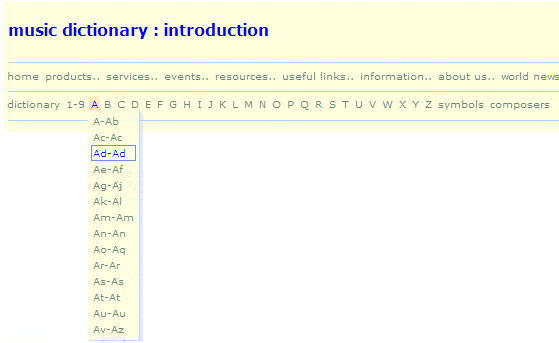
- Go to the appropriate chapter for the starting letter. For adagio, which begins with the letter a, place the mouse pointer over the the letter A in the menu line that begins with the word 'dictionary' (see picture above).
- The menu(s) will not display if javascript is disabled. This is explained here.
- Where we have divided the page into sub-chapters (see the drop down box for the letter A in the image above), draw the mouse down to the sub-chapter you require to go to the required page and click over the sub-chapter description.
- Check that you have reached the correct sub-chapter before using the search procedure we describe below.
- To locate the word on the appropriate page use the Find (on This Page)... facility which most web browsers have.
- In Internet Explorer this is an option in the drop-down Edit menu on the bar of your browser below the page title.
| File Edit View Favorites Tools Help
|
Names & Naming
In his book Die fröhliche Wissenschaft (The Gay Science) the German philosopher Friedrich Nietzsche (1844-1900) writes: "There is something that causes me the greatest difficulty, and continues to do so without relief: unspeakably more depends on what things are called than on what they are ... Creating new names and assessments and apparent truths is enough to create new 'things'."
Certainly, we have been, and continue to be, enthusiastic namers so that the same 'thing' may bear the weight of several names specific to region, people or time. In addition, ethnomusicologists have used both 'transliteration', a mapping from one script into another script so that the informed reader can reconstruct the original spelling of unknown transliterated words, and 'transcription', a mapping of the sounds of one language to the script of another language when offering European equivalents of non-European words. Wherever possible, we have tried to identify this problem in our dictionary, but even today disagreement exists about which name, or what form of the name, is most 'correct'.
Music Signs / Musical Symbols
One of our readers, Kathy Streit, suggested a page showing the standard symbols used in musical scores. To identify a symbol go to our chart of musical symbols.
Pronunciation
In the future, we plan to provide 'live' examples of each word in the dictionary, spoken by a person for whom the word is part of their native language. For the present, there are two ways of discovering how some of the words in the dictionary are pronounced. The first is via the extensive Pronouncing Dictionary of Music and Musicians devised by E. Douglas Brown of the staff of WOI Radio at Iowa State University. The second uses the AIFF files linked to the entries in the Virginia Tech Multimedia Music Dictionary. Neither of these sources covers more than a small number of the entries in our far larger dictionary but, for the present, we believe our vistors may find useful what they have to offer.
Abbreviations: s., pl., m., f. and n.
We identify particular forms of certain words (nouns, pronouns, adjectives, definite and indefinite articles), for example those that are singular or plural (Plural, pluriel), by marking them with the abbreviations s. and pl. respectively. In a similar manner we indicate the gender of words in those languages that make such a distinction. Where the word begins with a capital letter, m. marks nouns that are masculine (männlich, masculin), f. marks those that are feminine (weiblich, féminin) and, particularly in German, n. marks those of neuter gender (sächlich, neutre). In German there is only one form of plural which normally does not distinguish between a group of objects entirely of one gender and a group of mixed gender. Where German provides at specific distinction, we have distinguished groups entirely formed of men or of men and women, by using the identifier (pl.). If a group is formed entirely of girls or women, the identifier will be (f.pl.).
You may wish to refer to Nouns and Gender in German, French Gender - Genre français, Grasping the Concept of Gender in Spanish and Italian Lesson 2 (particularly Il, lo, la, un, uno and una: definite and indefinite articles). Where the word is written entirely in lower case but associated with m., f. or n., the word is usually an adjective (Adjektiv, adjectif) and the gender indicator is being used to distinguish the adjective's different gender-related forms. Words for which we have provided no gender information may not be nouns, they may be English nouns or they may be non-English nouns for which we have no relevant information.
Literal / Figurative / Familiar (Colloquial)
The majority of phrases can be translated literally - that is, one can substitute each word in a phrase with its equivalent in another language, allowing for some change in order, gender, tense, etc. Other phrases have taken on meanings that are not literal translations of the individual parts and these we call 'figurative'. For example, in German, aufgeblasen has the literal meaning 'blown up', but, through use, has come also to mean 'conceited'. For more information refer to Literal and Figurative Language. The descriptions 'familiar' or 'colloquial' (umgangssprachlich, familier) are applied to words or phrases that would be more appropriate in conversation within a relaxed circle of friends or family rather than on more formal occasions or when expressing oneself in print.
Mea culpa - In Case of Error
Our information is drawn from a wide range of publications. If we have made an error or an omission please contact us via the dictionary amendment form and we will correct it.
New Section on Composers
We are currently working on a Composers biographical dictionary, including dates of birth and death and a small amount of biographical detail.
Acknowledgements
Other online music dictionaries and sources of information may complement our own dictionary by providing more detailed explanations or useful illustrations. Where we have drawn information from any site we provide a link back to it either in the entry itself or below.
- about general music-related words and terms: Wikipedia, all text is available under the terms of the GNU Free Documentation License
- about musical terms in Dutch: Muziek Nederlands - Engels produced by J. Krammer
- about musical terms in several European languages: Musical Terms A-Z - part of the Lilypond resource
- about musical terms in Catalan: Terminologies del Gabinet de Terminologia © UIB - Oficina d'Informació
- about musical terms in Portuguese: Dicionário Inglês-Português by Paulo de Tarso Salles
- about bibliographic terms in non-English languages: Glossary of bibliographic information by language
- about medieval musical terms: ORB - Medieval Music Glossary, copyright © 1997 Cynthia J. Cyrus
- about thematic catalogues: Abbreviations used in Composer Works Lists & Thematic Catalogs, copyright © 1995-2004 by Classical Net
- about general musical topics: Virginia Tech Multimedia Music Dictionary, copyright © 2003 Virginia Tech
- about jazz terms: Glossary - Jazz Almanac
- about jazz improvisation: Jazz Improvisation Primer - lots of information on the fundamentals of jazz improvisation (recommended by Hayden Hill)
- about jazz piano: Jazz Piano Lessons - lots of free lessons with a nice visual learning style (recommended by Hayden Hill)
- about popular music: MusicWeb Encyclopedia of Popular Music edited by Donald Clarke
- about jesters & entertainers: Jester's Mask
- about traditional music terms: Rod's Encyclopedic Dictionary of Traditional Music copyright 2000 Rod Smith
- about the culture of Louisiana: Louisiana Voices © 1999-2003 Louisiana Division of the Arts
- about world music: World Music Central, copyright © 2003 World Music Central
- about ancient Greek music: Ancient Greek Music, by Michael Lahanas
- about modern Cretan and Greek music: Glossary of Greek terms by Tullia Magrini
- about African music: The African Music Encyclopedia copyright © 1995-2001 Janet Planet
- about African traditional dance: Popular African Traditional Dances
- about Hindustani classical music: ITC Sangeet Research Academy © 2001 ITC Sangeet Research Academy
- about performing and ritual arts of Kerala: Arts of Kerala © 2002 Department of Tourism, Government of Kerala
- about the instruments and music of India: chandrakantha.com, copyright © 1997-2004, David and Chandrakantha Courtney
- about world music instruments: World Instrument Gallery
- about a wide range of musical instruments: Musical Instrument Museums Online
- about musical instruments from Asia: Koizumi Fumio Memorial Archives KOIZUMI Fumio Memorial Archives, All rights reserved
- about the Medieval church: A Glossary of the Medieval Church compiled by Dianne Tillotson
- about terms used in French baroque music: Ranums' Panat Times
- Musings on Word-Music Relationships in French Baroque Music
- about orchestral instruments: Vienna Symphonic Library copyright © 2002 Vienna Symphonic Library GmbH
- about key and key mounting nomenclature: Key and Key Mounting Nomenclature by Robert E. Sheldon and Carol Lynn Ward Bamford, Library of Congress Music Division Staff
- about organs and organ stops: Encyclopedia of Organ Stops Copyright © Edward L. Stauff 1999-2001
- about organs and related terms: A short dictionary of pipe organ terms
- about terms relating to the accordion: Musician's Guide to the Club System Button Accordion - Glossary of Terms Copyright © 2003 Jacques Delaguerre
- about terms relating to mechanical music: Glossary of the Music Box Society Copyright © 2006 - MBSI - Springfield, MO
- about harps: Harp Spectrum copyright © 2002 - 2005, Harp Spectrum All Rights Reserved
- about world fiddling: Fiddling Around the World © Chris Haigh
- about woodwind instrument making: Woodwindwords by Molem
- about bagpipe terms: Glossary of Bagpipe Terms © Wikipedia GNU Free Documentation License
- about bagpipe terms: Dictionary of Bagpipe Terms © 1998-2006 Andrew T. Lenz
- about the guitar: Guitar Glossary copyright © 2004 Media Web Source
- about the guitar: Glossary of Common Guitar & Guitar Repair Terms copyright © 2006 - Rock N Roll Vintage Inc.
- about bells and bell-ringing: Bells and Their Music - Glossary
- about unusual musical instruments: The Gallery © 1999-2004 oddmusic.com
- about classical ballet: Absolutely Ballet
- about classical ballet (in Portuguese): Dicionário de Ballet copyright®2004 Ballet Olinda Saul
- about European dance: The Early Dance Circle
- about Polish dance: Polish Dances Copyright © 2000 by the Polish Music Center
- about Chinese performing arts: Chinese Traditional Performing Arts Copyright © 2003 Ministry of Culture, P. R. China
- about early and modern dance: Streetwings Dance History Archive copyright © www.StreetSwing.com 2000, www.Sonnywatson.com
- about electronic music: Electronic Music Foundation copyright © 2004 Electronic Music Foundation, Ltd.
- about the Arts and the Philosophy of Art: ArtLex Art Dictionary copyright © 1996 - Michael Delahunt
- about Greek mythology: Theoi Project copyright © 20002006 Aaron Atsma
- about philosophical ideas associated with music & art: Dictionary of the History of Ideas - © 2003 The Gale Group
- about acoustics: Acoustics FAQ
- about acoustics: Handbook for Acoustic Ecology © Cambridge Street Publishing, 1999
- about sheet music terminology: A Handy Glossary of Common but Frequently Misunderstood Sheet Music Terminology by Yesterday Service
- about medieval and renaissance terms: Renaissance Magazine Medieval Glossary of Terms
- about medieval cookery: Medieval Resources
- about literary terms and definitions: Literary Terms and Definitions © Dr. L. Kip Wheeler, 1998-2009
- about literary terms: A Glossary of Literary Terms © 1997, 2008 by Robert Harris
- about theatre terms: David's Glossary of Theatre Terms by David Eedle
- about theatre terms: Glossary of Technical Theatre Terms copyright © 1997-2007 Jon Primrose / University of Exeter Drama Department
- about theatre terms: A Glossary of Theatre Terms © Peter Lathan 2003
- about improvisational theatre terms: A Glossary of Improv Terms (in English)
- about improvisational theatre terms: A Glossary of Improv Terms (in Danish)
- about printing terms: Lithosphere Print Glossary © 2004 Lithosphere Print Production
- about gilding terms: Baggot Leaf Gilding Glossary James Lane. Copyright © 1998 - 2002
- about American film and theatre industries: Slanguage Dictionary © 2008 Reed Business Information, a division of Reed Elsevier Inc.
- about British utopian experiments: British Utopian Experiments 1325-1945
- about photography and printing: Metropolitan Postcard Club of New York City
|

| |
